


How has the COVID-19 pandemic impacted wastewater-based epidemiology?
- PMID: 37263440
- PMCID: PMC10226898
- DOI: 10.1016/j.scitotenv.2023.164561
How has the COVID-19 pandemic impacted wastewater-based epidemiology?
Abstract
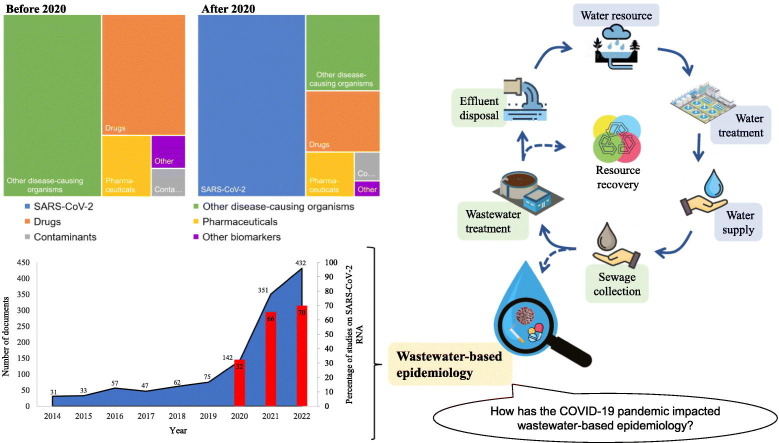
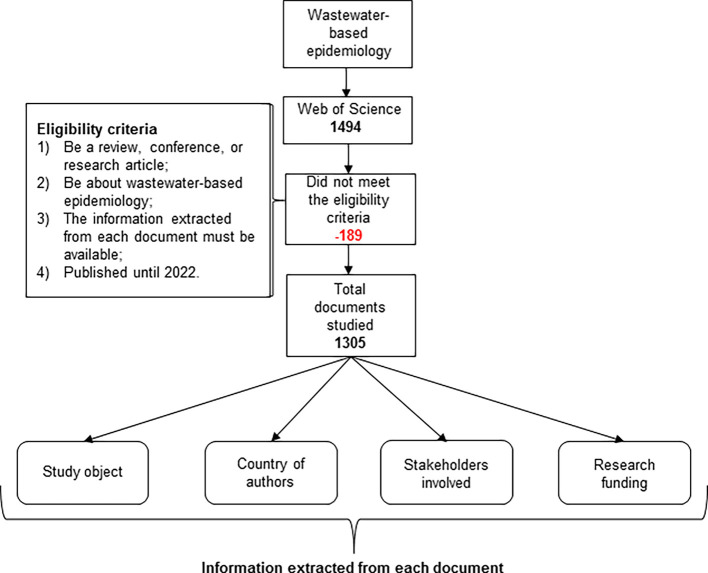
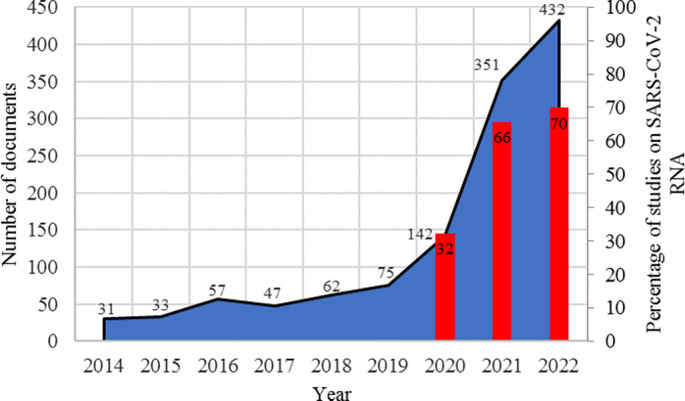
Wastewater-based epidemiology (WBE) was one of the areas of scientific knowledge that developed significantly with the COVID-19 pandemic, with robust worldwide application to monitor the circulation of the SARS-CoV-2 virus in urban communities at different scales and levels. This mini-review assesses how the COVID-19 pandemic may have influenced the WBE based on the investigation of 1305 scientific reports published (research, review, and conference papers) up to the end of 2022, considering the research objects, funding sources, actors, and countries involved. As a result, 71 % of all WBE-based publications occurred since the beginning of the pandemic, with 62 % addressing SARS-CoV-2, demonstrating the migration of WBE's relative importance in studies on drug abuse, pharmaceuticals consumption, and other disease-causing organisms to the constitution of a tool to support the monitoring of the coronavirus. Before the pandemic, WBE was a tool used for epidemiological surveillance of several diseases (54 % of studies), drug abuse (30 %), and pharmaceutical consumption (9 %). With the pandemic, these research topics lost to space, constituting only 37 % of the area's studies, and SARS-CoV-2 became the central object of studies. In addition, there has been a 4.7 % expansion of developing country participation in sewage surveillance publications and greater diversification of collaborators and funders, especially from government, businesses, and the water industry. International research partnerships had a reduction of 8 %, consequently, there was an increase in local and regional partnerships. With the COVID-19 pandemic, funding for research in WBE became approximately 6.5 % less dependent on traditional research funds. The future of WBE involves different approaches, including different focuses of research and technological advancements to improve the sensitivity, precision, and applicability of these investigations. The new WBE research arrangements are promising, although the post-pandemic challenges are likely to be in maintaining them and overcoming the trend toward a lack of diversity in study subjects.
Keywords: Environmental surveillance; Epidemiological surveillance; SARS-CoV-2; Sewage-based epidemiology; Stakeholders; Wastewater surveillance.
Copyright © 2023 Elsevier B.V. All rights reserved.
Conflict of interest statement
Declaration of competing interest The authors declare that they have no known competing financial interests or personal relationships that could have appeared to influence the work reported in this paper.
Figures
References
-
- Abdeldayem O.M., Dabbish A.M., Habashy M.M., Mostafa M.K., Elhefnawy M., Amin L., Al-Sakkari E.G., Ragab A., Rene E.R. Viral outbreaks detection and surveillance using wastewater-based epidemiology, viral air sampling, and machine learning techniques: A comprehensive review and outlook. Sci. Total Environ. 2022 doi: 10.1016/j.scitotenv.2021.149834. - DOI - PMC - PubMed
-
- Ahmad T., Anjum S., Afzal M.S., Raza H., Zaidi N.U., Arshad N. Molecular confirmation of enterovirus from sewage and drinking water samples from three cities, Pakistan: a potential risk factor for public health. Southeast Asian J. Trop. Med. Public Health. 2015;46(4):640–649. - PubMed
-
- Ahmed W., Angel N., Edson J., Bibby K., Bivins A., O’Brien J.W., Choi P.M., Kitajima M., Simpson S.L., Li J., Tscharke B., Verhagen R., Smith W., Zaugg J., Dierens L., Hugenholtz P., Thomas K.V., Mueller J.F. First confirmed detection of SARS-CoV-2 in untreated wastewater in Australia: a proof of concept for the wastewater surveillance of COVID-19 in the community. Sci. Total Environ. 2020;138764 doi: 10.1016/j.scitotenv.2020.138764. - DOI - PMC - PubMed
Publication types
MeSH terms
LinkOut - more resources
Full Text Sources
Medical
Miscellaneous
