


The relationship between anxiety and internet gaming disorder in children during COVID-19 lockdown: a network analysis
- PMID: 37265552
- PMCID: PMC10229880
- DOI: 10.3389/fpsyt.2023.1144413
The relationship between anxiety and internet gaming disorder in children during COVID-19 lockdown: a network analysis
Abstract
Background: Internet gaming disorder (IGD) has become a social problem in children. Evidence from previous studies has proven that anxiety is associated with IGD. However, IGD was always assessed as a whole based on total scores, and the fine-grained relationship between anxiety and IGD was hidden.
Objective: The present study aims to investigate the fine-grained relationship between anxiety and IGD in elementary school students during the COVID-19 lockdown, and to identify potential targets for psychological interventions.
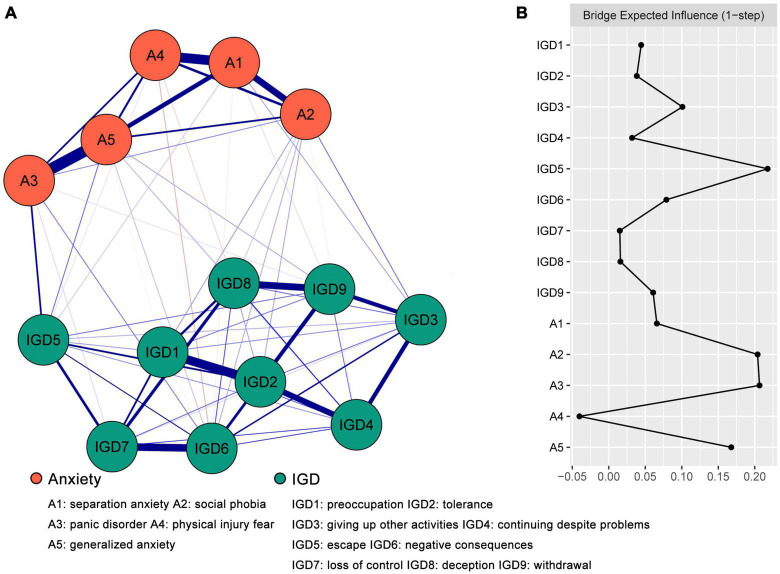
Methods: During the lockdown caused by the COVID-19 pandemic, 667 children from a primary school in China were investigated by the Spence Children's Anxiety Scale-Short Version and Internet Gaming Disorder Scale. R4.1.1 software was used to construct a network model, assess bridge centrality, and test the robustness of the network and conduct a network.
Results: There were 23 cross-community edges (weight ranged from -0.03 to 0.12), and each node of anxiety was connected to different nodes of IGD. The nodes with the top 80th percentile bridge expected influence were A2 "social phobia" (0.20), A3 "panic disorder" (0.21) and IGD5 "escape" (0.22). The robustness of the network was acceptable.
Conclusion: From the perspective of network analysis, the present study explored the correlation pathways between anxiety and IGD in children and identified social phobia and panic disorder as the best targets for intervention to reduce IGD.
Keywords: COVID-19; anxiety; children; internet gaming disorder; network analysis.
Copyright © 2023 Yang, He, He, Yang, Wu, Wei, Dong, Yang, Pu, Wang, Li, Xu, Liu and Wu.
Conflict of interest statement
The authors declare that the research was conducted in the absence of any commercial or financial relationships that could be construed as a potential conflict of interest.
Figures
References
-
- CNNIC. China internet network information center releases the 46th statistical report on the development status of China’s internet. Natl Libr J. (2021) 19.
-
- Wu S, Wu J, Wang H, Li C, Li Y, Nie W, et al. Analysis of the current situation and influencing factors of Chinese elementary school students’ online behavior. Chin J Sch Health. (2020) 41:704–8.
-
- Dong Q, Lin C. Key indicators and assessment of psychological development of children and adolescents aged 6-15 years in China. Beijing: Science Press; (2011).
-
- Lai L, Huang S, Zhang C, Tang B, Zhang M, Zhu C, et al. The association of cell phone addiction with interpersonal subjective well-being and school identity among primary and secondary school students. Chin J Sch Health. (2020) 41:139–42.
LinkOut - more resources
Full Text Sources
