


Subjective experiences during dexmedetomidine- or propofol-induced unresponsiveness and non-rapid eye movement sleep in healthy male subjects
- PMID: 37268445
- PMCID: PMC10375502
- DOI: 10.1016/j.bja.2023.04.026
Subjective experiences during dexmedetomidine- or propofol-induced unresponsiveness and non-rapid eye movement sleep in healthy male subjects
Abstract
Background: Anaesthetic-induced unresponsiveness and non-rapid eye movement (NREM) sleep share common neural pathways and neurophysiological features. We hypothesised that these states bear resemblance also at the experiential level.
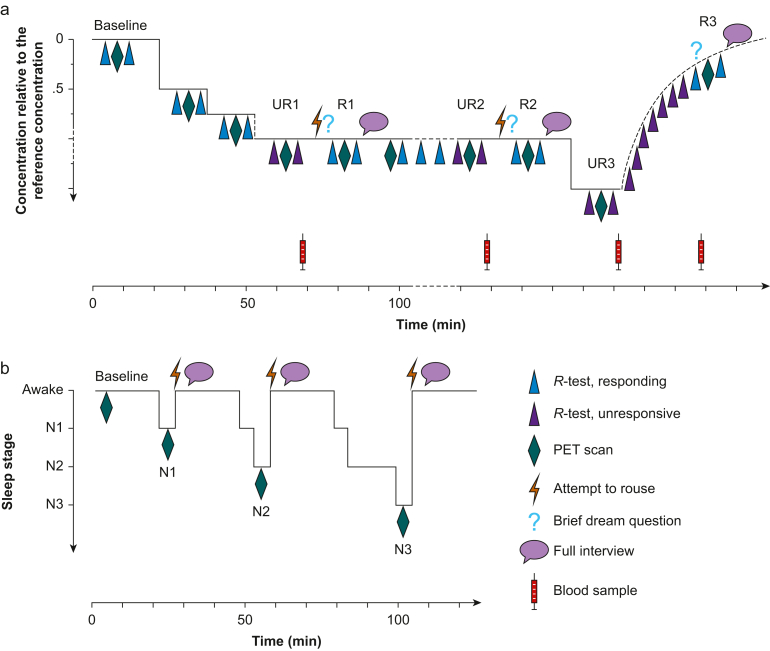
Methods: We compared, in a within-subject design, the prevalence and content of experiences in reports obtained after anaesthetic-induced unresponsiveness and NREM sleep. Healthy males (N=39) received dexmedetomidine (n=20) or propofol (n=19) in stepwise doses to induce unresponsiveness. Those rousable were interviewed and left unstimulated, and the procedure was repeated. Finally, the anaesthetic dose was increased 50%, and the participants were interviewed after recovery. The same participants (N=37) were also later interviewed after NREM sleep awakenings.
Results: Most subjects were rousable, with no difference between anaesthetic agents (P=0.480). Lower drug plasma concentrations were associated with being rousable for both dexmedetomidine (P=0.007) and propofol (P=0.002) but not with recall of experiences in either drug group (dexmedetomidine: P=0.543; propofol: P=0.460). Of the 76 and 73 interviews performed after anaesthetic-induced unresponsiveness and NREM sleep, 69.7% and 64.4% included experiences, respectively. Recall did not differ between anaesthetic-induced unresponsiveness and NREM sleep (P=0.581), or between dexmedetomidine and propofol in any of the three awakening rounds (P>0.05). Disconnected dream-like experiences (62.3% vs 51.1%; P=0.418) and memory incorporation of the research setting (88.7% vs 78.7%; P=0.204) were equally often present in anaesthesia and sleep interviews, respectively, whereas awareness, signifying connected consciousness, was rarely reported in either state.
Conclusions: Anaesthetic-induced unresponsiveness and NREM sleep are characterised by disconnected conscious experiences with corresponding recall frequencies and content.
Clinical trial registration: Clinical trial registration. This study was part of a larger study registered at ClinicalTrials.gov (NCT01889004).
Keywords: anaesthesia; awareness; consciousness; dexmedetomidine; dreaming; propofol; sleep; unresponsiveness.
Copyright © 2023 The Authors. Published by Elsevier Ltd.. All rights reserved.
Conflict of interest statement
The authors declare no conflicting interests.
Figures
Comment in
-
Similarities in consciousness occurring during sleep and sedation.Br J Anaesth. 2023 Oct;131(4):632-633. doi: 10.1016/j.bja.2023.07.019. Br J Anaesth. 2023. PMID: 37718091
References
-
- Franks N.P., Zecharia A.Y. Sleep and general anesthesia. Can J Anaesth. 2011;58:139–148. - PubMed
-
- Nelson L.E., Lu J., Guo T., Saper C.B., Franks N.P., Maze M. The α2-adrenoceptor agonist dexmedetomidine converges on an endogenous sleep-promoting pathway to exert its sedative effects. Anesthesiology. 2003;98:428–436. - PubMed
Publication types
MeSH terms
Substances
Associated data
LinkOut - more resources
Full Text Sources
Medical
