Review
. 2023 Sep;20(9):582-596.
doi: 10.1038/s41575-023-00794-z. Epub 2023 Jun 2.

Irritable bowel syndrome and mental health comorbidity - approach to multidisciplinary management

Affiliations
Review

Irritable bowel syndrome and mental health comorbidity - approach to multidisciplinary management

Heidi M Staudacher et al. Nat Rev Gastroenterol Hepatol. 2023 Sep.

Abstract

Irritable bowel syndrome (IBS) affects 5-10% of the global population. Up to one-third of people with IBS also experience anxiety or depression. Gastrointestinal and psychological symptoms both drive health-care use in people with IBS, but psychological comorbidity seems to be more important for long-term quality of life. An integrated care approach that addresses gastrointestinal symptoms with nutrition and brain-gut behaviour therapies is considered the gold standard. However, best practice for the treatment of individuals with IBS who have a comorbid psychological condition is unclear. Given the rising prevalence of mental health disorders, discussion of the challenges of implementing therapy for people with IBS and anxiety and depression is critical. In this Review, we draw upon our expertise in gastroenterology, nutrition science and psychology to highlight common challenges that arise when managing patients with IBS and co-occurring anxiety and depression, and provide recommendations for tailoring clinical assessment and treatment. We provide best practice recommendations, including dietary and behavioural interventions that could be applied by non-specialists and clinicians working outside an integrated care model.


Conflict of interest statement

H.M.S. has received research funding from DSM Pharmaceuticals, the Rome Foundation, VSL Pharmaceuticals; non-financial support from VSL Pharmaceuticals; and consulting fees from Dietitian Connection, Dietitians Australia and Microba. S.B.T. is employed by the University of New South Wales, Sydney, Australia, with funding from the Mindgardens Neuroscience Network; was a contractor to Nutrition Research Australia (2020–2021); and has received consulting fees from the British Dietetic Association, Dietitian Connection, Dietitians Australia, Education in Nutrition, the Royal Australian and New Zealand College of Psychiatrists (Tasmania Branch), the University of Newcastle, Australia, and the University of Technology Sydney, Australia. L.K. is a co-founder, consultant and equity owner in Trellus Health; is a paid consultant for Abbvie, Eli Lilly and Takeda; and serves as a member of the Rome Foundation Board of Directors. The other authors declare no competing interests.

Figures
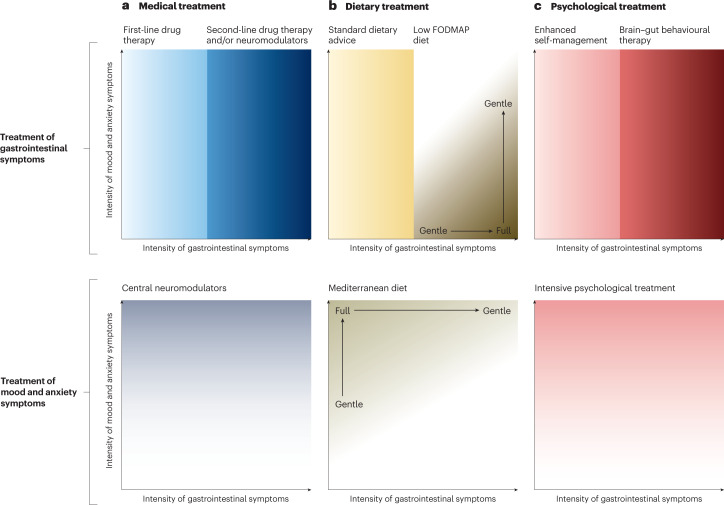
Fig. 1
Fig. 1. Guidelines for the treatment of individuals with IBS based on the severity of symptoms.
These are general guidelines. Treatments within and across specialties can be combined, and selection of treatment is necessary on a case-by-case basis, and depends on the severity of gastrointestinal and mood or anxiety symptoms, the presence of other psychological and physical comorbidities, psychosocial history and patient preference. a, Medical treatment. Patients with predominantly gastrointestinal symptoms (top) should be treated with first-line medical therapy, then second-line therapy if their symptoms do not respond. If patients have a co-occurring mood disorder (bottom), use of central neuromodulators — particularly selective serotonin reuptake inhibitors — should be considered alongside treatment of gastrointestinal symptoms. Central neuromodulators, such as low-dose tricyclic antidepressants can also be used for abdominal pain and global symptoms. b, Dietary treatment. Patients with mild gastrointestinal symptoms should be provided standard dietary advice. If symptoms persist, or a patient has moderate to severe gastrointestinal symptoms, then the low FODMAP (fermentable oligosaccharides, disaccharides, monosaccharides and polyols) diet should be used (top). Elements of both approaches might be appropriate in some patients. In patients with substantial coexisting psychological symptoms, the gentle FODMAP diet approach is recommended. In patients in whom psychological symptoms predominate (bottom), the Mediterranean diet can be considered, and can also be modified for FODMAP content if necessary in those with moderate to severe gastrointestinal symptoms. c, Psychological treatment. Patients with a low severity of psychological symptoms and/or gastrointestinal symptoms should be counselled to self-manage symptoms via education and lifestyle. Brain–gut behaviour therapy, such as cognitive behavioural therapy and hypnotherapy, can be used in those with moderate to severe gastrointestinal symptoms (top). In patients with substantial psychological symptoms, this therapy could be complemented with traditional psychological treatment (bottom). IBS, irritable bowel syndrome.
Fig. 2
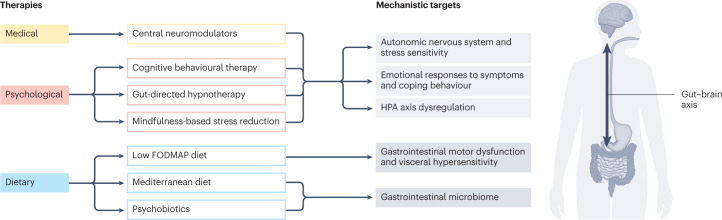
Fig. 2. Key mechanistic targets and interventions that improve IBS and depression via the gut–brain axis.
Various biological aberrations are present in the gut–brain axis in patients with irritable bowel syndrome (IBS), depression and anxiety. Medical, dietary and psychological therapies (right) can each theoretically target one or more of these aberrations, and when used in combination, they could work synergistically. Although only one key mechanisms or set of mechanisms is presented here for each therapy, some of these therapies might target more than one mechanism. For example, central neuromodulators and hypnotherapy might also target visceral hypersensitivity, the low FODMAP (fermentable oligosaccharides, disaccharides, monosaccharides and polyols) diet might influence symptoms via the microbiome, and the Mediterranean diet might target the hypothalamic–pituitary–adrenal (HPA) axis.

References

    1. Lacy BE, et al. Bowel disorders. Gastroenterology. 2016;150:1393–1407. doi: 10.1053/j.gastro.2016.02.031. - DOI
    1. Chey WD, Keefer L, Whelan K, Gibson PR. Behavioral and diet therapies in integrated care for patients with irritable bowel syndrome. Gastroenterology. 2021;160:47–62. doi: 10.1053/j.gastro.2020.06.099. - DOI - PubMed
    1. World Health Organization. Integrated care models: an overview. WHOhttps://www.researchgate.net/profile/Altynai-Satylganova/publication/315... (2016).
    1. World Health Organization. Depression and other common mental disorders: global health estimates. WHOhttps://apps.who.int/iris/bitstream/handle/10665/254610/WHO-MSD-MER-2017... (2017).
    1. Zamani M, Alizadeh-Tabari S, Zamani V. Systematic review with meta-analysis: the prevalence of anxiety and depression in patients with irritable bowel syndrome. Aliment. Pharmacol. Ther. 2019;50:132–143. doi: 10.1111/apt.15325. - DOI - PubMed