


Patients' Perspectives on Life and Recovery 1 Year After COVID-19 Hospitalization
- PMID: 37268779
- PMCID: PMC10237521
- DOI: 10.1007/s11606-023-08246-9
Patients' Perspectives on Life and Recovery 1 Year After COVID-19 Hospitalization
Abstract
Background: Many patients hospitalized for COVID-19 experience prolonged symptoms months after discharge. Little is known abou t patients' personal experiences recovering from COVID-19 in the United States (US), where medically underserved populations are at particular risk of adverse outcomes.
Objective: To explore patients' perspectives on the impact of COVID-19 hospitalization and barriers to and facilitators of recovery 1 year after hospital discharge in a predominantly Black American study population with high neighborhood-level socioeconomic disadvantage.
Design: Qualitative study utilizing individual, semi-structured interviews.
Participants: Adult patients hospitalized for COVID-19 approximately 1 year after discharge home who were engaged in a COVID-19 longitudinal cohort study.
Approach: The interview guide was developed and piloted by a multidisciplinary team. Interviews were audio-recorded and transcribed. Data were coded and organized into discrete themes using qualitative content analysis with constant comparison techniques.
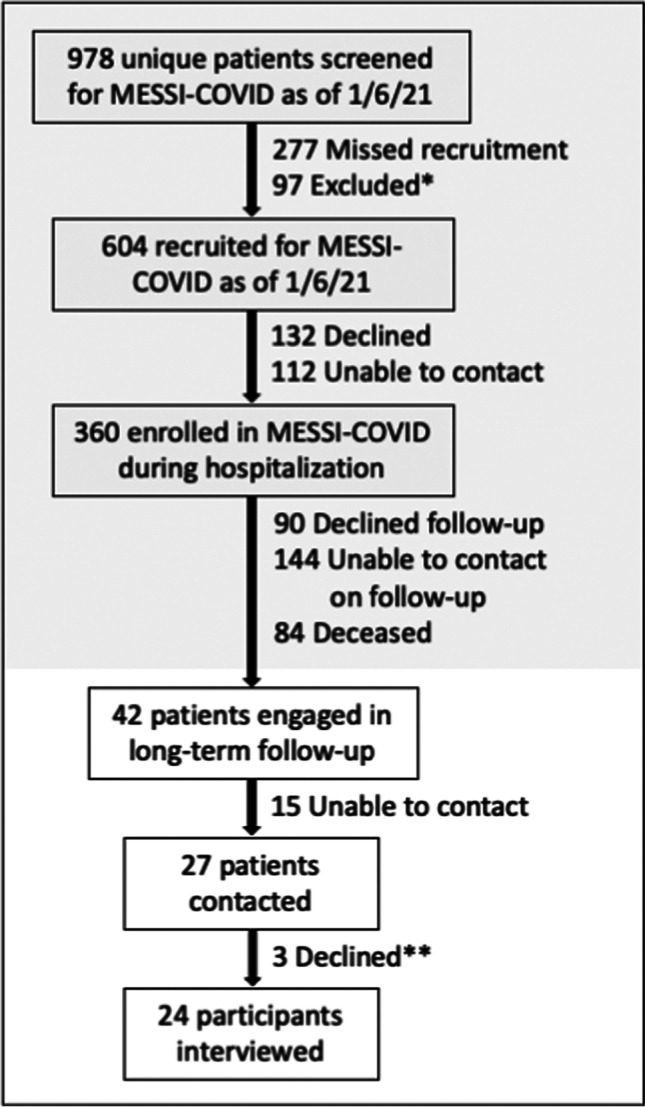
Key results: Of 24 participants, 17 (71%) self-identified as Black, and 13 (54%) resided in neighborhoods with the most severe neighborhood-level socioeconomic disadvantage. One year after discharge, participants described persistent deficits in physical, cognitive, or psychological health that impacted their current lives. Repercussions included financial suffering and a loss of identity. Participants reported that clinicians often focused on physical health over cognitive and psychological health, an emphasis that posed a barrier to recovering holistically. Facilitators of recovery included robust financial or social support systems and personal agency in health maintenance. Spirituality and gratitude were common coping mechanisms.
Conclusions: Persistent health deficits after COVID-19 resulted in downstream consequences in participants' lives. Though participants received adequate care to address physical needs, many described persistent unmet cognitive and psychological needs. A more comprehensive understanding of barriers and facilitators for COVID-19 recovery, contextualized by specific healthcare and socioeconomic needs related to socioeconomic disadvantage, is needed to better inform intervention delivery to patients that experience long-term sequelae of COVID-19 hospitalization.
Keywords: COVID-19; health disparities; outcomes; qualitative research; recovery.
© 2023. The Author(s), under exclusive licence to Society of General Internal Medicine.
Conflict of interest statement
N.J.M. has received funding from Endpoint Health, Inc and Janssen Inc for advising and consulting. She has received funding from the CAVIARDS (Careful Ventilation in ARDS) trial and SPIROMICS II cohort study to serve on a Data Safety Monitoring Board. M.O.H. has received funding from Elsevier, Guidepoint Advisors, and the American Thoracic Society for consulting and has received honoraria from Trinity Life Sciences. He has received funding from the University of California, San Francisco to serve on a Data Safety Monitoring Board.
Figures
References
-
- Crook H, Raza S, Nowell J, Young M, Edison P. Long COVID-Mechanisms, Risk Factors, and Management. BMJ. 2021;374. doi:10.1136/BMJ.N1648. - PubMed
Publication types
MeSH terms
Grants and funding
LinkOut - more resources
Full Text Sources
Medical
