. 2023 Jun 2;27(1):219.
doi: 10.1186/s13054-023-04503-9.

Circuit change during extracorporeal membrane oxygenation: single-center retrospective study of 48 changes

Affiliations

Circuit change during extracorporeal membrane oxygenation: single-center retrospective study of 48 changes

Thibaut Genty et al. Crit Care. .

Abstract

Background: Bleeding and thrombosis induce major morbidity and mortality in patients under extracorporeal membrane oxygenator (ECMO). Circuit changes can be performed for oxygenation membrane thrombosis but are not recommended for bleeding under ECMO. The objective of this study was to evaluate the course of clinical, laboratory, and transfusion parameters before and after ECMO circuit changes warranted by bleeding or thrombosis.

Methods: In this single-center, retrospective, cohort study, clinical parameters (bleeding syndrome, hemostatic procedures, oxygenation parameters, transfusion) and laboratory parameters (platelet count, hemoglobin, fibrinogen, PaO2) were collected over the seven days surrounding the circuit change.

Results: In the 274 patients on ECMO from January 2017 to August 2020, 48 circuit changes were performed in 44 patients, including 32 for bleeding and 16 for thrombosis. Mortality was similar in the patients with vs. without changes (21/44, 48% vs. 100/230, 43%) and in those with bleeding vs. thrombosis (12/28, 43% vs. 9/16, 56%, P = 0.39). In patients with bleeding, numbers of bleeding events, hemostatic procedures, and red blood cell transfusions were significantly higher before vs. after the change (P < 0.001); the platelet counts and fibrinogen levels decreased progressively before and increased significantly after the change. In patients with thrombosis, numbers of bleeding events and red blood cell transfusions did not change after membrane change. No significant differences were demonstrated between oxygenation parameters (ventilator FiO2, ECMO FiO2, and PaO2) and ECMO flow before vs. after the change.

Conclusions: In patients with severe and persistent bleeding, changing the ECMO circuit decreased clinical bleeding and red blood cell transfusion needs and increased platelets and fibrinogen levels. Oxygenation parameters did not change significantly in the group with thrombosis.

Keywords: Bleeding complication; ECMO; Oxygenator change; Oxygenator thrombosis; Transfusion.


Conflict of interest statement

The authors declare that they have no competing interests.

Figures
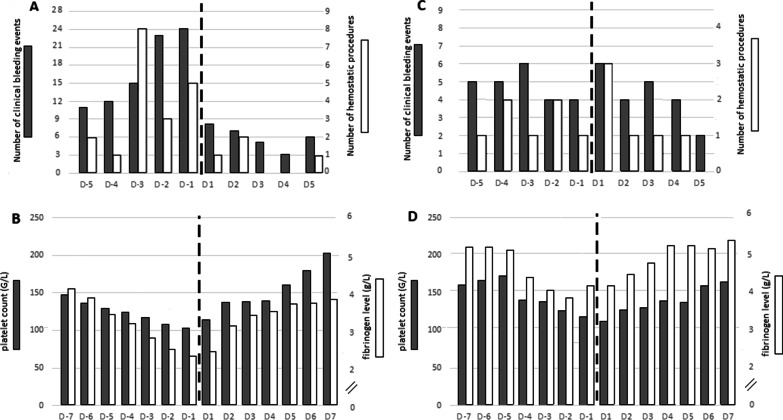
Fig. 1
Fig. 1
Main results in the group with bleeding (panels A and B) and in the group with thrombosis (panel C and D). A Group with bleeding: clinical bleeding events and hemostatic procedures during the five days before and the five days after the circuit change. The X-axis shows time in days; the black dotted line indicates the time of the circuit change. The Y-axis on the left shows the number of clinical bleeding events (gray bars) and the Y-axis on the right the number of hemostatic procedures (white bars). During the 5 days before the membrane change, 84 bleeding events occurred, 19 of which required a hemostatic procedure. In the 5 days following the membrane change, 29 bleeding events occurred, 4 of which required a hemostatic procedure. B Group with bleeding: changes in platelet counts and fibrinogen levels during the seven days before and the seven days after the circuit change. The X-axis shows time in days; the black dotted line indicates the time of the circuit change. The Y-axis on the left shows the platelet counts in G/L (gray bars) and the Y-axis on the right the fibrinogen levels in g/L (white bars). The ANOVA showed a significant difference in platelet (F = 5.7 P < 0.001) and fibrinogen values (F = 3.7 P < 0.001). In the period before the change (D-7 to D-1), the platelet values differed significantly (F = 10.2 P < 0.001). The decrease began at D-4 for a value of 34G/L P < 0.01. In the period after the membrane change (D + 1 to D + 7), the platelet values differed significantly (F = 7.2 P < 0.001). The increase started at D + 6 for a value of 73 G/L P = 0.01. In the period before the change (D-7 to D-1), the fibrinogen level differed significantly (F = 10.0 P < 0.001). The decrease began at D-3 for a value of 1.3 g/L P = 0.01. In the period after the membrane change (D + 1 to D + 7), the fibrinogen level differed significantly (F = 3.6 P = 0.002). The increase started at D + 5 for a value of 1.2 g/L P = 0.04. C Group with thrombosis: clinical bleeding events and hemostatic procedures during the five days before and the five days after the circuit change. The X-axis shows time in days; the black dotted line indicates the time of the circuit change. The Y-axis on the left shows the number of clinical bleeding events (gray bars) and the Y-axis on the right the number of hemostatic procedures (white bars). During the 5 days before the membrane change, 22 bleeding events occurred, 6 of which required a hemostatic procedure. In the 5 days following the membrane change, 24 bleeding events occurred, 7 of which required a hemostatic procedure. D Group with thrombosis: changes in platelet counts and fibrinogen levels during the seven days before and the seven days after the circuit change. The X-axis shows time in days; the black dotted line indicates the time of the circuit change. The Y-axis on the left shows the platelet counts in G/L (gray bars) and the Y-axis on the right the fibrinogen levels in g/L (white bars). The ANOVA showed a significant difference in platelet values (F = 2.0 P = 0.03). The ANOVA did not show a significant difference in fibrinogen level (F = 0.7 P = 0.71). In the period before the change (D-7 to D-1), the platelet values differed significantly (F = 2.9 P = 0.01). Individual comparison of platelet level showed no statistical difference. In the period after the membrane change (D + 1 to D + 7), the platelet values differed significantly (F = 2.8 P = 0.02). Individual comparison of platelet level showed no statistical difference. Before or after the membrane change, the fibrinogen values did not vary significantly (P = 0.12) Individual comparison of fibrinogen levels did not show any statistical difference

References

    1. Blum JM, Lynch WR, Coopersmith CM. Clinical and billing review of extracorporeal membrane oxygenation. Chest. 2015;147(6):1697–1703. doi: 10.1378/chest.14-2954. - DOI - PubMed
    1. Thiagarajan RR, Barbaro RP, Rycus PT, Mcmullan DM, Conrad SA, Fortenberry JD, et al. Extracorporeal life support organization registry international report 2016. ASAIO J. 2017;63(1):60–67. doi: 10.1097/MAT.0000000000000475. - DOI - PubMed
    1. McMichael ABV, Ryerson LM, Ratano D, Fan E, Faraoni D, Annich GM. 2021 ELSO adult and pediatric anticoagulation guidelines. ASAIO J. 2022;68(3):303–310. doi: 10.1097/MAT.0000000000001652. - DOI - PubMed
    1. Murphy DA, Hockings LE, Andrews RK, Aubron C, Gardiner EE, Pellegrino VA, et al. Extracorporeal membrane oxygenation-hemostatic complications. Transfus Med Rev. 2015;29(2):90–101. doi: 10.1016/j.tmrv.2014.12.001. - DOI - PubMed
    1. Lubnow M, Philipp A, Foltan M, Bull Enger T, Lunz D, Bein T, et al. Technical complications during veno-venous extracorporeal membrane oxygenation and their relevance predicting a system-exchange–retrospective analysis of 265 cases. PLoS ONE. 2014;9(12):e112316. doi: 10.1371/journal.pone.0112316. - DOI - PMC - PubMed
