


Remote Administration of ADHD-Sensitive Cognitive Tasks: A Pilot Study
- PMID: 37269091
- PMCID: PMC10291103
- DOI: 10.1177/10870547231172763
Remote Administration of ADHD-Sensitive Cognitive Tasks: A Pilot Study
Abstract
Objective: We assessed the feasibility and validity of remote researcher-led administration and self-administration of modified versions of two cognitive tasks sensitive to ADHD, a four-choice reaction time task (Fast task) and a combined Continuous Performance Test/Go No-Go task (CPT/GNG), through a new remote measurement technology system.
Method: We compared the cognitive performance measures (mean and variability of reaction times (MRT, RTV), omission errors (OE) and commission errors (CE)) at a remote baseline researcher-led administration and three remote self-administration sessions between participants with and without ADHD (n = 40).
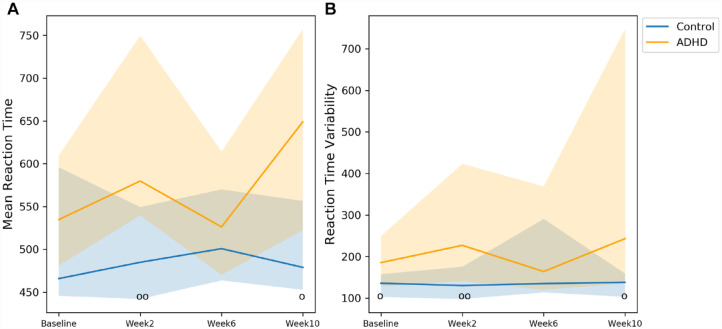
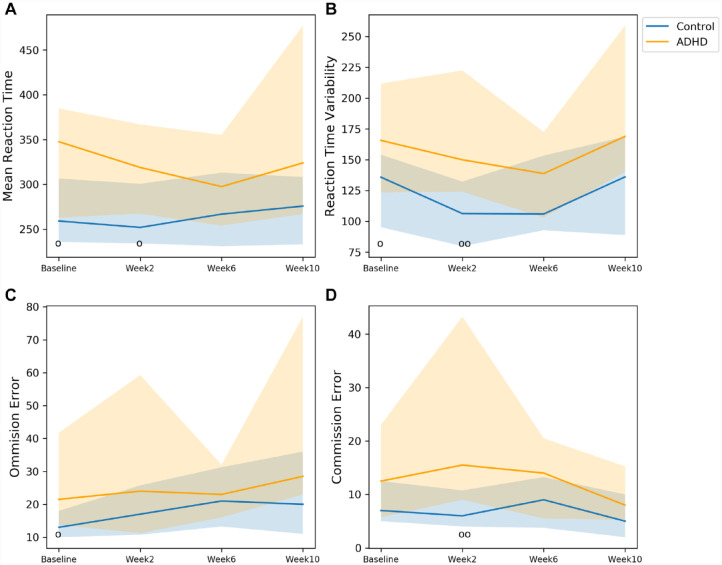
Results: The most consistent group differences were found for RTV, MRT and CE at the baseline researcher-led administration and the first self-administration, with 8 of the 10 comparisons statistically significant and all comparisons indicating medium to large effect sizes.
Conclusion: Remote administration of cognitive tasks successfully captured the difficulties with response inhibition and regulation of attention, supporting the feasibility and validity of remote assessments.
Keywords: ADHD; RADAR-base; attention regulation; remote monitoring; response inhibition.
Conflict of interest statement
The author(s) declared the following potential conflicts of interest with respect to the research, authorship, and/or publication of this article: Prof. Jonna Kuntsi has given talks at educational events sponsored by Medice; all funds are received by King’s College London and used for studies of ADHD. Prof. Philip Asherson has received funding for research by Vifor Pharma and has given sponsored talks and been an advisor for Shire, Janssen-Cilag, Eli-Lilly, Flynn Pharma, and Pfizer, regarding the diagnosis and treatment of ADHD; all funds are received by King’s College London and used for studies of ADHD. The other authors report no conflicts of interest.
Figures
References
-
- Andreou P., Neale B. M., Chen W., Christiansen H., Gabriels I., Heise A., Meidad S., Muller U. C., Uebel H., Banaschewski T., Manor I., Oades R., Roeyers H., Rothenberger A., Sham P., Steinhausen H. C., Asherson P., Kuntsi J. (2007). Reaction time performance in ADHD: Improvement under fast-incentive condition and familial effects Psychological Medicine, 37(12), 1703–1715. 10.1017/S0033291707000815 - DOI - PMC - PubMed
-
- Barkley R. A. (2011. a). Barkley adult ADHD Rating Scale—IV (BAARS-IV). Guilford Press.
-
- Barkley R. A. (2011. b). Barkley Functional Impairment Scale (BFIS for Adults). Guilford Press.
-
- Barkley R. A., Murphy K. R. (2006). Attention-deficit hyperactivity disorder: A clinical workbook. Guilford Press.
Publication types
MeSH terms
Grants and funding
LinkOut - more resources
Full Text Sources
Medical
