Decrease of Muscle Mass in Young Patients With Neuromuscular Disease: Assessment of Sarcopenia
- PMID: 37270922
- PMCID: PMC10226852
- DOI: 10.3346/jkms.2023.38.e187
Decrease of Muscle Mass in Young Patients With Neuromuscular Disease: Assessment of Sarcopenia
Abstract
Background: Sarcopenia can be associated with the disease etiologies other than degenerative processes, such as neurologic disease including cerebral palsy, myelomeningocele, or Duchenne muscular dystrophy, even in children. Although the relationship between neurologic disease and scoliosis or ambulatory function is known, the mediators affecting scoliosis or gait function in these patients are unclear, an example might be sarcopenia. This study aimed to assess the degree of sarcopenia in young patients with neurologic diseases using computed tomography (CT), and analyze the correlation between sarcopenia and scoliosis or ambulatory function.
Methods: Pediatric and young adult patients (≤ 25 years old) who underwent whole-spine or lower-extremity CT were retrospectively included. From bilateral psoas muscle areas (PMAs) at the L3 level, the psoas muscle z-score (PMz) and psoas muscle index [PMI = PMA/(L3 height)²] were calculated. The t-test, Fisher's exact test, and logistic regression analyses were performed.
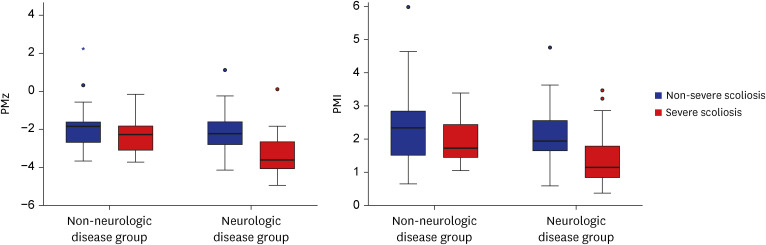
Results: A total of 121 patients (56 men, mean age 12.2 ± 3.7 years) were included with 79 neurologic and 42 non-neurologic diseases. Patients with neurologic diseases had lower PMz (P = 0.013) and PMI (P = 0.026) than patients without. In neurologic disease patients, severe scoliosis patients showed lower PMz (P < 0.001) and PMI (P = 0.001). Non-ambulatory patients (n = 42) showed lower BMI (β = 0.727, P < 0.001) and PMz (β = 0.547, P = 0.025). In non-ambulatory patients, patients with severe scoliosis also showed lower PMz (P < 0.001) and PMI (P = 0.004).
Conclusion: Patients with neurologic diseases could have sarcopenia even in young age. Psoas muscle volume was also associated with ambulatory function in these patients. Sarcopenia was more severe in severe scoliosis patients in the non-ambulatory subgroup.
Keywords: Child; Neurologic Diseases; Sarcopenia; Scoliosis.
© 2023 The Korean Academy of Medical Sciences.
Conflict of interest statement
The authors have no potential conflicts of interest to disclose.
Figures


References
-
- Boutin RD, Yao L, Canter RJ, Lenchik L. Sarcopenia: current concepts and imaging implications. AJR Am J Roentgenol. 2015;205(3):W255-66. - PubMed
-
- Mourtzakis M, Prado CM, Lieffers JR, Reiman T, McCargar LJ, Baracos VE. A practical and precise approach to quantification of body composition in cancer patients using computed tomography images acquired during routine care. Appl Physiol Nutr Metab. 2008;33(5):997–1006. - PubMed
-
- Jeon I, Bang MS, Lim JY, Shin HI, Leigh JH, Kim K, et al. Sarcopenia among adults with cerebral palsy in South Korea. PM R. 2019;11(12):1296–1301. - PubMed
MeSH terms
LinkOut - more resources
Full Text Sources
Medical