. 2024 Apr:58:193-210.
doi: 10.1016/j.jare.2023.05.012. Epub 2023 Jun 2.

Targeting Trop2 by Bruceine D suppresses breast cancer metastasis by blocking Trop2/β-catenin positive feedback loop

Affiliations

Targeting Trop2 by Bruceine D suppresses breast cancer metastasis by blocking Trop2/β-catenin positive feedback loop

Wenjuan Tang et al. J Adv Res. 2024 Apr.

Abstract

Introduction: Tumor-associated calcium signal transducer 2 (Trop2) has been used as a transport gate for cytotoxic agents into cells in antibody-drug conjugate designs because of its expression in a wide range of solid tumors. However, the specific role of Trop2 itself in breast cancer progression remains unclear and small molecules targeting Trop2 have not yet been reported.

Objectives: To screen small molecules targeting Trop2, and to reveal its pharmacological effects and the molecular mechanisms of action.

Methods: Small molecule targeting Trop2 was identified by cell membrane chromatography, and validated by cellular thermal shift assay and point mutation analyses. We investigated the pharmacological effects of Trop2 inhibitor using RNA-seq, human foreskin fibroblast (HFF)-derived extracellular matrix (ECM), Matrigel drop invasion assays, colony-forming assay, xenograft tumor model, 4T1 orthotopic metastasis model and 4T1 experimental metastasis model. The molecular mechanism was determined using immunoprecipitation, mass spectrometry, immunofluorescence, immunohistochemistry and Western blotting.

Results: Here we identified Bruceine D (BD) as the inhibitor of Trop2, and demonstrated anti-metastasis effects of BD in breast cancer. Notably, Lys307 and Glu310 residues of Trop2 acted as critical sites for BD binding. Mechanistically, BD suppressed Trop2-induced cancer metastasis by blocking the formation of Trop2/β-catenin positive loop, in which the Trop2/β-catenin complex prevented β-catenin from being degraded via the ubiquitin-proteosome pathway. Destabilized β-catenin caused by BD reduced nucleus translocation, leading to the reduction of transcription of Trop2, the reversal of epithelial-mesenchymal transition (EMT) process, and the inhibition of ECM remodeling, further inhibiting cancer metastasis. Additionally, the inhibitory effects of BD on lung metastatic colonization and the beneficial effects of BD on prolongation of survival were validated in 4T1 experimental metastasis model.

Conclusions: These results support the tumor-promoting role of Trop2 in breast cancer by stabilizing β-catenin in Trop2/β-catenin positive loop, and suggest Bruceine D as a promising candidate for Trop2 inhibition.

Keywords: Breast cancer; Lung colonization; Metastasis; Trop2; β-catenin.


Conflict of interest statement

Declaration of Competing Interest The authors declare that they have no known competing financial interests or personal relationships that could have appeared to influence the work reported in this paper.

Figures

None
Graphical abstract
Fig. 1
Fig. 1
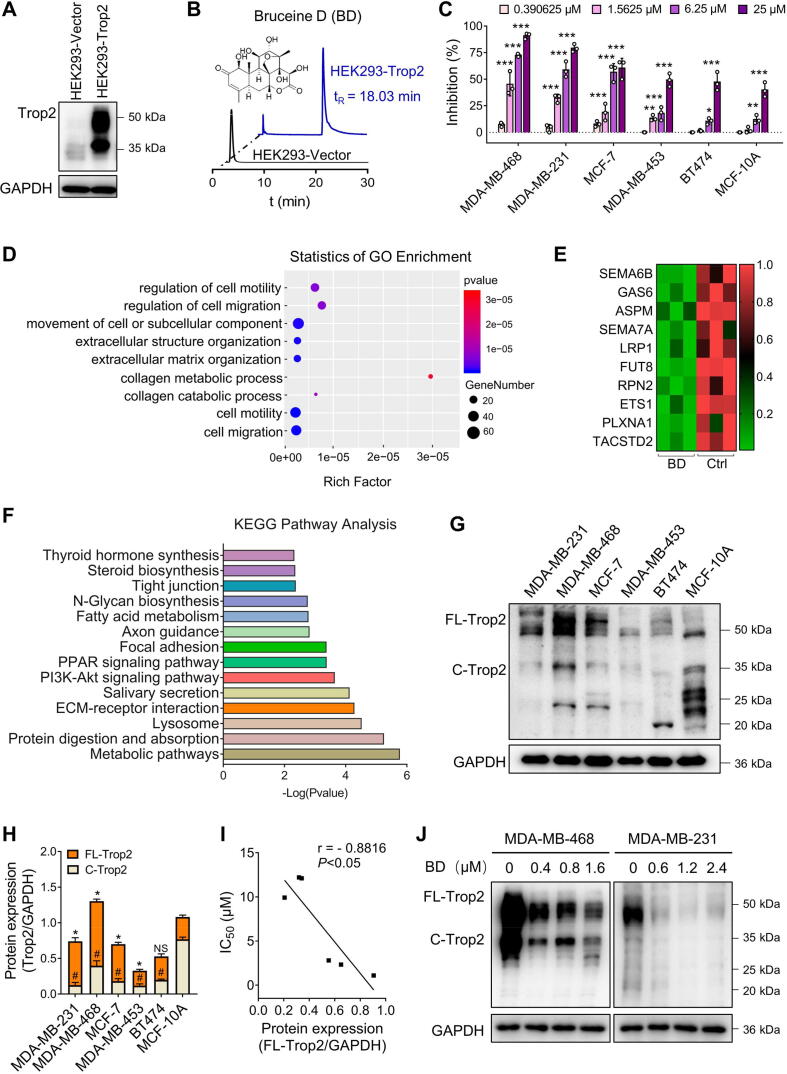
TACSTD2 was a critical gene associated with inhibitory effects of Bruceine D (BD) on breast cancer cell viability. (A) Trop2 expression analysis in HEK293 cells transfected with Vector and plasmid. (B) The chromatograms of BD on the HEK293-Trop2/CMC column (blue) and HEK293/CMC column (blank). tR: the retention time of BD. flow rate: 0.2 mL/min; column temperature: 37 °C; mobile phase: 1 mM phosphate-buffer saline; pH 7.4; the detection wavelength was 248 nm. (C) Effects of BD on cell viability in MDA-MB-468, MDA-MB-231, MCF-7, MDA-MB-453, BT474, and MCF-10A cells. Cells were cultured with BD for 48 h and subjected to MTT assay. Data are presented as mean ± SD (n = 3), * P < 0.05, ** P < 0.01, *** P < 0.001 vs. the control. (D) GO biological process enrichment analysis of BD-downregulated genes, P < 0.05. (E) Heatmap of top 10 significant BD-downregulated genes associated with cell migration, P < 0.05. (F) Kyoto Encyclopedia of Genes and Genomes pathway analysis of BD-downregulated genes in RNA-seq, P < 0.05. (G) Protein levels of Trop2 in breast cancer cell lines and MCF-10A cells. (H) Quantification of (G), data are presented as mean ± SD (n = 3). *P < 0.05 vs the FL-Trop2 of MCF-10A cells; #P < 0.05 vs the C-Trop2 of MCF-10A cells; NS, P > 0.05, not significant. (I) Pearson’s correlation analysis between IC50 values and FL-Trop2 relative protein levels. (J) Protein levels of Trop2 in MDA-MB-468 and MDA-MB-231 cells exposed to BD for 48 h. (For interpretation of the references to colour in this figure legend, the reader is referred to the web version of this article.)
Fig. 2
Fig. 2
Biophysical analysis of the interaction between Bruceine D (BD) and Trop2. (A) Cellular Thermal Shift Assay (CETSA) was used to analyze the melting temperatures of Trop2. Cells were cultured with BD (MDA-MB-468: 0.8 μM; MDA-MB-231: 1.2 μM) for 4 h, after which cell was collected, heated, lysed and subjected to western blotting. (B) Quantification of (A), data are presented as mean ± SD, n = 3. * P < 0.05, ** P < 0.01, *** P < 0.001, NS, P > 0.05, not significant. (C) Binding pocket between Trop2 protein and BD using molecular docking analysis. (D) Effects of BD on cell viability in HEK293 cells transfected with Vector, WT-Trop2, and four mutations of predicted key interface residues on Trop2 (R301A, K302A, K307A, and E310A). Cells were cultured with BD for 48 h and subjected to MTT assays. (E) Effects of BD on Trop2 expression in HEK293 cells transfected with Vector, WT-Trop2, and four mutations. Cells were cultured with BD (Vector: 3.8 μM, WT-Trop2: 0.9 μM, R301A: 1.3 μM, K302A: 2.5 μM, K307A: 3.6 μM, E310A: 3.6 μM) for 48 h, and subjected to western blotting. (F) The chromatograms of BD on the CMC (cell membrane chromatography) column with four mutations of Trop2. tR: the retention time of BD. flow rate: 0.2 mL/min; column temperature: 37 °C; mobile phase: 1 mM phosphate-buffer saline; pH 7.4; the detection wavelength was 248 nm. (G) CETSA was used to analyze the melting temperatures of Trop2 in HEK293-Trop2/WT cells after treatment with 0.9 μM BD for 4 h. (H) Quantification of (G), data are presented as mean ± SD, n = 3. * P < 0.05, ** P < 0.01, NS, P > 0.05, not significant. (I) CETSA was used to analyze the melting temperatures of Trop2 in HEK293-Trop2/ K307A and HEK293-Trop2/ E310A cells following treatment with 3.6 μM BD for 4 h.
Fig. 3
Fig. 3
Bruceine D (BD) suppressed breast cancer proliferation in vitro and in vivo dependent on Trop2 levels. (A-C) Effects of BD on cell viability in Trop2-KD and Trop2-OE MDA-MB-468 (A), MDA-MB-231 cells (B), and Trop2-OE MDA-MB-453 cells (C). Cells were exposed to BD for 48 h and subjected to an MTT assay. Data are presented as mean ± SD, n = 3. * P < 0.05, ** P < 0.01, *** P < 0.001 vs. the Vector. (D-F) Colony formation assay in Vector, Trop2-KD and Trop2-OE MDA-MB-468 (D) and MDA-MB-231 cells (E) treated with 0.8 μM and 1.2 μM BD, and in Vector and Trop2-OE MDA-MB-453 cells (F) treated with 3 μM BD. (G-I) Quantification of (D), (E) and (F), respectively. Data are presented as mean ± SD, n = 3. ** P < 0.01, *** P < 0.001, NS, P > 0.05, not significant. (J) Tumor weight of different groups in an MDA-MB-231 xenograft model. Data are presented as mean ± SD, n = 5. ** P < 0.01, *** P < 0.01, NS, P > 0.05, not significant. (K) Tumor volume changes during the period of BD treatment. Data are presented as mean ± SD, n = 5. * P < 0.05, ** P < 0.01 vs. the Vector/Ctrl group. &&P < 0.01 vs. the Vector/Ctrl group. ##P < 0.01 vs. the Trop2-OE/Ctrl group. (L) Photographs of tumors in different groups (n = 5). (M) Immunohistochemical staining of Ki67 and Trop2 (× 400 magnification).
Fig. 4
Fig. 4
Bruceine D (BD) suppressed breast cancer metastasis by inhibiting Trop2-involved EMT and ECM remodeling. (A) Effects of BD on migration and invasion abilities of MDA-MB-468 and MDA-MB-231 cells transfected with Vector, plasmid, siRNA. Cells were treated with BD (MDA-MB-468: 0.8 μM, MDA-MB-231: 1.2 μM) for 48 h, then cells were collected and subjected to migration assay and Matrigel invasion assay. Data are presented as mean ± SD, n = 3. *P < 0.05, **P < 0.01, ***P < 0.001, NS, P > 0.05, not significant. (B) Matrigel drop invasion assays to evaluate the 3D-invasion ability of Vector, Trop2-OE, and Trop2-KD MDA-MB-468 cells following treatment with 0.8 μM BD for 48 h. Upper row: the whole Matrigel drop; Lower row: the DAPI staining of the nucleus in the drop, the images were taken at × 200 magnification. (C) Confocal laser scanning microscopy images of HFF-derived ECM to observe deposition and assembly of fibronectin and collagen in Vector and Trop2-KD MDA-MB-468 cells (left) treated with 0.8 μM BD, as well as in Vector and Trop2-OE MDA-MB-231 cells (right) treated with 1.2 μM BD for 48 h. COL1A2: red, FN1: green, DAPI: blue. Scar bar: 75 μm. (D, E) Expression of protein associated with EMT (D) and ECM remodeling (E) in Vector and Trop2-KD MDA-MB-468 cells as well as in Vector and Trop2-OE MDA-MB-231 cells. MDA-MB-468 cells and MDA-MB-231 cells were exposed to 0.8 μM BD and 1.2 μM BD for 48 h, respectively. (For interpretation of the references to colour in this figure legend, the reader is referred to the web version of this article.)
Fig. 5
Fig. 5
Bruceine D (BD) decreased the Trop2/β-catenin complex and inhibited the formation of the Trop2/β-catenin positive feedback loop. (A) Co-Immunoprecipitation (Co-IP) of Trop2 and β-catenin in MDA-MB-468 and MDA-MB-231 cells following treatment with 0.8 μM and 1.2 μM BD for 48 h, respectively. (B) Mass spectrometry analysis of Co-IP samples conducted with anti-Trop2 antibody in MDA-MB-468 and MDA-MB-231 cells. Representative peptide sequence of the β-catenin protein (LVQNCLWTLR) was detected in MDA-MB-468 (left) and MDA-MB-231 cells (right). (C) Pearson’s correlation analysis between Trop2 and β-catenin in protein levels of tumor tissues obtained from the MDA-MB-231 xenograft model. (D) Pearson’s correlation analysis between Trop2 and β-catenin in mRNA levels of human breast cancer (GSE158309). (E) Protein levels of Trop2, β-catenin, and p-β-catenin in Vector, Trop2-KD MDA-MB-468 cells, and Vector, Trop2-OE MDA-MB-231 cells after treatment with BD (MDA-MB-468: 0.8 μM, MDA-MB-231: 1.2 μM) for 48 h. (F) Quantification of p-β-catenin in (E). Data are presented as mean ± SD, n = 3. NS, P > 0.05, not significant. (G) mRNA levels of β-catenin in Vector, Trop2-KD MDA-MB-468 cells (left) and Vector, Trop2-OE MDA-MB-231 cells (right) after treatment with BD (MDA-MB-468: 0.8 μM, MDA-MB-231: 1.2 μM) for 48 h. Data are presented as mean ± SD, n = 3. NS, P > 0.05, not significant. (H) Protein levels of Trop2, β-catenin in Vector, β-catenin-KD, and β-catenin-OE MDA-MB-468 cells following treatment with 0.8 μM BD for 48 h. (I) mRNA levels of TACSTD2 in Vector, β-catenin-KD, and β-catenin-OE MDA-MB-468 cells treated with 0.8 μM BD for 48 h. Data are presented as the mean ± SD, n = 3. **P < 0.01, ***P < 0.001, NS, P > 0.05, not significant.
Fig. 6
Fig. 6
Bruceine D (BD) disrupted the Trop2/β-catenin complex and led to the degradation of β-catenin via the ubiquitin-proteosome pathway in breast cancer. (A) Effects of knockdown or overexpression of Trop2 on β-catenin stability in MDA-MB-231 and MDA-MB-468 cells in the presence of 25 μg/mL cycloheximide (CHX) at different time points. (B, C) Quantification of (A). Data are presented as mean ± SD, n = 3. (D, E) Protein levels of β-catenin in BD-treated MDA-MB-468 (BD, 0.8 μM) and MDA-MB-231 cells (BD, 1.2 μM) in the presence of 0.1 μM MG132 (D) or 20 μM CQ (E). (F) Co-Immunoprecipitation of Trop2 and β-catenin in nucleus (Nuc) and cytoplasm (Cyto) in BD-treated MDA-MB-468, respectively. (G) Distribution of Trop2 and β-catenin in the nucleus (Nuc) and cytoplasm (Cyto) in BD-treated MDA-MB-468 (BD, 0.8 μM) and MDA-MB-231 cells (BD, 1.2 μM). Histone H3 serves as a nucleus protein marker, GAPDH as a cytosolic protein marker. (H) Immunofluorescence co-staining of Trop2 and β-catenin to detect the effects of BD on their expression and distribution in MDA-MB-468 and MDA-MB-231 cells. Trop2 (green), β-catenin (red) and DAPI (blue) images were taken at × 200 magnification. (For interpretation of the references to colour in this figure legend, the reader is referred to the web version of this article.)
Fig. 7
Fig. 7
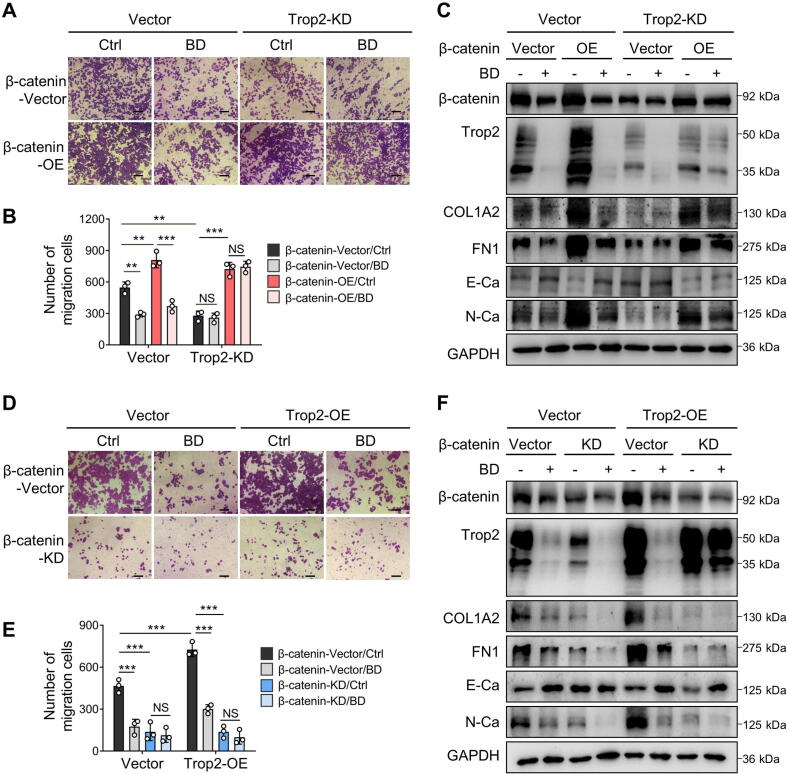
β-catenin was key factor for Trop2-mediated breast cancer cells metastasis. (A) Migration assay to observe the effects of β-catenin overexpression on migration ability in Vector and Trop-KD MDA-MB-468 cells with or without 0.8 μM BD after 48 h. The images were taken at × 100 magnification. (B) Quantification of (A), data are presented as mean ± SD, n = 3. **P < 0.01, ***P < 0.001, NS, P > 0.05, not significant. (C) Effects of β-catenin overexpression on the protein levels of Trop2, β-catenin, COL1A2, FN1, E-Ca and N-Ca in Vector and Trop-KD MDA-MB-468 cells treated with or without 0.8 μM BD for 48 h. (D) Migration assay to observe the effects of β-catenin knockdown on migration ability in Vector and Trop-OE MDA-MB-468 cells treated with or without 0.8 μM BD for 48 h. The images were taken at × 100 magnification. (E) Quantification of (D), data are presented as mean ± SD, n = 3. ***P < 0.001, NS, P > 0.05, not significant. (F) Effects of β-catenin knockdown on the protein levels of Trop2, β-catenin, COL1A2, FN1, E-Ca and N-Ca in Vector and Trop-OE MDA-MB-468 cells treated with or without 0.8 μM BD for 48 h.
Fig. 8
Fig. 8
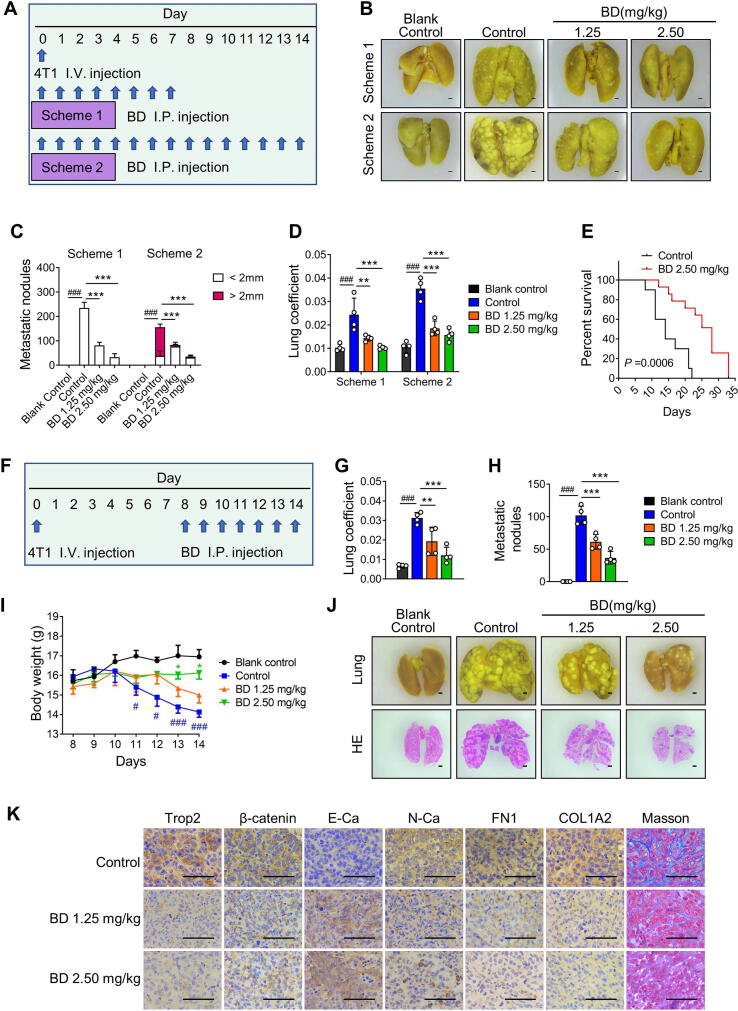
Bruceine D (BD) suppressed metastatic lung colonization and prolonged survival. (A) A procedure of tail vein injection (i.v.) of 4T1 tumor cells and intraperitoneal injection (i.p.) of BD or vehicle daily starting on day 0. There were 2 schemes, mice were sacrificed on day 7 (Scheme 1) or Day 14 (Scheme 2). (B) Representative images of lung tissues fixed with Bouin’s solution in Scheme 1 and Scheme 2 (×4.5 magnification). (C, D) Metastatic nodules (C) and lung coefficient (D) in the Scheme 1 and Scheme 2. Data are presented as mean ± SD, n = 4. **P < 0.01, ***P < 0.001 vs the control group. ###P < 0.001, control group vs blank control group. (E) Kaplan-Meier survival curve for control and BD-treated mice in 4T1 experimental metastasis model, n = 10. (F) Procedure for tail vein injection (i.v.) of 4T1 tumor cells at day 0, and intraperitoneal injection (i.p.) of BD or vehicle from days 8 to 14. (G-I) Lung coefficient (G), metastatic nodules (H) and body weight (I) in different treatment groups. Data are presented as mean ± SD, n = 4. *P < 0.05, **P < 0.01, ***P < 0.001 vs the control group. #P < 0.05, ###P < 0.001, control group vs blank control group. (J) Representative images of lung tissues fixed with Bouin’s solution (upper row) and stained with HE (lower row). The images were taken at × 4.5 magnification. (K) Representative images of immunohistochemical staining of Trop2, β-catenin, E-Ca, N-Ca, FN1 and COL1A2, and Masson staining in lung metastatic nodules (×400 magnification).

References

    1. Sung H., Ferlay J., Siegel R.L., Laversanne M., Soerjomataram I., Jemal A., et al. Global cancer statistics 2020: Globocan estimates of incidence and mortality worldwide for 36 cancers in 185 countries. CA Cancer J Clin. 2021;71(3):209–249. doi: 10.3322/caac.21660. - DOI - PubMed
    1. Waks A.G., Winer E.P. Breast cancer treatment. JAMA. 2019;321(3):316. doi: 10.1001/jama.2018.20751. - DOI - PubMed
    1. Liang Y., Zhang H., Song X., Yang Q. Metastatic heterogeneity of breast cancer: Molecular mechanism and potential therapeutic targets. Semin Cancer Biol. 2020;60:14–27. doi: 10.1016/j.semcancer.2019.08.012. - DOI - PubMed
    1. Metzger-Filho O., Tutt A., de Azambuja E., Saini K.S., Viale G., Loi S., et al. Dissecting the heterogeneity of triple-negative breast cancer. J Clin Oncol. 2012;30(15):1879–1887. doi: 10.1200/JCO.2011.38.2010. - DOI - PubMed
    1. Hwang S.Y., Park S., Kwon Y. Recent therapeutic trends and promising targets in triple negative breast cancer. Pharmacol Ther. 2019;199:30–57. doi: 10.1016/j.pharmthera.2019.02.006. - DOI - PubMed

Publication types