


Outcomes after definitive treatment for cutaneous angiosarcomas of the face and scalp: Reevaluating the role of surgery and radiation therapy
- PMID: 37272774
- PMCID: PMC11350586
- DOI: 10.1002/hed.27418
Outcomes after definitive treatment for cutaneous angiosarcomas of the face and scalp: Reevaluating the role of surgery and radiation therapy
Abstract
Introduction: We investigated outcomes and prognostic factors for patients treated for cutaneous angiosarcoma (CA).
Methods: We conducted a retrospective review of patients treated for CA of the face and scalp from 1962 to 2019. All received definitive treatment with surgery, radiation (RT), or a combination (S-XRT). The Kaplan-Meier method was used to estimate outcomes. Multivariable analyses were conducted using the Cox proportional hazards model.
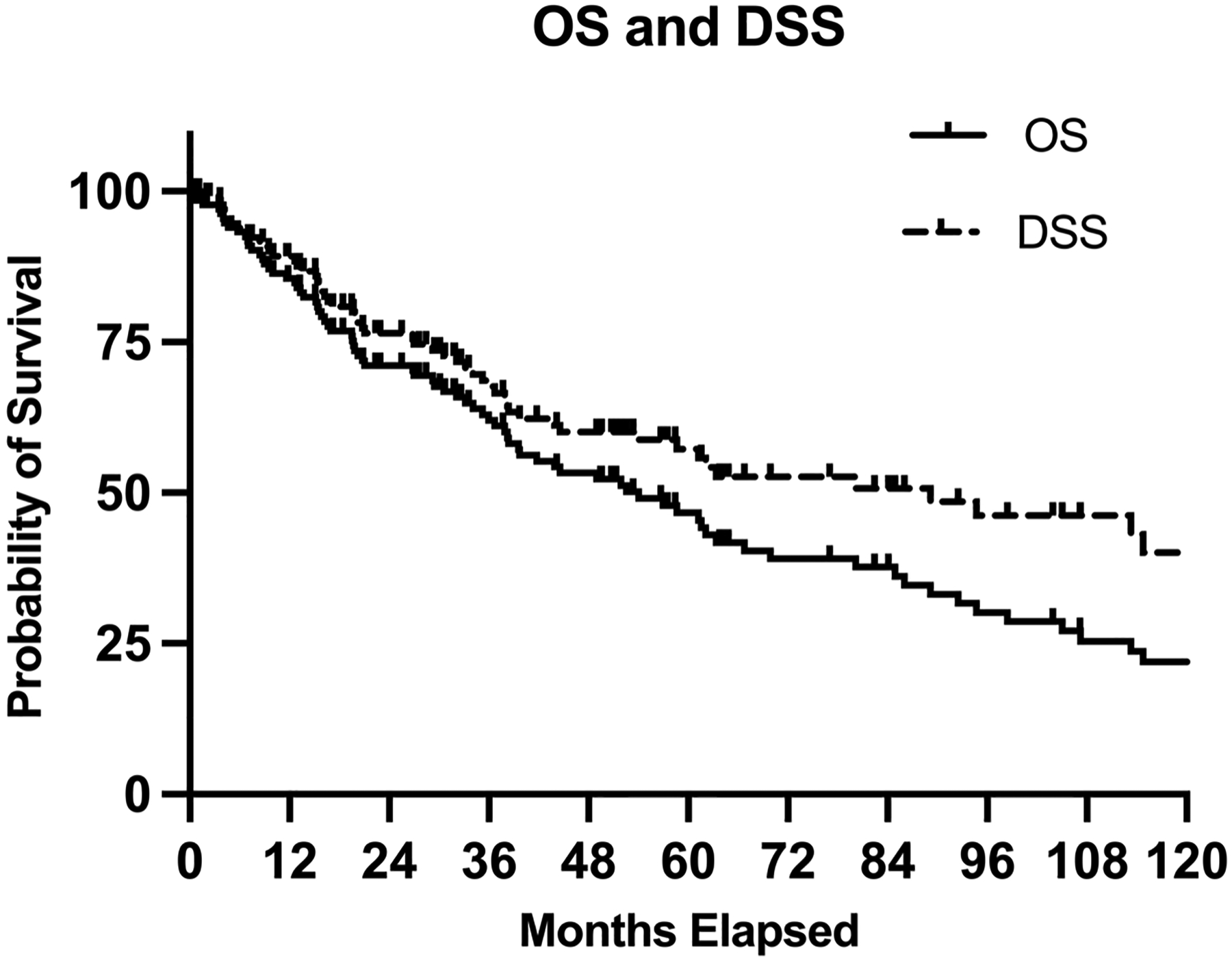
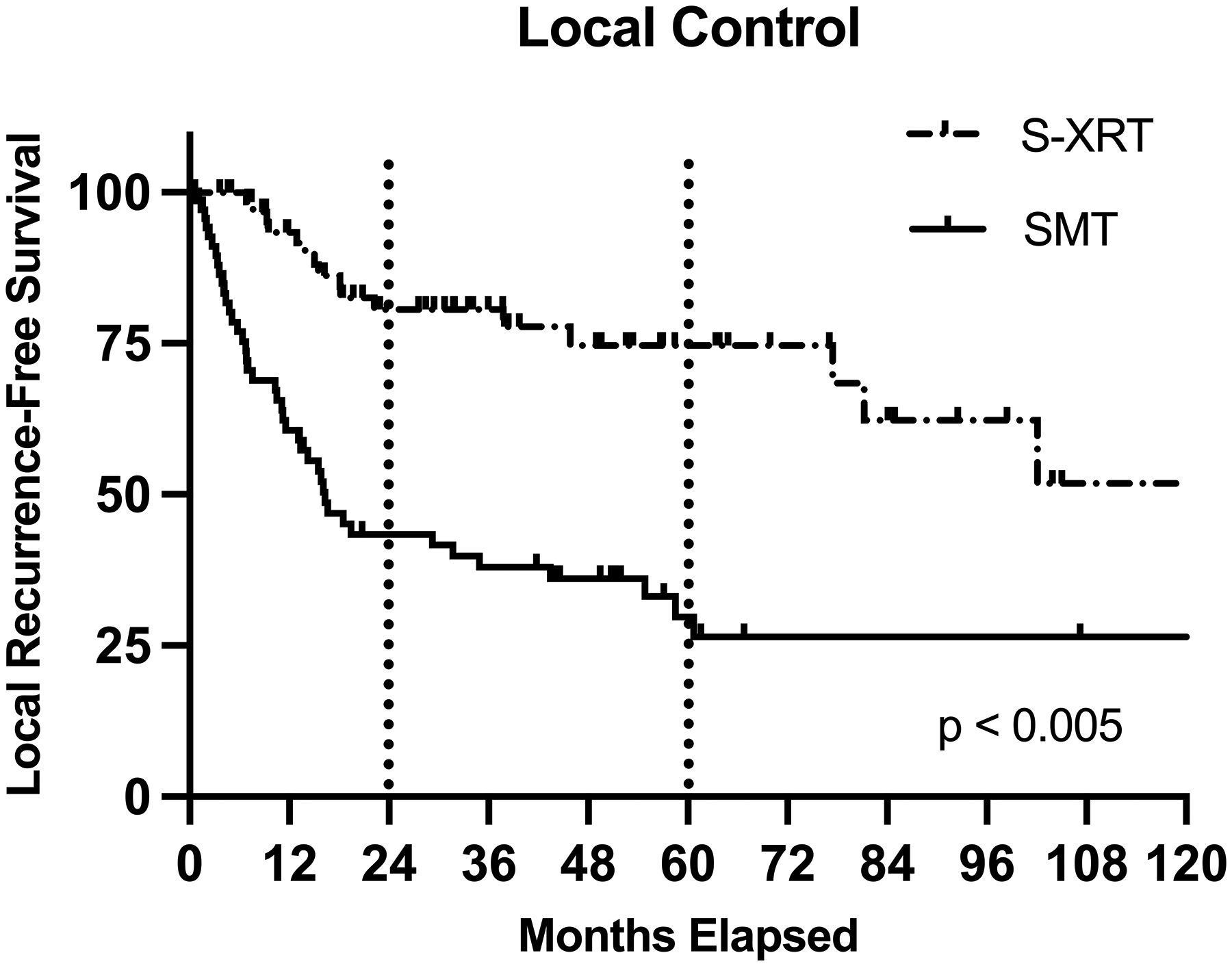
Results: For the 143 patients evaluated median follow-up was 33 months. Five-year LC was 51% and worse in patients with tumors >5 cm, multifocal tumors, those treated pre-2000, and with single modality therapy (SMT). These remained associated with worse LC on multivariable analysis. The 5-year disease-specific survival (DSS) for the cohort was 56%. Tumor size >5 cm, non-scalp primary site, treatment pre-2000, and SMT were associated with worse DSS.
Conclusion: Large or multifocal tumors are negative prognostic factors in patients with head and neck CA. S-XRT improved outcomes.
Keywords: angiosarcoma; radiation; surgery.
© 2023 Wiley Periodicals LLC.
Conflict of interest statement
Figures
References
-
- Costache M, Ene AM, Simionescu O, Sajin M. Histopathological diagnosis of cutaneous vascular sarcomas. Rom J Morphol Embryol. 2010;51(1):105–9. - PubMed
-
- Rouhani P, Fletcher CDM, Devesa SS, Toro JR. Cutaneous soft tissue sarcoma incidence patterns in the U.S. Cancer. 2008;113(3):616–27. - PubMed
-
- Albores-Saavedra J, Schwartz AM, Henson DE, Kostun L, Hart A, Angeles-Albores D, et al. Cutaneous angiosarcoma. Analysis of 434 cases from the Surveillance, Epidemiology, and End Results Program, 1973–2007. Annals of Diagnostic Pathology. 2011;15(2):93–7. - PubMed
-
- Fayette J, Martin E, Piperno-Neumann S, Le Cesne A, Robert C, Bonvalot S, et al. Angiosarcomas, a heterogeneous group of sarcomas with specific behavior depending on primary site: a retrospective study of 161 cases. Annals of Oncology. 2007;18(12):2030–6. - PubMed
-
- Holden CA, Spittle MF, Jones EW. Angiosarcoma of the face and scalp, prognosis and treatment. Cancer. 1987;59(5):1046–57. - PubMed
Publication types
MeSH terms
Grants and funding
LinkOut - more resources
Full Text Sources
Medical
