


Acetate and Acetyl-CoA Metabolism of ANME-2 Anaerobic Archaeal Methanotrophs
- PMID: 37272802
- PMCID: PMC10304654
- DOI: 10.1128/aem.00367-23
Acetate and Acetyl-CoA Metabolism of ANME-2 Anaerobic Archaeal Methanotrophs
Abstract
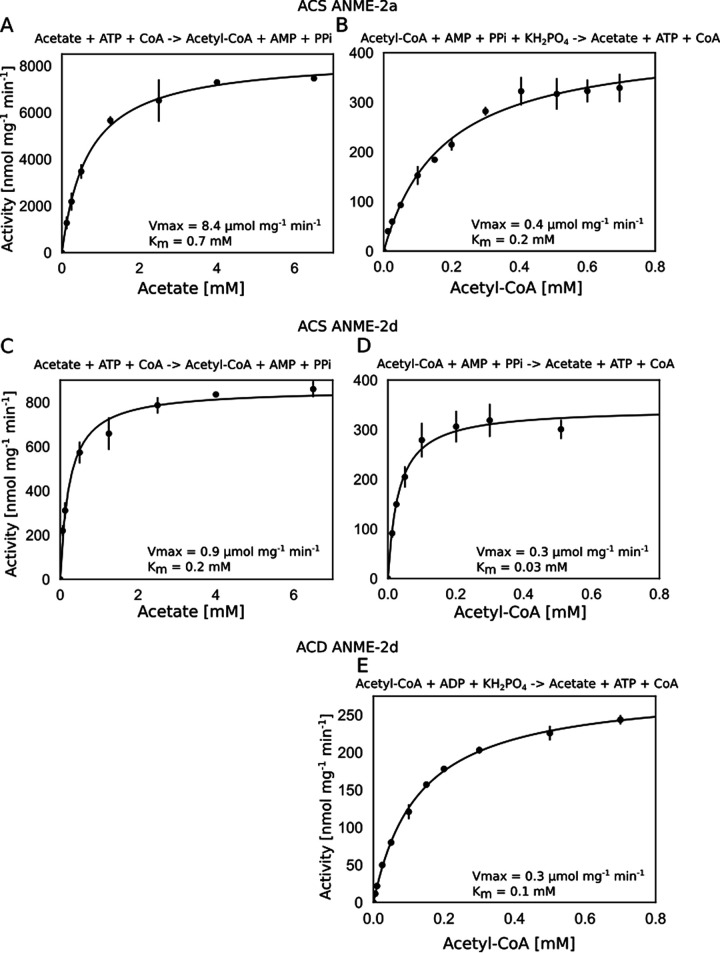
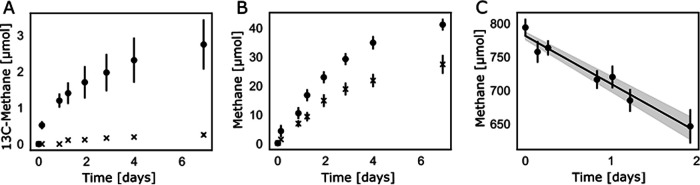
Acetyl-CoA synthetase (ACS) and acetate ligase (ACD) are widespread among microorganisms, including archaea, and play an important role in their carbon metabolism, although only a few of these enzymes have been characterized. Anaerobic methanotrophs (ANMEs) have been reported to convert methane anaerobically into CO2, polyhydroxyalkanoate, and acetate. Furthermore, it has been suggested that they might be able to use acetate for anabolism or aceticlastic methanogenesis. To better understand the potential acetate metabolism of ANMEs, we characterized an ACS from ANME-2a as well as an ACS and an ACD from ANME-2d. The conversion of acetate into acetyl-CoA (Vmax of 8.4 μmol mg-1 min-1 and Km of 0.7 mM acetate) by the monomeric 73.8-kDa ACS enzyme from ANME-2a was more favorable than the formation of acetate from acetyl-CoA (Vmax of 0.4 μmol mg-1 min-1 and Km of 0.2 mM acetyl-CoA). The monomeric 73.4-kDa ACS enzyme from ANME-2d had similar Vmax values for both directions (Vmax,acetate of 0.9 μmol mg-1 min-1 versus Vmax,acetyl-CoA of 0.3 μmol mg-1 min-1). The heterotetrameric ACD enzyme from ANME-2d was active solely in the acetate-producing direction. Batch incubations of an enrichment culture dominated by ANME-2d fed with 13C2-labeled acetate produced 3 μmol of [13C]methane in 7 days, suggesting that this anaerobic methanotroph might have the potential to reverse its metabolism and perform aceticlastic methanogenesis using ACS to activate acetate albeit at low rates (2 nmol g [dry weight]-1 min-1). Together, these results show that ANMEs may have the potential to use acetate for assimilation as well as to use part of the surplus acetate for methane production. IMPORTANCE Acetyl-CoA plays a key role in carbon metabolism and is found at the junction of many anabolic and catabolic reactions. This work describes the biochemical properties of ACS and ACD enzymes from ANME-2 archaea. This adds to our knowledge of archaeal ACS and ACD enzymes, only a few of which have been characterized to date. Furthermore, we validated the in situ activity of ACS in ANME-2d, showing the conversion of acetate into methane by an enrichment culture dominated by ANME-2d.
Keywords: ANME; acetate ligase; acetate metabolism; aceticlastic methanogenesis; acetyl-CoA synthetase.
Conflict of interest statement
The authors declare no conflict of interest.
Figures
References
-
- Dean JF, Middelburg JJ, Röckmann T, Aerts R, Blauw LG, Egger M, Jetten MSM, de Jong AEE, Meisel OH, Rasigraf O, Slomp CP, in’t Zandt MH, Dolman AJ. 2018. Methane feedbacks to the global climate system in a warmer world. Rev Geophys 56:207–250. doi: 10.1002/2017RG000559. - DOI
-
- Raghoebarsing AA, Pol A, van de Pas-Schoonen KT, Smolders AJP, Ettwig KF, Rijpstra WIC, Schouten S, Sinninghe Damsté JS, Op den Camp HJM, Jetten MSM, Strous M. 2006. A microbial consortium couples anaerobic methane oxidation to denitrification. Nature 440:918–921. doi: 10.1038/nature04617. - DOI - PubMed
Publication types
MeSH terms
Substances
LinkOut - more resources
Full Text Sources
Miscellaneous
