


Effect of laser bleaching, ultrasonic scaling and powered tooth brushing on surface roughness and bacterial adherence of class V composite restorations
- PMID: 37274090
- PMCID: PMC10233206
- DOI: 10.1016/j.jobcr.2023.03.012
Effect of laser bleaching, ultrasonic scaling and powered tooth brushing on surface roughness and bacterial adherence of class V composite restorations
Erratum in
-
Erratum regarding missing declaration of competing interest statements in previously published articles.J Oral Biol Craniofac Res. 2024 Jul-Aug;14(4):360-361. doi: 10.1016/j.jobcr.2024.05.009. Epub 2024 May 23. J Oral Biol Craniofac Res. 2024. PMID: 38826841 Free PMC article.
Abstract
Objective: To evaluate and compare the effect of diode laser assisted bleaching, ultrasonic scaling and powered tooth brushing on surface roughness and bacterial adherence on class V cavities restored with composites.
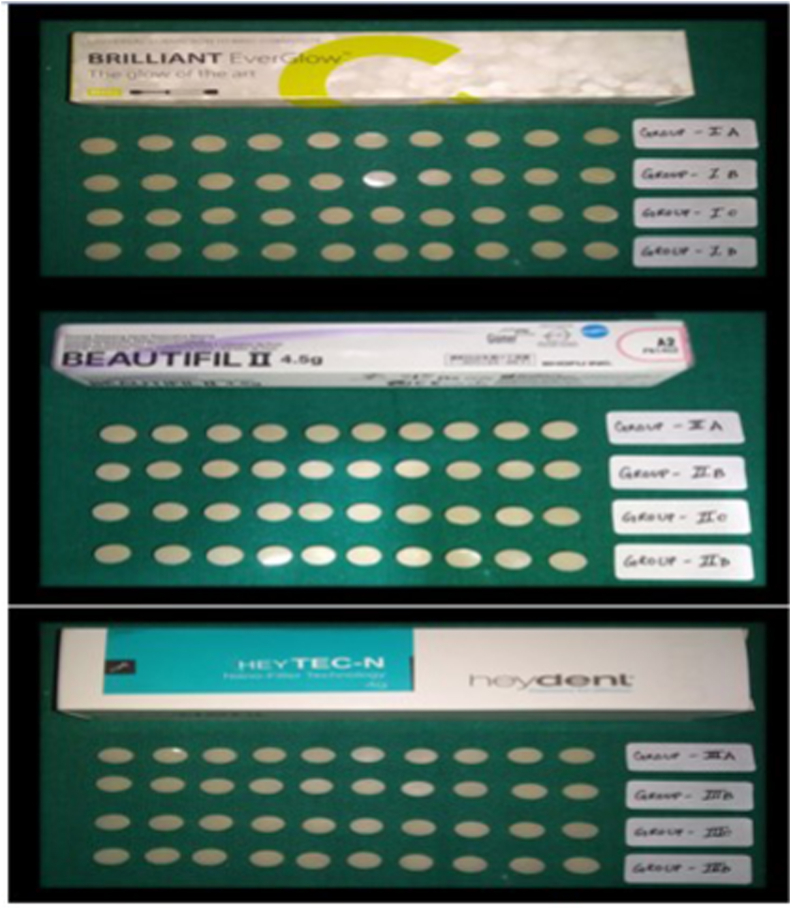
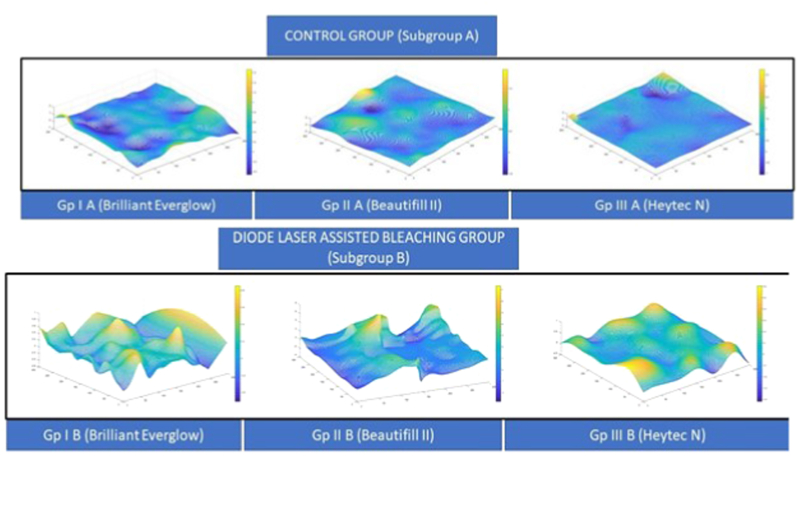
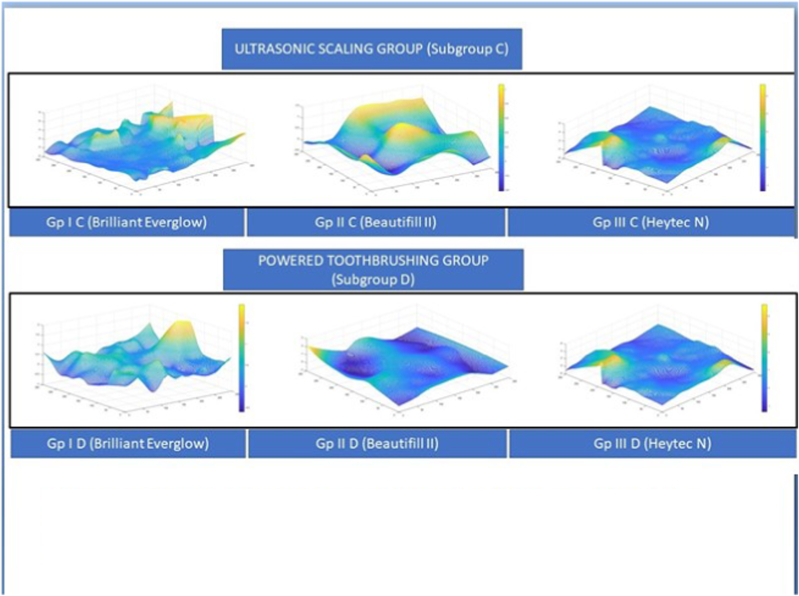
Materials and methods: A total of one hundred and twenty samples (40 samples each of Brilliant Everglow, Beautifil II and Heytec-N) were prepared in standardized stainless steel molds. The samples were further subdivided into four subgroups i.e. one control group (without any intervention) and three experimental groups - diode laser assisted bleaching, ultrasonic scaling and powered tooth brushing consisting of 10 sample each. Surface roughness was measured quantitatively with the help of 3D Optical Profilometer. For bacterial adherence analysis S. mutans strain (ATCC 25175) was cultured in BHI medium and samples were evaluated for the presence of viable bacteria using the Colony Forming Unit (CFU) count. Results obtained were then tabulated and subjected to statistical analysis.
Results: Diode laser bleaching caused a significant increase in surface roughness and bacterial adherence with lowest mean change exhibited by Heytec-N followed by Beautifil II and highest by Brilliant Everglow group. Similarly, Ultrasonic scaling increased the surface roughness of all the three tested samples with significant difference between the groups. Powered tooth brushing had no effect on the surface roughness and bacterial adherence of the tested composites.
Conclusion: Diode assisted laser bleaching and ultrasonic caused significantly higher surface roughness and bacterial adherence values for all the tested composites. It may therefore be recommended to do finishing and polishing of restorations after such procedures.
Keywords: Bacterial adherence; Composites; Diode laser bleaching; Powered tooth brushing; Surface roughness; Ultrasonics.
© 2023 Published by Elsevier B.V. on behalf of Craniofacial Research Foundation.
Figures


References
-
- Mackenzie L., Shortall A., Burke T., Parmar D. Posterior composites: an update. Dent Update. 2019 Apr 2;46(4):323–343.
-
- Stewardson D., Creanor S., Thornley P., et al. The survival of Class V restorations in general dental practice: part 3, five-year survival. Br Dent J. 2012 May 11;212(9):E14. - PubMed
-
- Tyas M.J. The class V lesion – aetiology and restoration. Aust Dent J. 1995;40(3):167–170. - PubMed
-
- Kaida K., Kubo S., Egoshi T., Taira Y. Eight-year clinical evaluation of two types of resin composite in non-carious cervical lesions. Clin Oral Investig. 2022 Oct;26(10):6327–6337. - PubMed
-
- Bansal K., Gupta S., Nikhil V., Jaiswal S., Jain A., Aggarwal N. Effect of different finishing and polishing systems on the surface roughness of resin composite and enamel: an in vitroProfilometric and scanning electron microscopy study. Int J Appl Basic Med Res. 2019 Jul-Sep;9(3):154–158. - PMC - PubMed
LinkOut - more resources
Full Text Sources
Molecular Biology Databases
