Case Reports
. 2023 May 19:10:1199657.
doi: 10.3389/fmed.2023.1199657. eCollection 2023.

Case report: Analysis of phage therapy failure in a patient with a Pseudomonas aeruginosa prosthetic vascular graft infection

Affiliations
Case Reports

Case report: Analysis of phage therapy failure in a patient with a Pseudomonas aeruginosa prosthetic vascular graft infection

Lucia Blasco et al. Front Med (Lausanne). .

Abstract

Clinical case of a patient with a Pseudomonas aeruginosa multidrug-resistant prosthetic vascular graft infection which was treated with a cocktail of phages (PT07, 14/01, and PNM) in combination with ceftazidime-avibactam (CZA). After the application of the phage treatment and in absence of antimicrobial therapy, a new P. aeruginosa bloodstream infection (BSI) with a septic residual limb metastasis occurred, now involving a wild-type strain being susceptible to ß-lactams and quinolones. Clinical strains were analyzed by microbiology and whole genome sequencing techniques. In relation with phage administration, the clinical isolates of P. aeruginosa before phage therapy (HE2011471) and post phage therapy (HE2105886) showed a clonal relationship but with important genomic changes which could be involved in the resistance to this therapy. Finally, phenotypic studies showed a decrease in Minimum Inhibitory Concentration (MIC) to ß-lactams and quinolones as well as an increase of the biofilm production and phage resistant mutants in the clinical isolate of P. aeruginosa post phage therapy.

Keywords: Pseudomonas aeruginosa; antibiotic resistance; bypass; phage; phage therapy; prosthetic vascular graft infection.


Conflict of interest statement

The authors declare that the research was conducted in the absence of any commercial or financial relationships that could be construed as a potential conflict of interest.

Figures
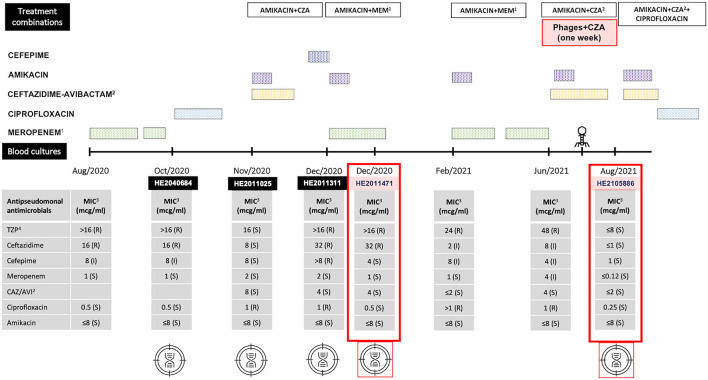
Figure 1
Figure 1
Timeline depicting the different antibiotic and phage therapies, the isolation of Pseudomonas aeruginosa strains from blood cultures and their antibiotic susceptibility and genomic analyses. PFGE of these strains in described in Supplementary Figure S1. Antimicrobial information: 1MEM, Meropenem. 2CZA, Ceftazidime-avibactam. 3MIC, Minimum inhibitory concentration. 4TZP, Piperacillin-tazobactam. The five isolates that underwent Whole Genome Sequencing (WGS) are shown with the “target” symbols; of those, the two isolates that are further analyzed in the manuscript, P. aeruginosa isolate HE2011471 (pre-phage therapy) and P. aeruginosa isolate HE2105886 (post-phage therapy) are highlighted with the red boxes.
Figure 2
Figure 2
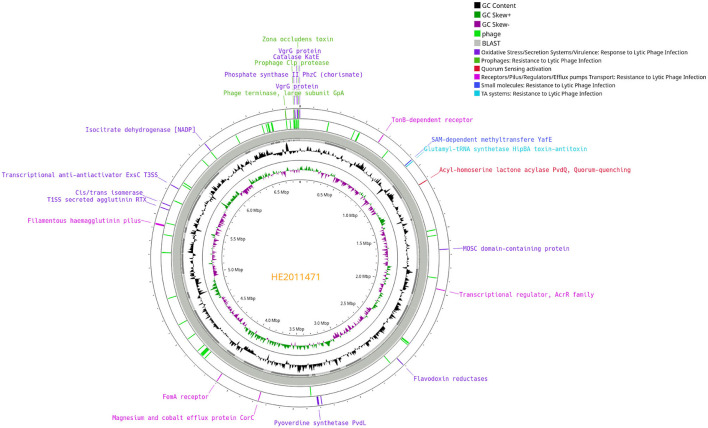
Circular chromosomic view of the bacterial genomes of two Pseudomonas aeruginosa isolates: P. aeruginosa isolate HE2105886 (after phage treatment) in comparison with P. aeruginosa isolate HE2011471 (prior to phage administration). The SNPs found in P. aeruginosa isolate HE2105886 respect to P. aeruginosa isolate HE2011471 are indicated.
Figure 3
Figure 3
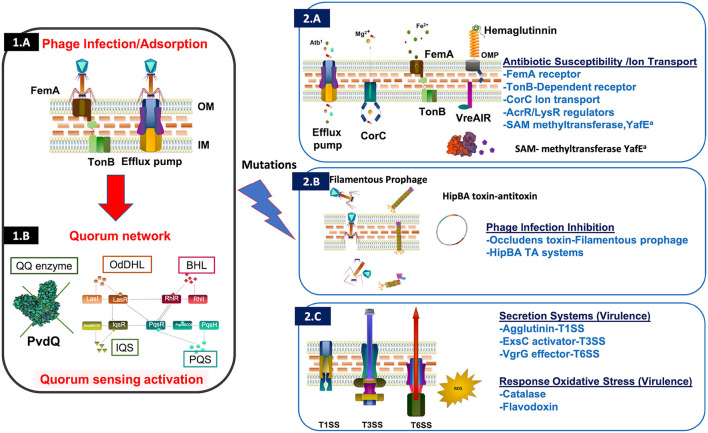
Graphic representation of the proteins coded by the P. aeruginosa HE2105886 genome (post-phage therapy isolate), that presented mutations when compared to pre-phage therapy isolate, with emphasis of changes associated with mechanisms of resistance and response to phage infection (12). Among them we highlight phage infection by adsorption as well as Quorum Sensing activation (1A, 1B) alteration of the antibiotic susceptibility (receptors and efflux pumps) (2A), inhibition of the phage infection (filamentous prophages, TA (toxin-antitoxin) systems and small molecules) (–15) (2B) and finally, virulence (oxidative stress and secretion systems) (2C). aSmall molecules such as aminoglycosides which participate in the inhibition of the phage infection well as bacterial antimicrobial profile.
Figure 4
Figure 4
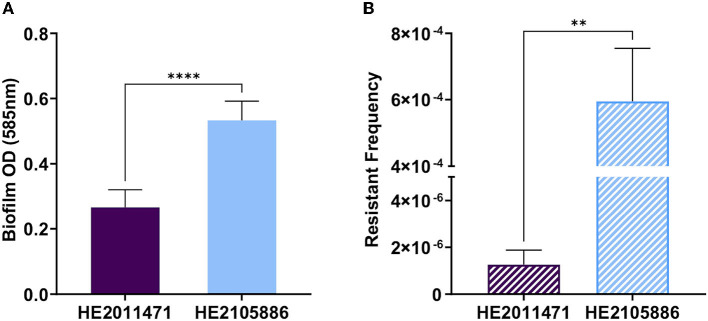
Comparison of the biofilm production (A) and the frequency of occurrence of phage resistant mutants (B) between the Pseudomonas aeruginosa isolates HE2011471 (pre-phage therapy) and HE2105886 (post-phage therapy). Statistical analysis is t-test with Graphpad 9.0.0 ****<0.0001; **0.0030.

References

    1. Legout L, Sarraz-Bournet B, D'Elia PV, Devos P, Pasquet A, Caillaux M, et al. Characteristics and prognosis in patients with prosthetic vascular graft infection: a prospective observational cohort study. Clin Microbiol Infect. (2012) 18:352–8. 10.1111/j.1469-0691.2011.03618.x - DOI - PubMed
    1. SR BMaK. Infections and Antibiotics in Vascular Surgery. In: Basic Science and Clinical Correlations, editor. White RA and Hollier LH, Philadelphia: J. B. Lippincott company. (1994).
    1. Tacconelli E, Carrara E, Savoldi A, Harbarth S, Mendelson M, Monnet DL, et al. Discovery, research, and development of new antibiotics: the WHO priority list of antibiotic-resistant bacteria and tuberculosis. Lancet Infect Dis. (2018) 18:318–27. 10.1016/S1473-3099(17)30753-3 - DOI - PubMed
    1. Cabot G, Ocampo-Sosa AA, Tubau F, Macia MD, Rodríguez C, Moya B, et al. Spanish Network for Research in Infectious Diseases (REIPI). Overexpression of AmpC and efflux pumps in Pseudomonas aeruginosa isolates from bloodstream infections: prevalence and impact on resistance in a Spanish multicenter study. Antimicrob Agents Chemother. (2011) 55:1906–11. 10.1128/AAC.01645-10 - DOI - PMC - PubMed
    1. Hatfull GF, Dedrick RM, Schooley RT. Phage Therapy for Antibiotic-Resistant Bacterial Infections. Annu Rev Med. (2022) 73:197–211. 10.1146/annurev-med-080219-122208 - DOI - PubMed

Publication types

LinkOut - more resources