


Adenoviral-vectored next-generation respiratory mucosal vaccines against COVID-19
- PMID: 37276833
- PMCID: PMC10172971
- DOI: 10.1016/j.coviro.2023.101334
Adenoviral-vectored next-generation respiratory mucosal vaccines against COVID-19
Abstract
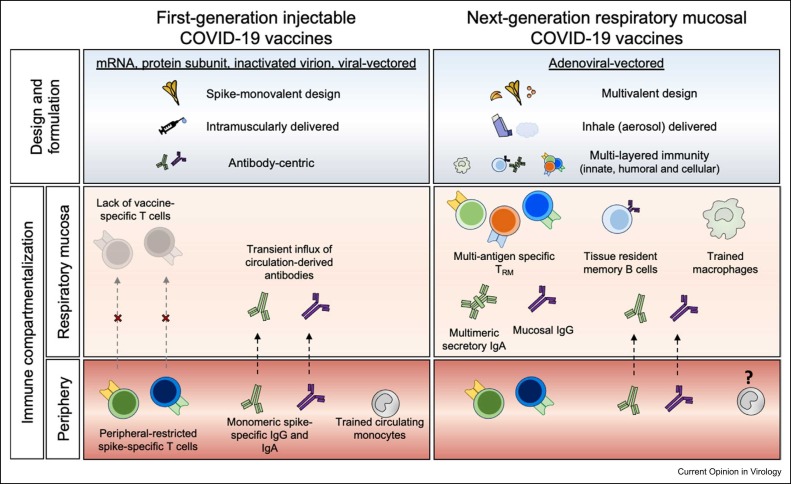
The world is in need of next-generation COVID-19 vaccines. Although first-generation injectable COVID-19 vaccines continue to be critical tools in controlling the current global health crisis, continuous emergence of SARS-CoV-2 variants of concern has eroded the efficacy of these vaccines, leading to staggering breakthrough infections and posing threats to poor vaccine responders. This is partly because the humoral and T-cell responses generated following intramuscular injection of spike-centric monovalent vaccines are mostly confined to the periphery, failing to either access or be maintained at the portal of infection, the respiratory mucosa (RM). In contrast, respiratory mucosal-delivered vaccine can induce immunity encompassing humoral, cellular, and trained innate immunity positioned at the respiratory mucosa that may act quickly to prevent the establishment of an infection. Viral vectors, especially adenoviruses, represent the most promising platform for RM delivery that can be designed to express both structural and nonstructural antigens of SARS-CoV-2. Boosting RM immunity via the respiratory route using multivalent adenoviral-vectored vaccines would be a viable next-generation vaccine strategy.
Copyright © 2023 Elsevier B.V. All rights reserved.
Conflict of interest statement
Declaration of Competing Interest The authors declare the following financial interests/personal relationships which may be considered as potential competing interests: Z.X. is one of the inventors on a patent application PCT/CA2022/051107, entitled “Novel COVID vaccine and method for delivery”. All other authors declare no competing interests.
Figures
References
-
- WHO: Registry Data of COVID-19 Vaccine Candidates; 2022. Available at: 〈https://covid19.trackvaccines.org/vaccines/approved/#vaccine-list〉 (Accessed 21 November 2022).
-
- Liu J., Chandrashekar A., Sellers D., Barrett J., Jacob-Dolan C., Lifton M., McMahan K., Sciacca M., VanWyk H., Wu C., et al. Vaccines elicit highly conserved cellular immunity to SARS-CoV-2 Omicron. Nature. 2022;603:493–496. - PMC - PubMed
-
Spike-specific T cell responses induced by first-generation COVID-19 vaccines are conserved in their ability to recognize the omicron spike protein.
Publication types
MeSH terms
Substances
Supplementary concepts
Grants and funding
LinkOut - more resources
Full Text Sources
Medical
Miscellaneous
