Review
. 2023 Aug;19(8):481-490.
doi: 10.1038/s41581-023-00726-9. Epub 2023 Jun 5.

Portable, wearable and implantable artificial kidney systems: needs, opportunities and challenges

Affiliations
Review

Portable, wearable and implantable artificial kidney systems: needs, opportunities and challenges

David Loureiro Ramada et al. Nat Rev Nephrol. 2023 Aug.

Abstract

Haemodialysis is life sustaining but expensive, provides limited removal of uraemic solutes, is associated with poor patient quality of life and has a large carbon footprint. Innovative dialysis technologies such as portable, wearable and implantable artificial kidney systems are being developed with the aim of addressing these issues and improving patient care. An important challenge for these technologies is the need for continuous regeneration of a small volume of dialysate. Dialysate recycling systems based on sorbents have great potential for such regeneration. Novel dialysis membranes composed of polymeric or inorganic materials are being developed to improve the removal of a broad range of uraemic toxins, with low levels of membrane fouling compared with currently available synthetic membranes. To achieve more complete therapy and provide important biological functions, these novel membranes could be combined with bioartificial kidneys, which consist of artificial membranes combined with kidney cells. Implementation of these systems will require robust cell sourcing; cell culture facilities annexed to dialysis centres; large-scale, low-cost production; and quality control measures. These challenges are not trivial, and global initiatives involving all relevant stakeholders, including academics, industrialists, medical professionals and patients with kidney disease, are required to achieve important technological breakthroughs.


Conflict of interest statement

The authors declare no competing interests.

Figures
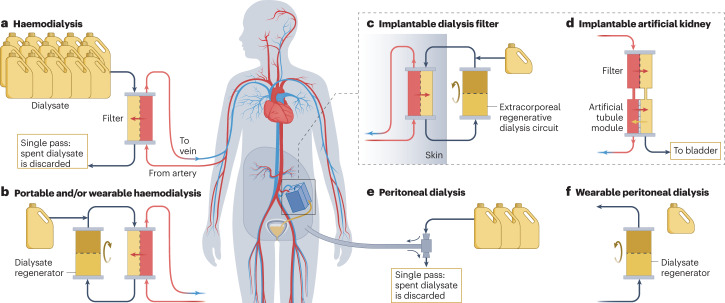
Fig. 1
Fig. 1. Dialysis technologies.
a, Single-pass haemodialysis is the most common modality of kidney replacement therapy, but requires very large volumes of dialysate, which limits the portability of the system. b, Portable and/or wearable haemodialysis devices use dialysate regeneration systems based on chemical sorbents, urease, electro-oxidation, photo-oxidation or combinations of these approaches. c, Haemodialysis can also be performed using an implantable dialysis filter (typical Si-wafer based) with an external regenerative dialysate circuit. d, Fully implantable artificial kidneys are also being developed. These systems use a silicon-wafer filter as an artificial glomerulus in combination with an artificial tubule module (which might be a bioreactor or a fully technological approach) that has a urine outlet to the bladder. e, Single-pass peritoneal dialysis also uses large volumes of dialysate (image shows typical tidal peritoneal dialysis). f, Peritoneal dialysis can also be miniaturized using dialysate regeneration systems. This approach is suitable for continuous flow peritoneal dialysis.
Fig. 2
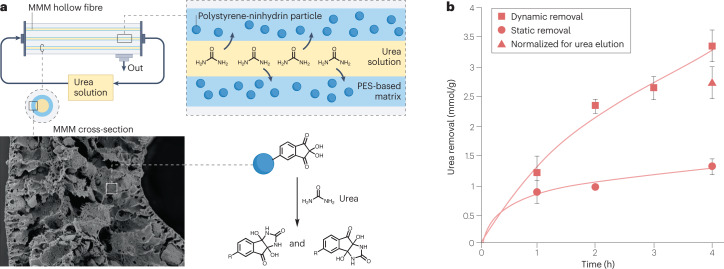
Fig. 2. Removal of urea using a mixed matrix membrane.
a, Urea solution is pumped through a mixed matrix membrane (MMM) hollow fibre device consisting of polystyrene ninhydrin particles within a polyethersulfone (PES)-based polymer matrix. Ninhydrin contains highly electrophilic carbonyl groups that covalently bind to the nitrogen atoms of urea and thereby remove it from dialysate solution. b, Urea removal by the MMM at 70°C under static (stirring) and dynamic (filtration and recirculation) conditions. Urea removal is estimated per grams of particles incorporated into the membrane matrix. Adapted from ref. , CC BY 4.0 (https://creativecommons.org/licenses/ by/4.0/).
Fig. 3
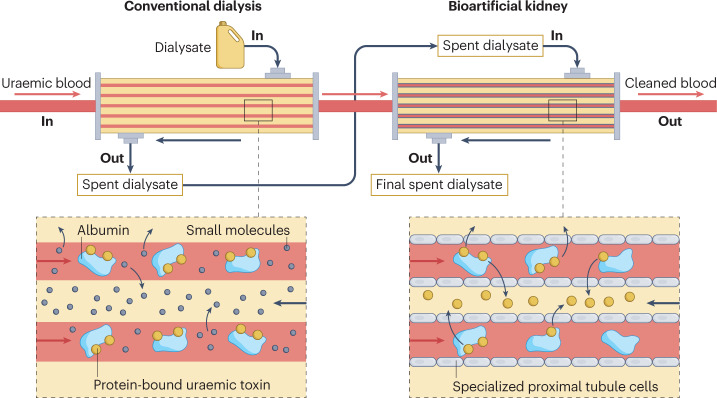
Fig. 3. A bioartificial kidney.
Schematic representation of a bioartificial kidney integrated with a conventional dialysis filter in a series configuration. First, the patient’s blood flows through a dialysis filter, which removes small molecules and medium-sized molecules (up to 45 kDa) and excess fluid. The blood then enters the bioartificial kidney, which consists of immortalized proximal tubule cells cultured on polymeric hollow fibre membranes. These cells take up protein-bound uraemic toxins from the blood after release of the molecules from the plasma protein (predominantly albumin) to the free solute, owing to the higher affinity of the solutes for the basolateral influx transporters, which can then be secreted into the dialysate via the actions of apical efflux transporters. The blood is then returned to the patient.

References

    1. Renal Data System - USA, Annual Data Report https://usrds-adr.niddk.nih.gov/2022 (2022).
    1. Saran R, et al. US Renal Data System 2019 annual data report: epidemiology of kidney disease in the United States. Am. J. Kidney Dis. 2020;75:A6–A7. doi: 10.1053/j.ajkd.2019.09.003. - DOI - PubMed
    1. Fresenius Annual Report 2021. https://www.fresenius.com/sites/default/files/2022-03/Fresenius_Annual_R... (2021).
    1. Zhou B, et al. Worldwide trends in hypertension prevalence and progress in treatment and control from 1990 to 2019: a pooled analysis of 1201 population-representative studies with 104 million participants. Lancet. 2021;398:957–980. doi: 10.1016/S0140-6736(21)01330-1. - DOI - PMC - PubMed
    1. Magliano DJ, et al. Trends in incidence of total or type 2 diabetes: systematic review. Br. Med. J. 2019 doi: 10.1136/bmj.l5003. - DOI - PMC - PubMed

Publication types

Substances