


Determinants of Preexposure Prophylaxis Cascade Among Sexual and Gender Minorities in Nigeria
- PMID: 37277897
- PMCID: PMC10527664
- DOI: 10.1097/OLQ.0000000000001841
Determinants of Preexposure Prophylaxis Cascade Among Sexual and Gender Minorities in Nigeria
Abstract
Background: Preexposure prophylaxis (PrEP) is effective in preventing human immunodeficiency virus (HIV) infection among sexual and gender minorities (SGMs). We evaluated the characteristics associated with engagement in 7 steps of the PrEP cascade among SGMs in Nigeria.
Methods: Sexual and gender minorities without HIV from the Abuja site of TRUST/RV368 cohort who were surveyed on awareness of and willingness to use PrEP were approached for PrEP initiation upon availability of oral daily PrEP. To understand gaps in the uptake of oral daily PrEP, we categorized the HIV PrEP cascade as (i) education about PrEP, (ii) interest in PrEP, (iii) successful contact, (iv) appointment scheduled, (v) appointment attendance, (vi) PrEP initiation, and (vii) plasma protective levels of tenofovir disoproxil fumarate. Multivariable logistic regression models were used to determine factors associated with each of the 7 steps in the HIV PrEP cascade.
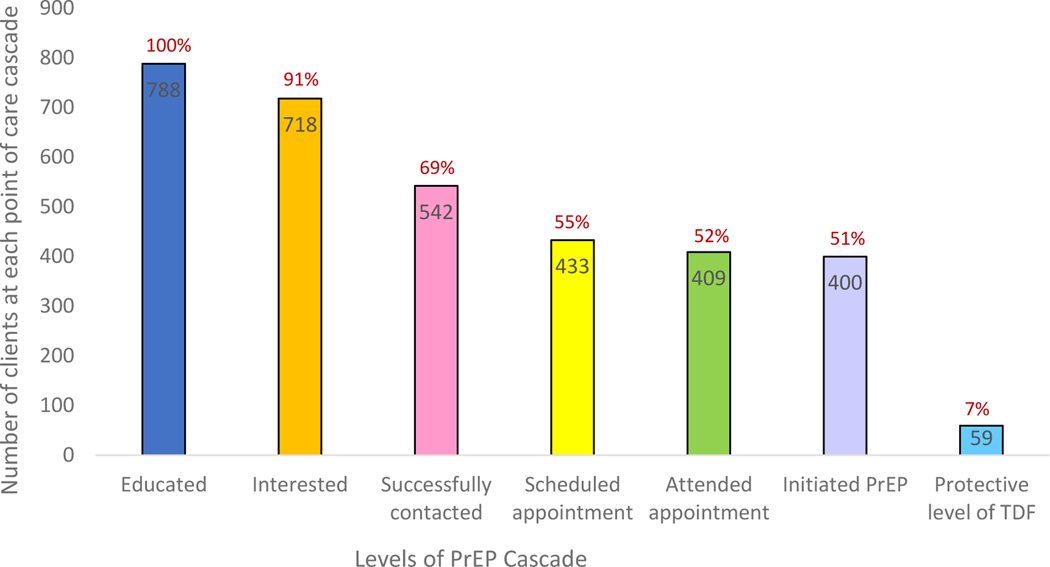
Results: Of 788 participants, 718 (91.1%) showed interest in taking oral daily PrEP every day and/or after a sexual act, 542 (68.8%) were successfully contacted, 433 (54.9%) scheduled an appointment, 409 (51.9%) attended a scheduled appointment, 400 (50.8%) initiated oral daily PrEP, and 59 (7.4%) had protective levels of tenofovir disoproxil fumarate. Of initiators of PrEP, 23 (5.8%) seroconverted at a rate of 13.9 cases/100 person-years. Better social support, larger network density, and higher education were associated with engagement in 4 to 5 components of the cascade.
Conclusions: Our data highlight a gap between willingness and actual PrEP use. Despite PrEP's effectiveness in preventing HIV, the optimal impact of PrEP for SGMs in sub-Saharan Africa will require multifaceted approaches that combine social support, education, and destigmatization.
Copyright © 2023 American Sexually Transmitted Diseases Association. All rights reserved.
Conflict of interest statement
Conflict of Interest and Sources of Funding: The authors declare no conflict of interest. This work was supported by cooperative agreements between the Henry M. Jackson Foundation for the Advancement of Military Medicine, Inc, and the US Department of Defense (W81XWH-11-2-0174, W81XWH-18-2-0040); the National Institutes of Health (R01 MH099001, R01 AI120913, R01 MH110358); the Fogarty Epidemiology Research Training for Public Health Impact in Nigeria program (D43TW010051); and the President's Emergency Plan for AIDS Relief through a cooperative agreement between the Department of Health and Human Services/Centers for Disease Control and Prevention, Global AIDS Program, and the Institute for Human Virology—Nigeria (NU2GGH002099), and Gilead Sciences, Inc (ISR IN-EU-276-4468).
Figures
References
-
- Ramadhani HO, Liu H, Nowak RG, et al. Sexual partner characteristics and incident rectal Neisseria gonorrhoeae and Chlamydia trachomatis infections among gay men and other men who have sex with men (MSM): a prospective cohort in Abuja and Lagos, Nigeria. Sex Transm Infect. Aug 2017;93(5):348–355. - PMC - PubMed
Publication types
MeSH terms
Substances
Grants and funding
LinkOut - more resources
Full Text Sources
Medical
Miscellaneous
