


Enlarged perivascular spaces in patients with migraine: a case-control study based on 3T MRI
- PMID: 37278245
- PMCID: PMC10351656
- DOI: 10.1002/acn3.51798
Enlarged perivascular spaces in patients with migraine: a case-control study based on 3T MRI
Abstract
Objective: To explore whether MRI-visible enlarged perivascular spaces (EPVS) are associated with migraine and may serve as a predictor of migraine. Then further explore its correlation with migraine chronification.
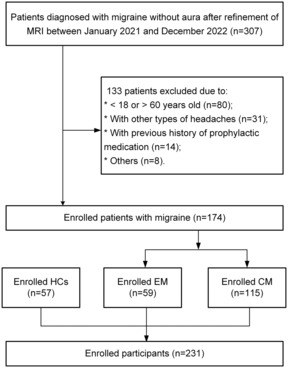
Methods: A total of 231 participants (healthy control [HC] = 57, episodic migraine [EM] = 59, chronic migraine [CM] = 115) were included in this case-control study. A 3T MRI device and the validated visual rating scale were used to assess the grades of EPVS in centrum semiovale (CSO), midbrain (MB), and basal ganglia (BG). Comparisons between the two groups were made using the chi-square or Fisher's exact tests to initially determine whether high-grade EPVS were associated with migraine and migraine chronification. A multivariate logistic regression model was constructed to further investigate the role of high-grade EPVS in migraine.
Results: The prevalence of high-grade EPVS in CSO and MB were significantly higher in patients with migraine than in HCs (CSO: 64.94% vs. 42.11%, P = 0.002; MB: 55.75% vs. 29.82%, P = 0.001). Subgroup analysis showed no statistical difference between patients with EM and CM (CSO: 69.94% vs. 62.61%, P = 0.368; MB: 50.85% vs. 58.26%, P = 0.351). Individuals with high-grade EPVS in CSO (odds ratio [OR]: 2.324; 95% confidence interval [CI]: 1.136-4.754; P = 0.021) and MB (OR: 3.261; 95% CI: 1.534-6.935; P = 0.002) were more likely to suffer from migraine.
Interpretation: This case-control study showed that high-grade EPVS in CSO and MB in clinical practice with the underlying mechanism of dysfunction of the glymphatic system could be a predictor of migraine, but no significant correlation had been found with migraine chronification.
© 2023 The Authors. Annals of Clinical and Translational Neurology published by Wiley Periodicals LLC on behalf of American Neurological Association.
Conflict of interest statement
There is no potential competing interest to be declared by the authors.
Figures

References
-
- Charles A. The pathophysiology of migraine: implications for clinical management. Lancet Neurol. 2018;17(2):174‐182. - PubMed
-
- Hablitz LM, Nedergaard M. The glymphatic system. Curr Biol. 2021;31(20):R1371‐R1375. - PubMed
-
- Piantino J, Lim MM, Newgard CD, Iliff J. Linking traumatic brain injury, sleep disruption and post‐traumatic headache: a potential role for glymphatic pathway dysfunction. Curr Pain Headache Rep. 2019;23(9):62. - PubMed
Publication types
MeSH terms
LinkOut - more resources
Full Text Sources
Medical
Miscellaneous