. 2023 Jun 6;13(1):9182.
doi: 10.1038/s41598-023-36444-2.

A computationally efficient algorithm for wearable sleep staging in clinical populations

Affiliations

A computationally efficient algorithm for wearable sleep staging in clinical populations

Pedro Fonseca et al. Sci Rep. .

Abstract

This study describes a computationally efficient algorithm for 4-class sleep staging based on cardiac activity and body movements. Using an accelerometer to calculate gross body movements and a reflective photoplethysmographic (PPG) sensor to determine interbeat intervals and a corresponding instantaneous heart rate signal, a neural network was trained to classify between wake, combined N1 and N2, N3 and REM sleep in epochs of 30 s. The classifier was validated on a hold-out set by comparing the output against manually scored sleep stages based on polysomnography (PSG). In addition, the execution time was compared with that of a previously developed heart rate variability (HRV) feature-based sleep staging algorithm. With a median epoch-per-epoch κ of 0.638 and accuracy of 77.8% the algorithm achieved an equivalent performance when compared to the previously developed HRV-based approach, but with a 50-times faster execution time. This shows how a neural network, without leveraging any a priori knowledge of the domain, can automatically "discover" a suitable mapping between cardiac activity and body movements, and sleep stages, even in patients with different sleep pathologies. In addition to the high performance, the reduced complexity of the algorithm makes practical implementation feasible, opening up new avenues in sleep diagnostics.


Conflict of interest statement

At the time of writing, P.F., M.R., A.C. and P.A. were employed by Royal Philips, a commercial company and manufacturer of consumer and medical electronic devices, commercializing products in the area of sleep diagnostics and sleep therapy. Their employer had no influence on the study and on the decision to publish. The other authors declare that they have no competing interests.

Figures

Figure 1
Figure 1
Distribution of recordings from each database into training and hold-out validation sets, with an indication of the number of participants and recordings, and signals used in the study with the corresponding sampling frequency (fs) (ECG, Electrocardiogram, PPG, Photoplethysmogram, Acc., Accelerometer).
Figure 2
Figure 2
Overview of the processing steps for sleep stage classification based on accelerometer and PPG inputs; from top to bottom the plots represent: probability of the participant being at rest (in blue), and resting period found in the complete recording (in yellow), activity counts (in grey for the excluded period outside the resting period, in blue, during the resting period), instantaneous heart rate (idem), and predicted sleep stages; the vertical dashed red lines indicate the boundaries of the lights off period.
Figure 3
Figure 3
Architecture of the sleep staging neural network. Panel (a) illustrates the overall architecture of the feature extraction network. Residual convolutional blocks with increasing number of outputs are combined with maximum pooling layers in an alternating fashion to gradually increase the complexity of extracted features and at the same time reduce the temporal resolution from the 10 Hz input to one feature vector per 30 s. Skip connections are added after each step. Panel (b) shows the architecture of the recurrent sleep stage classifier. Bidirectional GRU layers are stacked and skip connections ease the learning of simple relationships by bypassing the recurrent layers. Panel (c) shows the architecture of the residual convolutional blocks used in the feature extraction network. Convolutional layers are combined with additional dense layers to increase the network depth without increasing the perceptive field of the convolutional block.
Figure 4
Figure 4
Histograms with (left) κ and (right) accuracy for (red) 4-class and (blue) Wake/Sleep stage classification in the hold-out validation set; overlapping portions of the histograms are represented in purple.
Figure 5
Figure 5
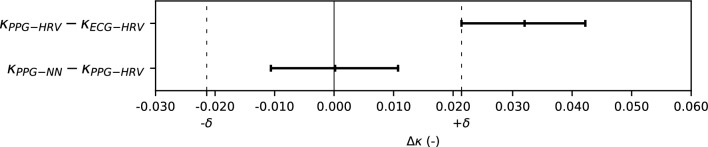
95% confidence intervals for difference in performance (above) between the PPG–HRV and ECG–HRV models, with the lower bound to establish δ and (below) between the PPG–NN and PPG–HRV model. Statistical equivalence in performance was established between the PPG and NN and the PPG–HRV models.

References

    1. Gauld C, Micoulaud-Franchi J. Why could sleep medicine never do without polysomnography? J. Sleep Res. 2022;31:e13541. doi: 10.1111/jsr.13541. - DOI - PubMed
    1. de Zambotti M, Cellini N, Goldstone A, Colrain IM, Baker FC. Wearable sleep technology in clinical and research settings. Med. Sci. Sports Exerc. 2019 doi: 10.1249/MSS.0000000000001947. - DOI - PMC - PubMed
    1. Wulterkens BM, et al. It is all in the wrist: Wearable sleep staging in a clinical population versus reference polysomnography. Nat. Sci. Sleep. 2021;13:885–897. doi: 10.2147/NSS.S306808. - DOI - PMC - PubMed
    1. Klosch G, et al. The SIESTA project polygraphic and clinical database. IEEE Eng. Med. Biol. 2001;20:51–57. doi: 10.1109/51.932725. - DOI - PubMed
    1. Rechtschaffen A, Kales A. A Manual of Standardized Terminology, Techniques and Scoring System for Sleep Stages of Human Subjects. Public Health Service; 1968. - PubMed

Publication types