


National Brain Tumour Registry of China (NBTRC) statistical report of primary brain tumours diagnosed in China in years 2019-2020
- PMID: 37283963
- PMCID: PMC10240383
- DOI: 10.1016/j.lanwpc.2023.100715
National Brain Tumour Registry of China (NBTRC) statistical report of primary brain tumours diagnosed in China in years 2019-2020
Abstract
Background: The lack of a well-designed brain tumour registry with standardized pathological diagnoses in underdeveloped countries hinders the ability to compare epidemiologic data across the globe. The National Brain Tumour Registry of China (NBTRC), created in January 2018, is the first multi-hospital-based brain tumour registry in China. Patient data reported to the NBTRC in years 2019-2020 were assessed.
Methods: Tumour pathology was based on the 2016 World Health Organization (WHO) classification of tumours of the central nervous system and ICD-O-3. The anatomical site was coded per the Surveillance, Epidemiology, and End Results (SEER) solid tumour module (version of July 2019). The cases were tabulated by histology and anatomical site. Categorical variables were reported as numbers (percentages). The distribution of tumours by age (0-14, 15-19, 20-39, 40-64, and 65+ years) was analysed.
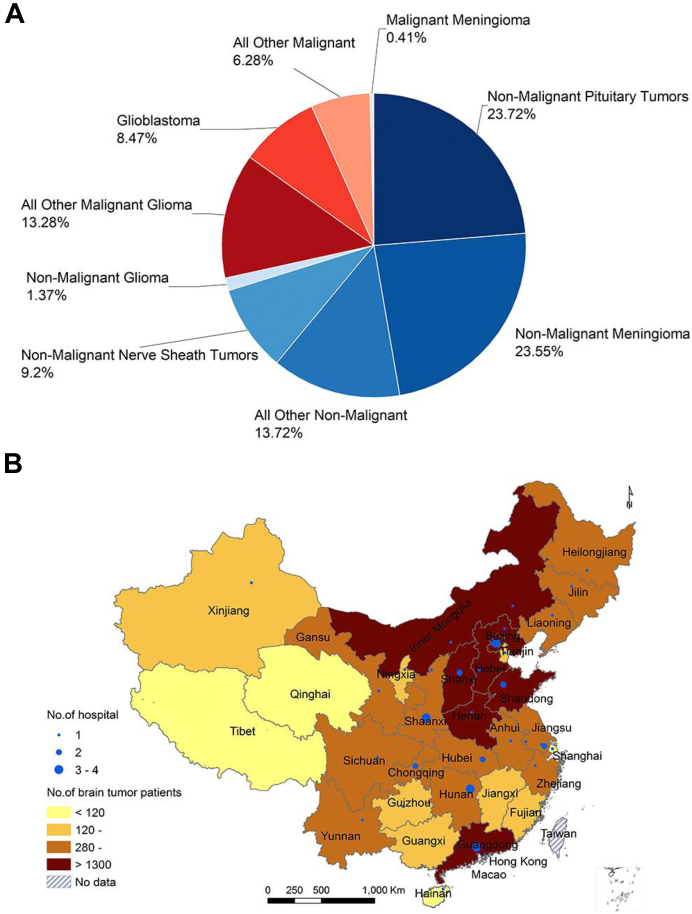
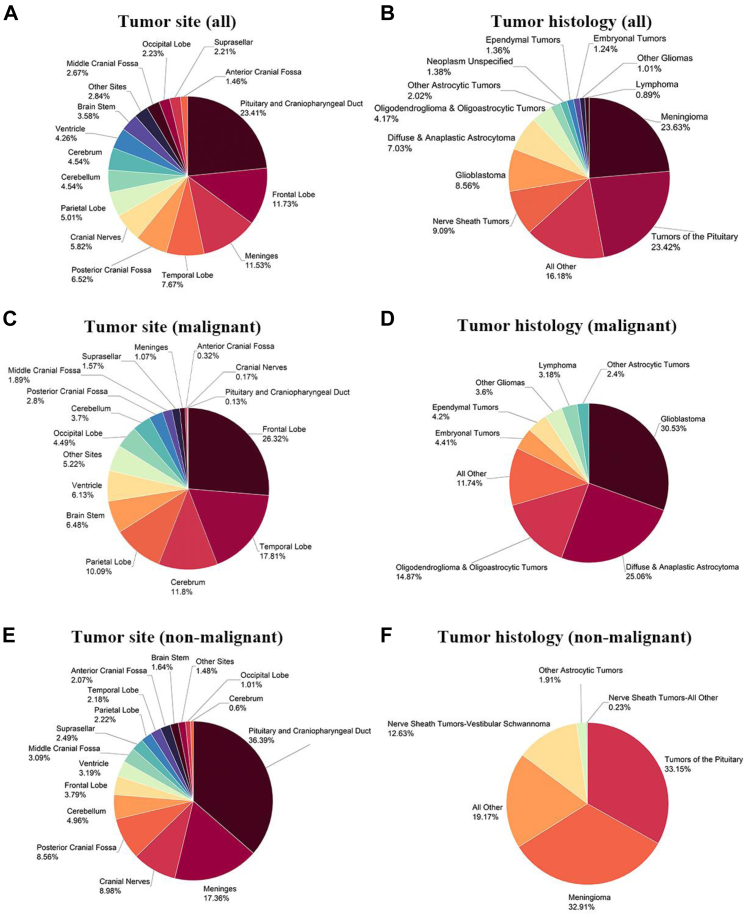
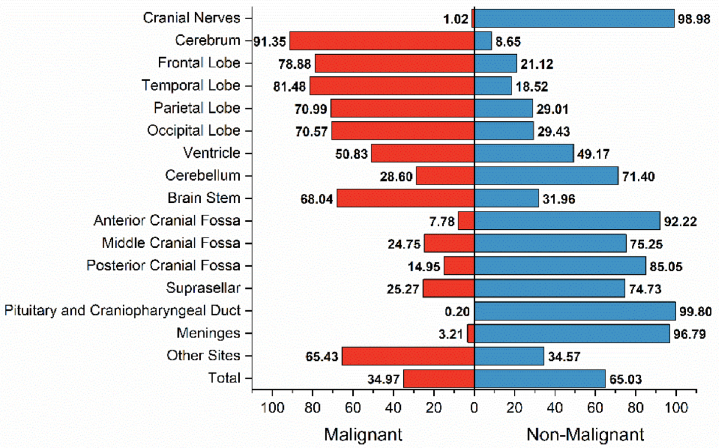
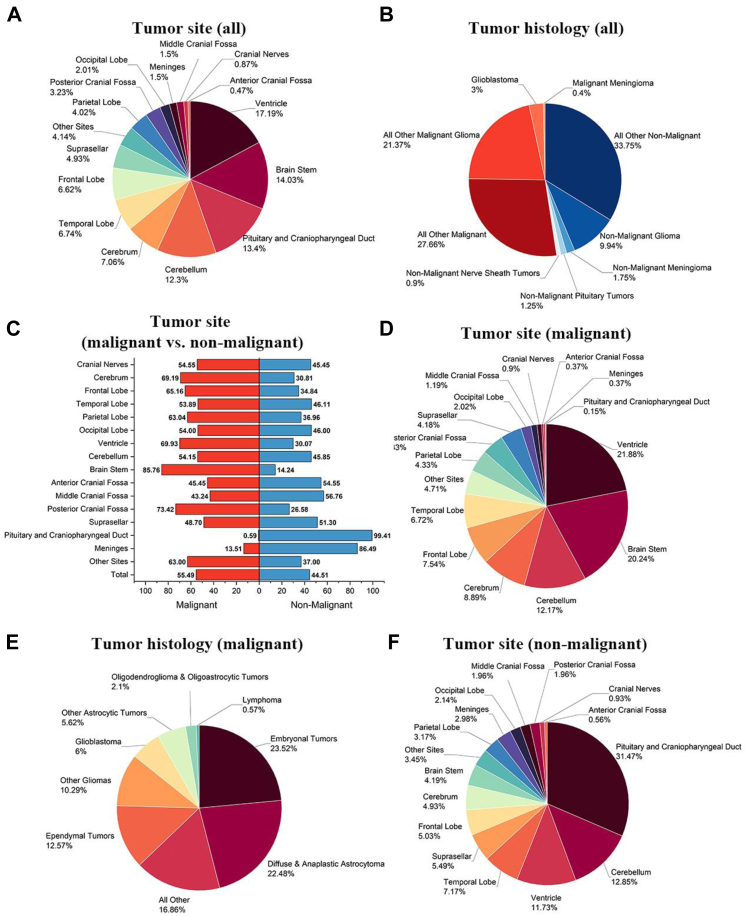
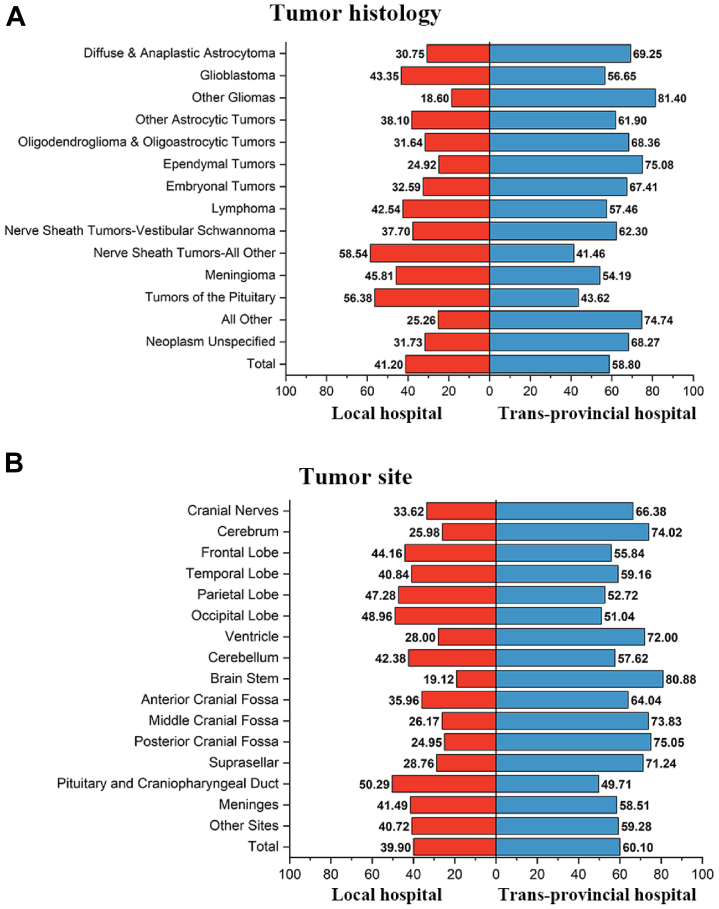
Findings: There were a total of 25,537 brain tumours, foremost among them meningioma (23.63%), followed by tumours of the pituitary (23.42%), and nerve sheath tumours (9.09%). Glioblastoma, the most common and lethal form of primary brain cancer in adults, represented 8.56% of all cases. Of note, 6.48% of the malignant tumours were located in the brain stem. The percentage of malignant brain tumours decreased with increasing age, 24.08% in adults (40+ years), 30.25% in young adults (20-39 years), 35.27% in adolescents (15-19 years), and 49.83% in children (0-14 years). Among the 2107 paediatric patients, the most common sites were ventricle (17.19%), brainstem (14.03%), pituitary and craniopharyngeal duct (13.4%), and cerebellum (12.3%), a distribution that differed from that of the entire cohort. The histology distribution was also unique in children, with glioblastoma much less incident compared to the whole cohort (3% vs. 8.47%, p < 0.01). 58.80% of all patients chose higher-level neurosurgical hospitals outside of their province of residence. The median in-hospital length of stay (LOS) for the various pathologies ranged from 11 to 19 days.
Interpretation: The histological and anatomical site distribution of brain tumours in the NBTRC was statistically different in the subgroup of children (0-14 years). Patient choice of pursuing trans-provincial treatment was common and the in-hospital LOS was longer compared to that reported in similar European and American patient populations, which merits further attention.
Funding: The National Key Research and Development Program of China (2015BAI12B04, 2013BAI09B03, 2014BAI04B01, and 2021YFF1201104) and Chinese National Natural Science Foundation of China (81971668).
Keywords: Brain tumor; China; Distribution; Registry.
© 2023 Published by Elsevier Ltd.
Conflict of interest statement
CP reports grants from American Association for Cancer Research (AACR), grants from The Robert and Janice McNair Foundation, grants from the University of Texas MD Anderson Cancer Centre SPORE Program, grants, personal fees and non-financial support from Novocure Ltd., outside of the submitted work. In addition, CP has a patent using alternating electric fields to increase cell membrane permeability (us PATENT 11103698 B2) issued, and a patent Methods of Normalizing Aberrant Glycolytic Metabolism in Cancer Cells (US patent application US 2021 0199640 A1) with royalties paid and Foreign Senior Advisor of the National Brain Tumor Registry of China (NBTRC). The NBTRC is an initiative sponsored by the China National Clinical Research Center for Neurologic Diseases with the support of the Chinese government. This is an unpaid advisory role in which CP provides guidance on the development of the platform. Deling Li reports a patent issued entitled with novel method for data integration and classification, related to this work and was developed during the NBTRC platform construction. The rest of the authors declare no competing interests.
Figures
References
-
- Zeng H., Chen W., Zheng R., et al. Changing cancer survival in China during 2003-15: a pooled analysis of 17 population-based cancer registries. Lancet Glob Health. 2018;6(5):e555–e567. - PubMed
LinkOut - more resources
Full Text Sources
