


Survival Status and Predictors of Mortality Among Patients Admitted to Pediatric Intensive Care Unit at Selected Tertiary Care Hospitals in Ethiopia: A Prospective Observational Study
- PMID: 37284002
- PMCID: PMC10240865
- DOI: 10.1177/11795565231169498
Survival Status and Predictors of Mortality Among Patients Admitted to Pediatric Intensive Care Unit at Selected Tertiary Care Hospitals in Ethiopia: A Prospective Observational Study
Abstract
Background: Advances in pediatric intensive care have dramatically improved the prognosis for critically ill patients. The study aimed to determine the survival status and predictors of mortality among patients admitted to the pediatric intensive care unit at selected tertiary care hospitals in Ethiopia.
Methods: A health facility-based prospective observational study from October 2020 to May 30, 2021, was conducted in a selected tertiary care hospital in Ethiopia. Kaplan Meier was used to compare patient survival experiences and Cox regression was used to identify independent predictors of ICU mortality. The hazard ratio was used as a measure of the strength of the association, and a P-value of <.05 was considered to declare statistical significance.
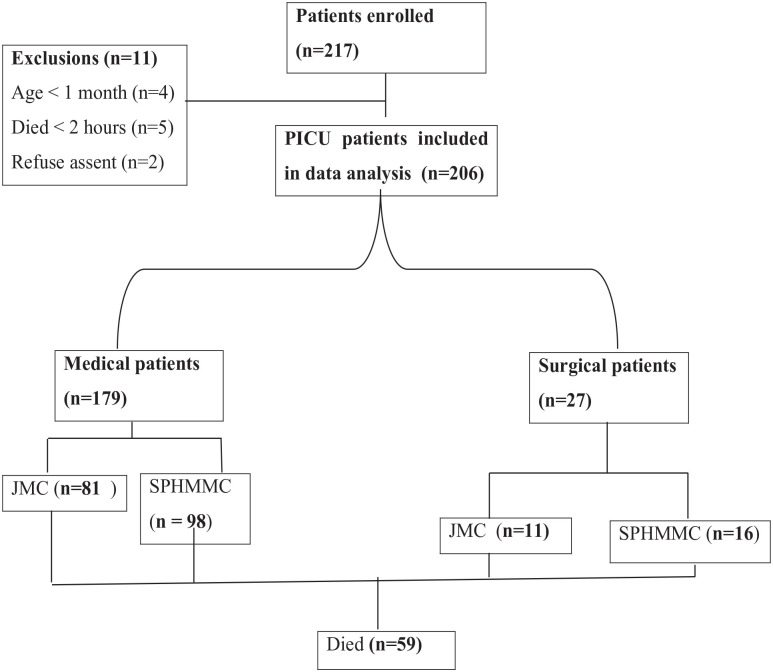
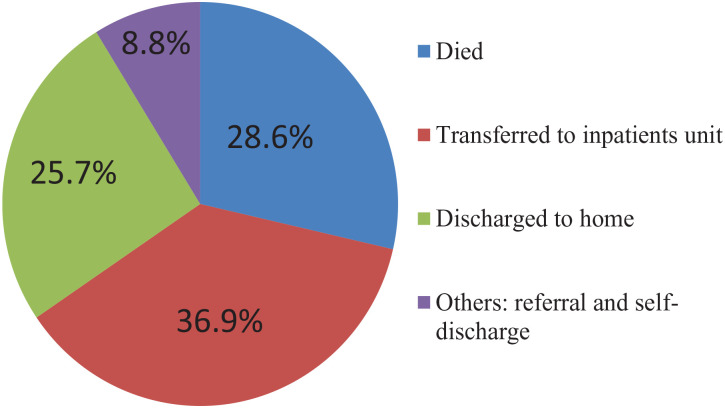
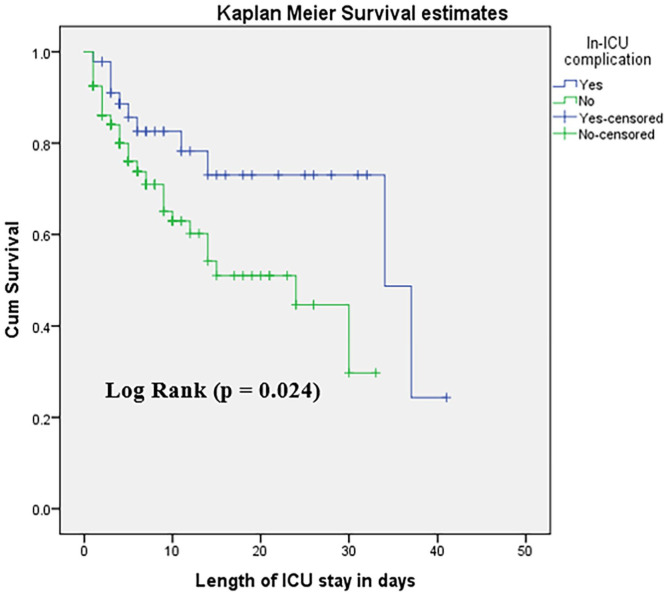
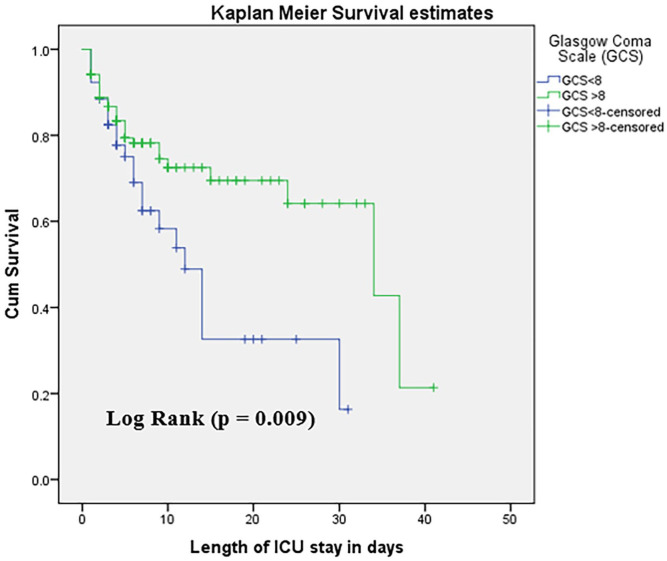
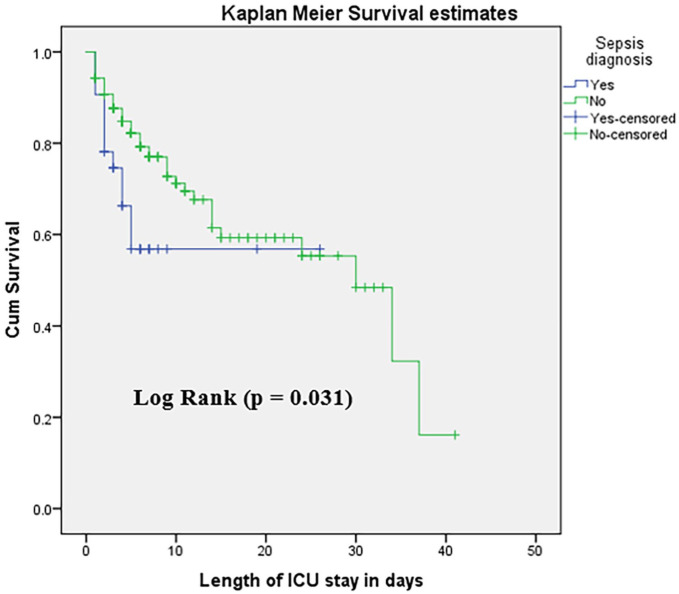
Results: Of 206 study participants, 59 (28.6%) patients died during follow-up time, and the incidence of mortality was 3.6 deaths per 100 person-day observation (95% CI: 2.04-5.04 deaths per 100 person-days). Respiratory failure 19 (32.2%) was the commonest cause of death followed by septic shock 11(18.6). In-ICU complications (AHR: 2.13; 95% CI: 1.02, 4.42; P = .04), sepsis diagnosis (AHR: 2.43; 95% CI: 1.24, 4.78; P = .01), GCS < 8 (AHR: 1.96; 95% CI: 1.12, 3.43; P = .02), use of sedative drugs (AHR: 2.40; 95% CI: 1.16, 4.95; P = .02) were linked with increased risk of in-ICU mortality. In contrast, the use of mechanical ventilation was associated with decreased mortality (AHR: 0.45; 95% CI: 0.21, 0.92; P = .03).
Conclusion: The study found a high incidence of in-ICU mortality among admitted pediatric patients in selected Ethiopian tertiary care hospitals. In-ICU complications, sepsis diagnosis, GCS < 8, and patient use of sedative drugs were independent predictors of in-ICU mortality. Prudent follow-up is warranted for those patients with the aforementioned risk factors.
Keywords: Ethiopia; Survival status; pediatric intensive care unit; predictors of mortality.
© The Author(s) 2023.
Conflict of interest statement
The authors declare that they have no competing interests.
Figures
References
-
- Marshall JC, Bosco L, Adhikari NK, et al. What is an intensive care unit? A report of the task force of the World Federation of Societies of intensive and Critical Care Medicine. J Crit Care. 2017;37:270-276. - PubMed
-
- Klieg R.M., GEME J. S.Overview of pediatrics. Nelson Textbook of Pediatrics. 21st ed. Elsevier Saunders; 2020:1-9.
-
- Ezbakhe F, Pérez-Foguet A.Child mortality levels and trends. Demogr Res. 2020;43:1263-1296.
-
- Vincent J-L, Marshall JC, Namendys-Silva SA, et al. Assessment of the worldwide burden of critical illness: the intensive care over nations (ICON) audit. Lancet Respir Med. 2014;2:380-386. - PubMed
-
- Riviello ED, Letchford S, Achieng L, Newton MW.Critical care in resource-poor settings: lessons learned and future directions. Crit Care Med. 2011;39:860-867. - PubMed
LinkOut - more resources
Full Text Sources
