Dynamic Patterns and Persistence of Anticoagulation Therapy in Patients with Venous Thromboembolism in South Korea: A Nationwide Cohort Study
- PMID: 37285903
- PMCID: PMC10824586
- DOI: 10.1055/a-2107-0815
Dynamic Patterns and Persistence of Anticoagulation Therapy in Patients with Venous Thromboembolism in South Korea: A Nationwide Cohort Study
Abstract
Background: Venous thromboembolism (VTE) is associated with increased morbidity, mortality, and health care expenditure. However, the comprehensive utilization of anticoagulation therapy in patients with VTE, especially regarding active cancer, in real-world practice remains unclear.
Objective: To describe the prescription, persistence, and patterns of anticoagulation therapy among patients with VTE stratified according to active cancer.
Methods: Using Korean nationwide claims data, we identified an incident, treatment-naïve cohort of patients with VTE from 2013 to 2019 and classified them according to the presence/absence of active cancer. We explored the secular trends, treatment patterns (e.g., discontinuation, interruption, and switch), and persistence of anticoagulation therapy.
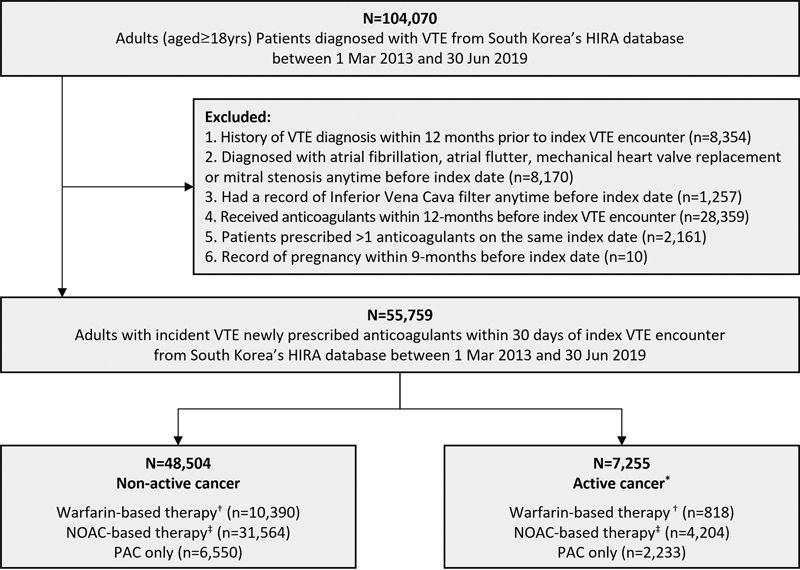
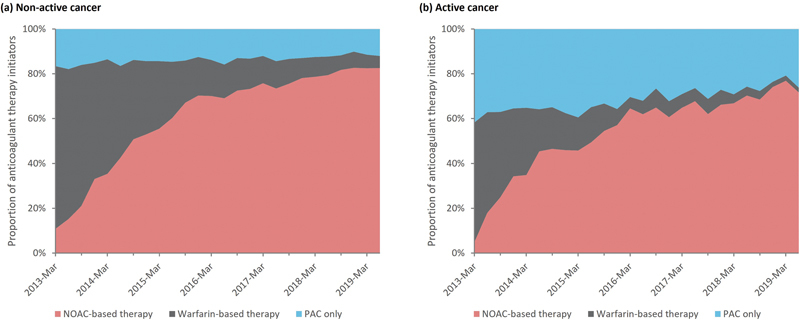
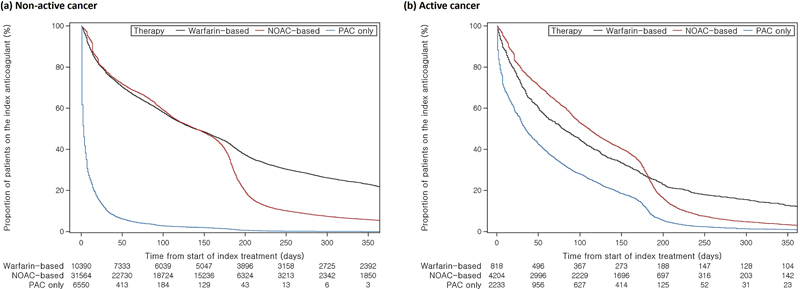
Results: There were 48,504 and 7,255 patients without and with active cancer, respectively. Non-vitamin K antagonist oral anticoagulants (NOACs) were the most common anticoagulant in both groups (65.1 and 57.9%, respectively). The prescription of NOACs increased steeply over time, regardless of active cancer, whereas parenteral anticoagulants (PACs) plateaued and warfarin decreased sharply. A heterogeneous pattern was observed between the groups without and with active cancer (3-month persistence was 60.8, 62.9, 57.2, and 3.4%, respectively; 6-month persistence was 42.3, 33.5, 25.9, and 1.2% vs. 9.9%). Median durations of continuous anticoagulant therapy for warfarin, NOAC, and PAC were 183, 147, and 3 days in nonactive cancer patients, and 121, 117, and 44 days in active cancer patients.
Conclusion: Our findings suggest that there were substantial differences in persistence, patterns, and patient characteristics of anticoagulant therapy based on index anticoagulant and active cancer.
The Author(s). This is an open access article published by Thieme under the terms of the Creative Commons Attribution-NonDerivative-NonCommercial License, permitting copying and reproduction so long as the original work is given appropriate credit. Contents may not be used for commercial purposes, or adapted, remixed, transformed or built upon. (https://creativecommons.org/licenses/by-nc-nd/4.0/).
Conflict of interest statement
The authors J.-Y. S. and S.-M.B. received honoraria as speakers and/or consultants from Pfizer and Bristol Myers Squibb. S.C. is a previous employee of Pfizer Korea.
Figures
Comment in
- Patterns and Persistence of Anticoagulant Use in the Treatment of Venous Thromboembolism: Insights from South Korea doi: 10.1055/a-2131-7066
References
-
- Di Nisio M, van Es N, Büller H R.Deep vein thrombosis and pulmonary embolism Lancet 2016388(10063):3060–3073. - PubMed
-
- Lee L H, Gallus A, Jindal R, Wang C, Wu C C. Incidence of venous thromboembolism in asian populations: a systematic review. Thromb Haemost. 2017;117(12):2243–2260. - PubMed
-
- Venous Thromboembolism Research Group of Korean Society of Echocardiography . Kim H Y, Chang S A, Kim K H et al. Epidemiology of venous thromboembolism and treatment pattern of oral anticoagulation in Korea, 2009-2016: a nationwide study based on the national health insurance service database. J Cardiovasc Imaging. 2021;29(03):265–278. - PMC - PubMed
-
- EINSTEIN Investigators . Bauersachs R, Berkowitz S D, Brenner B et al. Oral rivaroxaban for symptomatic venous thromboembolism. N Engl J Med. 2010;363(26):2499–2510. - PubMed
-
- AMPLIFY Investigators . Agnelli G, Buller H R, Cohen A et al. Oral apixaban for the treatment of acute venous thromboembolism. N Engl J Med. 2013;369(09):799–808. - PubMed