. 2023 Nov 13;4(6):100634.
doi: 10.1016/j.xplc.2023.100634. Epub 2023 Jun 7.

The plant cytosolic m6A RNA methylome stabilizes photosynthesis in the cold

Affiliations

The plant cytosolic m6A RNA methylome stabilizes photosynthesis in the cold

Alexandre Magno Vicente et al. Plant Commun. .

Abstract

The sessile lifestyle of plants requires an immediate response to environmental stressors that affect photosynthesis, growth, and crop yield. Here, we showed that three abiotic perturbations-heat, cold, and high light-triggered considerable changes in the expression signatures of 42 epitranscriptomic factors (writers, erasers, and readers) with putative chloroplast-associated functions that formed clusters of commonly expressed genes in Arabidopsis. The expression changes under all conditions were reversible upon deacclimation, identifying epitranscriptomic players as modulators in acclimation processes. Chloroplast dysfunctions, particularly those induced by the oxidative stress-inducing norflurazon in a largely GENOME UNCOUPLED-independent manner, triggered retrograde signals to remodel chloroplast-associated epitranscriptomic expression patterns. N6-methyladenosine (m6A) is known as the most prevalent RNA modification and impacts numerous developmental and physiological functions in living organisms. During cold treatment, expression of components of the primary nuclear m6A methyltransferase complex was upregulated, accompanied by a significant increase in cellular m6A mRNA marks. In the cold, the presence of FIP37, a core component of the writer complex, played an important role in positive regulation of thylakoid structure, photosynthetic functions, and accumulation of photosystem I, the Cytb6f complex, cyclic electron transport proteins, and Curvature Thylakoid1 but not that of photosystem II components and the chloroplast ATP synthase. Downregulation of FIP37 affected abundance, polysomal loading, and translation of cytosolic transcripts related to photosynthesis in the cold, suggesting m6A-dependent translational regulation of chloroplast functions. In summary, we identified multifaceted roles of the cellular m6A RNA methylome in coping with cold; these were predominantly associated with chloroplasts and served to stabilize photosynthesis.

Keywords: Arabidopsis thaliana; RNA methylation; chloroplast; cold acclimation; m(6)A; photosynthesis; stress response.


Figures

Figure 1
Figure 1
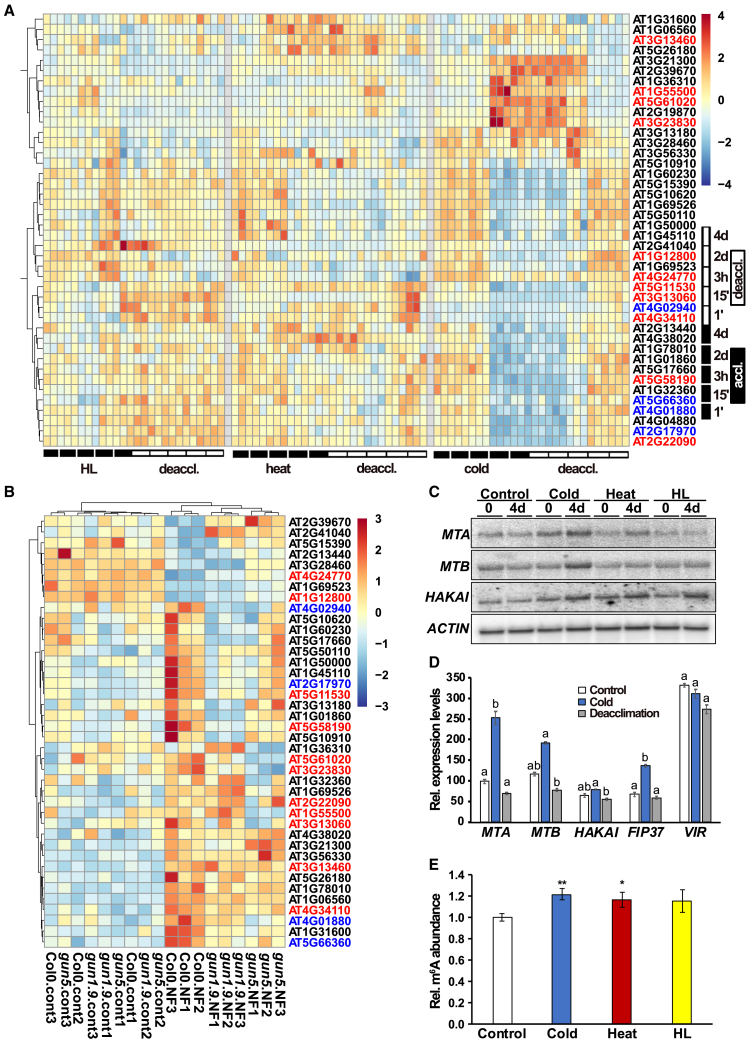
Changes in transcript levels of writers, erasers, and readers during acclimation to high light, heat, and cold followed by deacclimation. (A and B) Heatmaps with hierarchical clustering of transcript values for chloroplast-associated epitranscriptomic players (writers, erasers, and readers in black, blue, and red, respectively) were elaborated according to the Ward d2 method using (A) z-means of plants (de)acclimated to high light, heat, and cold treatments for 4 days as reported recently (Garcia-Molina et al., 2020) or (B)Z scores of normalized 5-day-old WT (Col0), genome uncoupled (gun)1-9, and gun5 mutant seedlings under control or norflurazon treatment as reported by Koussevitzky et al. (2007). (C) RNA gel blot analysis of selected genes of the m6A writer complex in the WT before and after 4 days of cold, heat, and high light treatment using 8 μg leaf RNA. An actin probe was used as the loading control. (D) Reversibility of upregulation of genes encoding m6A writer components during deacclimation, as revealed by RNA sequencing analysis. Bar plots depict means ± standard deviation for normalized counts of selected transcripts in pretreated, cold-treated, and deacclimated plants at day 4. Statistical significance was tested by one-way ANOVA with post hoc Tukey’s honestly significant difference (HSD) test (p ≤ 0.05). (E) Quantification of m6A marks in poly(A)-enriched RNA samples using LC–MS. m6A abundance was normalized to that of the control for each sample (n = 5), and statistical significance among treatments was determined using one-way ANOVA and Tukey’s HSD post hoc test (∗p ≤ 0.05; ∗∗p ≤ 0.01). Normalization to the control was performed for each sample.
Figure 2
Figure 2
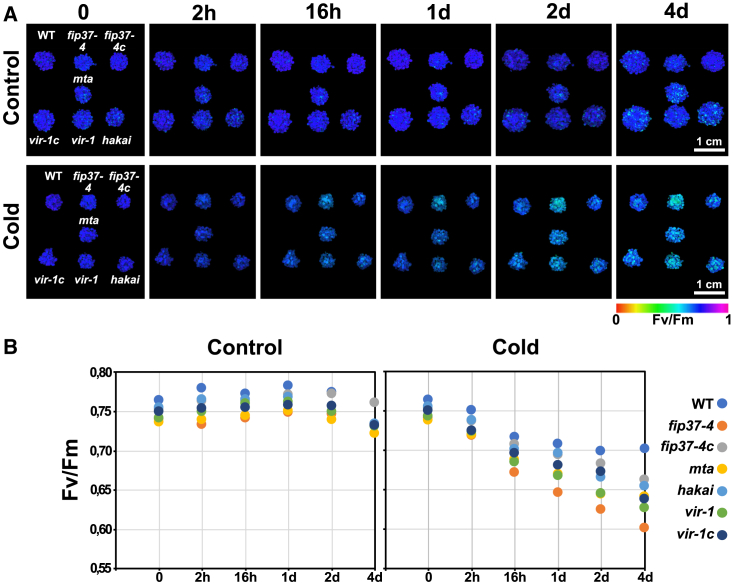
Photosynthetic performance of m6A writer complex mutants is negatively affected by cold treatment. (A) Imaging of Fv/Fm values for the WT, knockdowns (fip37-4, mta, vir-1, hakai), and corresponding complemented lines (fip37-4c, vir-1c) grown for 10 days on medium. Scale bar: 1 cm. (B) Fv/Fm data were collected at several time points of cold treatment as indicated. The corresponding numeric Fv/Fm values reflect the cold sensitivity of the writer mutants.
Figure 3
Figure 3
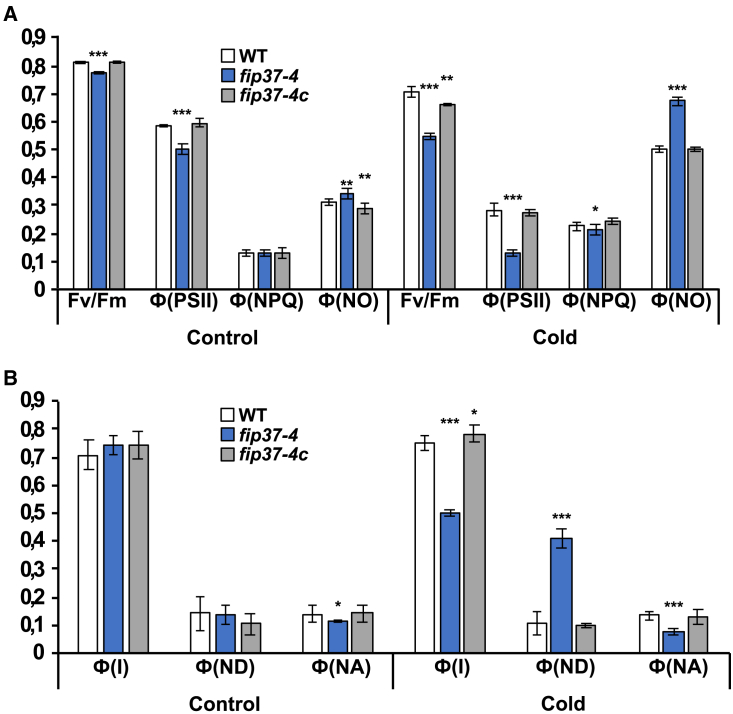
Cold-induced photosynthetic deficiency in fip37-4. (A) The photosynthetic parameters Fv/Fm, Φ(II), Φ(NPQ), and Φ(NO) were calculated from plants grown in soil for 14 days under standard conditions and then subjected to 4 days of cold treatment. (B) PSI parameters Φ(I), Φ(ND), and Φ(NA) were calculated from plants grown as described in (A). Statistically significant differences compared with the control condition were assessed using Student’s t-tests in (A) and (B) (∗p ≤ 0.05; ∗∗p ≤ 0.01; ∗∗∗p ≤ 0.001).
Figure 4
Figure 4
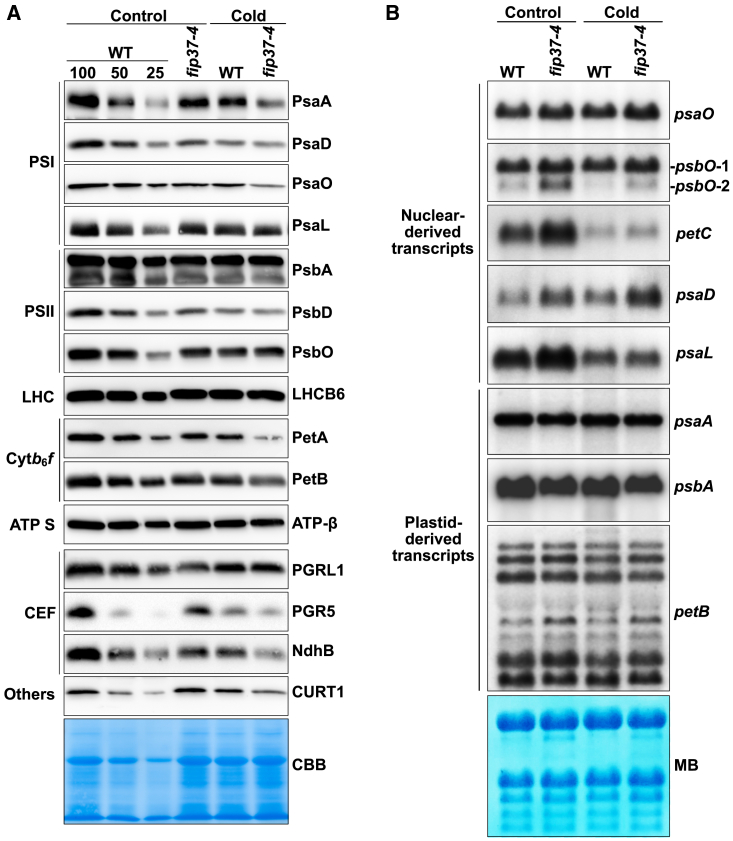
Accumulation of photosynthetic proteins and RNAs in FIP37-deficient plants. (A) Steady-state levels of representative subunits of photosynthetic complexes. Immunoblot analyses were performed with plants grown for 10 days under standard conditions and an additional 4 days under cold conditions. Coomassie brilliant blue staining served as a loading control. ATP S, ATP synthase. (B) RNA gel blot analysis of plastid- and nuclear-derived transcripts encoding chloroplast proteins in WT and fip37-4 under control and cold conditions. 3 μg total RNA was loaded. Methylene blue was used as a loading control.
Figure 5
Figure 5
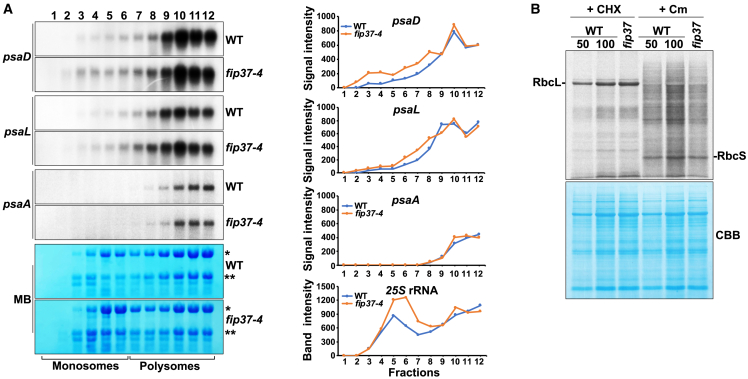
Polysome loading and in vivo radiolabeling of cytoplasmic and chloroplast proteins. (A) Separation of intact polysomes fractionated by ultracentrifugation. Fractions were stained with methylene blue. Monosomal and polysomal fractions are indicated. Isolated RNA was denatured and subjected to gel blot analysis using psaA, psaD, and psaL probes. The signal intensity of the fractions is represented graphically on the right side. MB, methylene blue. (B) Cytoplasmic and chloroplast proteins were freshly radiolabeled in the presence of chloramphenicol or cycloheximide, respectively. In vivo labeled proteins were subjected to SDS–PAGE. RbcL and RbcS bands are indicated in the chloroplast and cytosolic labels, respectively. Asterisks show the cytoplasmic 25S (∗) and the 18S (∗∗) rRNAs. Coomassie brilliant blue staining was used as a loading control. CHX, cycloheximide; Cm, chloramphenicol.
Figure 6
Figure 6
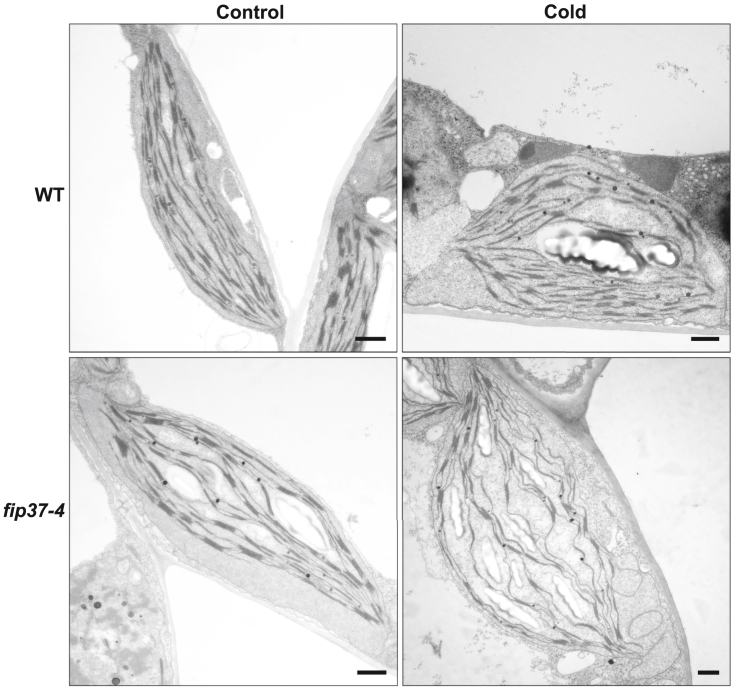
Chloroplast ultrastructure of WT and fip37-4 grown under standard and cold conditions. Representative transmission electron micrographs of WT and fip37-4 chloroplasts. Plants were cultivated on Murashige and Skoog medium for 10 days under standard conditions and then placed in the cold for 4 days. Scale bar: 1 μm.
Figure 7
Figure 7
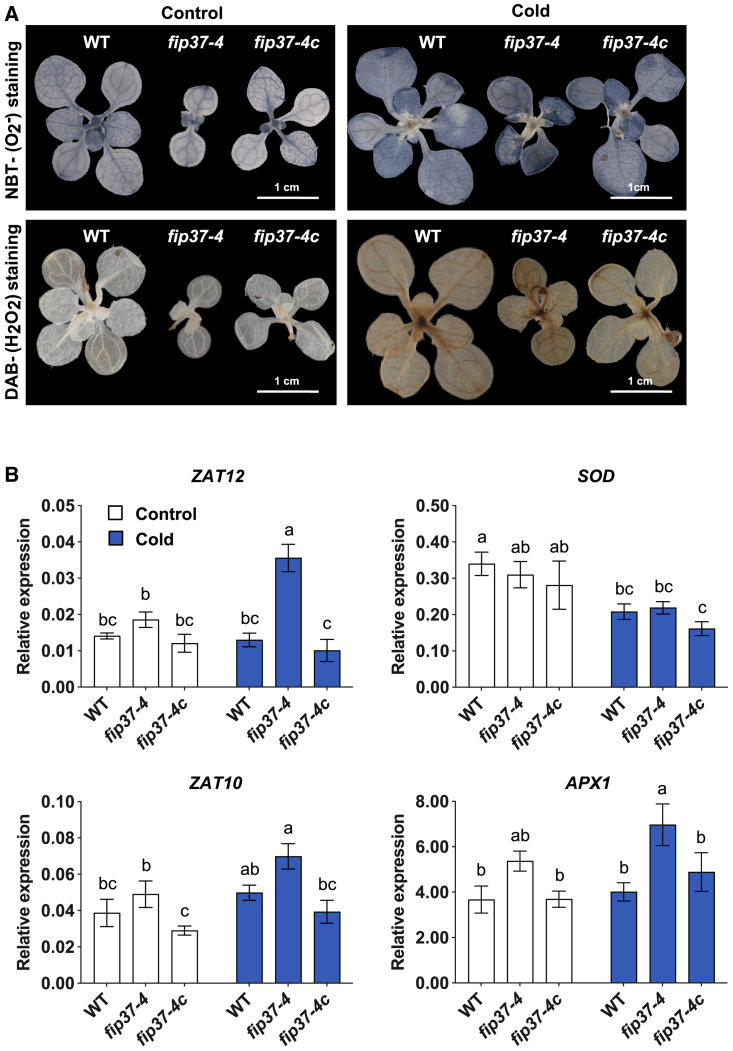
Cold treatment leads to increased accumulation of ROS in fip37-4. (A) NBT and DAB staining of plants before or after 4 days of cold treatment. NBT staining is indicative of superoxide (O2) production and DAB staining of H2O2 production. Scale bar: 1 cm. (B) Expression of ROS-related genes (ZAT12, ZAT10, SOD1, and APX1) analyzed by qRT–PCR. Bars denote the means of 3 independent biological replicates with the corresponding standard deviations. Different letters within individual titles represent significant differences between tested temperatures (22°C and 4°C) and genotypes (WT, fip37-4, and fip37-4c) according to two-way ANOVA with post hoc Tukey’s HSD (p ≤ 0.05).

References

    1. Anderson S., Kramer M., Gosai S., Yu X., Vandivier L., Nelson A., Anderson Z., Beilstein M., Fray R., Lyons E., et al. N6-Methyladenosine inhibits local ribonucleolytic cleavage to stabilize mRNAs in arabidopsis. Cell Rep. 2018;25:1146–1157. doi: 10.1016/j.celrep.2018.10.020. - DOI - PubMed
    1. Armbruster U., Labs M., Pribil M., Viola S., Xu W., Scharfenberg M., Hertle A., Rojahn U., Jensen P., Rappaport F., et al. Arabidopsis CURVATURE THYLAKOID1 proteins modify thylakoid architecture by inducing membrane curvature. Plant Cell. 2013;25:2661–2678. doi: 10.1105/tpc.113.113118. - DOI - PMC - PubMed
    1. Boccaletto P., Machnicka M.A., Purta E., Piątkowski P., Bagiński B., Wirecki T.K., de Crécy-Lagard V., Ross R., Limbach P.A., Kotter A., et al. Modomics: a database of RNA modification pathways. Nucleic Acids Research. 2021;46:303–307. doi: 10.1093/nar/gkab1083. - DOI - PMC - PubMed
    1. Chinnusamy V., Zhu J., Zhu J.-K. Cold stress regulation of gene expression in plants. Trends Plant Sci. 2007;12:444–451. doi: 10.1016/j.tplants.2007.07.002. - DOI - PubMed
    1. Choi H.L., Seo J.W., Hwang M.H., Yu C.Y., Seong E.S. A cold stress-responsive gene, provides resistance to environmental stress in T2-generation transgenic plants. Transgenic Res. 2022;31:381–389. doi: 10.1007/s11248-022-00307-9. - DOI - PubMed

Publication types

LinkOut - more resources