


Impact of the built, social, and food environment on long-term weight loss within a behavioral weight loss intervention
- PMID: 37287525
- PMCID: PMC10242259
- DOI: 10.1002/osp4.645
Impact of the built, social, and food environment on long-term weight loss within a behavioral weight loss intervention
Abstract
Background: Behavioral weight loss interventions can lead to an average weight loss of 5%-10% of initial body weight, however there is wide individual variability in treatment response. Although built, social, and community food environments can have potential direct and indirect influences on body weight (through their influence on physical activity and energy intake), these environmental factors are rarely considered as predictors of variation in weight loss.
Objective: Evaluate the association between built, social, and community food environments and changes in weight, moderate-to-vigorous physical activity (MVPA), and dietary intake among adults who completed an 18-month behavioral weight loss intervention.
Methods: Participants included 93 adults (mean ± SD; 41.5 ± 8.3 years, 34.4 ± 4.2 kg/m2, 82% female, 75% white). Environmental variables included urbanicity, walkability, crime, Neighborhood Deprivation Index (includes 13 social economic status factors), and density of convenience stores, grocery stores, and limited-service restaurants at the tract level. Linear regressions examined associations between environment and changes in body weight, waist circumference (WC), MVPA (SenseWear device), and dietary intake (3-day diet records) from baseline to 18 months.
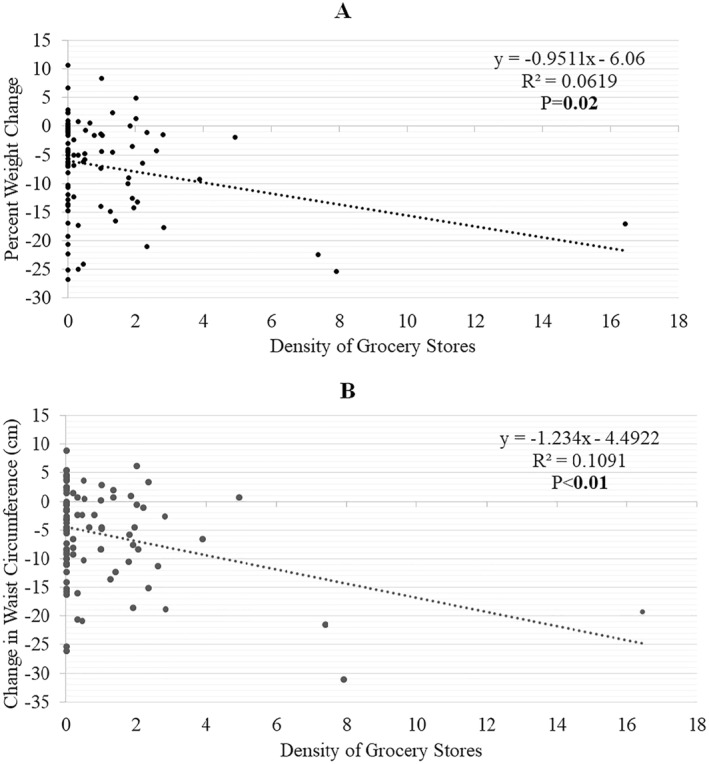
Results: Grocery store density was inversely associated with change in weight (β = -0.95; p = 0.02; R 2 = 0.062) and WC (β = -1.23; p < 0.01; R 2 = 0.109). Participants living in tracts with lower walkability demonstrated lower baseline MVPA and greater increases in MVPA versus participants with higher walkability (interaction p = 0.03). Participants living in tracts with the most deprivation demonstrated greater increases in average daily steps (β = 2048.27; p = 0.02; R 2 = 0.039) versus participants with the least deprivation. Limited-service restaurant density was associated with change in % protein intake (β = 0.39; p = 0.046; R 2 = 0.051).
Conclusion: Environmental factors accounted for some of the variability (<11%) in response to a behavioral weight loss intervention. Grocery store density was positively associated with weight loss at 18 months. Additional studies and/or pooled analyses, encompassing greater environmental variation, are required to further evaluate whether environment contributes to weight loss variability.
Keywords: environmental factors; lifestyle modifications; obesity treatment; socio economic deprivation; weight maintenance.
© 2022 The Authors. Obesity Science & Practice published by World Obesity and The Obesity Society and John Wiley & Sons Ltd.
Conflict of interest statement
The authors declare no conflicts of interest.
Figures

References
-
- Tewahade S, Li K, Goldstein RB, Haynie D, Iannotti RJ, Simons‐Morton B. Association between the built environment and active transportation among U.S. Adolescents. J Transport Health. 2019;15:100629. Epub 2020/08/31. 10.1016/j.jth.2019.100629. PubMed PMID: 32864336; PubMed Central PMCID: PMCPMC7448751. - DOI - PMC - PubMed
Grants and funding
LinkOut - more resources
Full Text Sources