


Child Neuropsychological Functioning and Interpersonal Callousness as Predictors of Externalising Behaviour in Early Adolescence: A Prospective Population-based Study
- PMID: 37289329
- PMCID: PMC10543790
- DOI: 10.1007/s10802-023-01091-8
Child Neuropsychological Functioning and Interpersonal Callousness as Predictors of Externalising Behaviour in Early Adolescence: A Prospective Population-based Study
Abstract
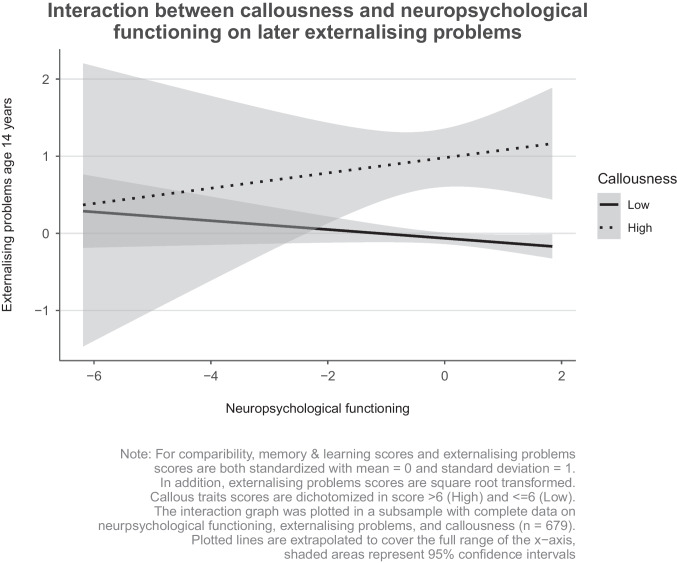
Externalizing problems are a key predictor of individual functioning in adulthood. Therefore, identifying possible risk factors for externalising problems is valuable for optimising prevention and treatment programmes. Previous research has shown that (domains of) neuropsychological functioning predict externalising problems later in life. However, the influence of callous traits, and sex as potential moderators in this relation remains unclear. The aim of this study was to examine associations between neuropsychological functioning in children (at age 8 years) and later externalising behaviour in adolescence (at age 14 years), as well as to test the role of callous traits (at age 10 years) and sex as moderating factors. The analyses were conducted using data from 661 Dutch children from the population-based Generation R Study (47.2% female). We found no association between neuropsychological functioning and later externalising behaviour. However, callous traits predicted externalising problems at age 14 years. Further, callous traits moderated the association between neuropsychological functioning and externalising behaviour, though this association dropped below the statistical significance level when adjusted for confounders. Specifically, while higher neuropsychological functioning was associated with more externalising behaviour in children with high callous traits, lower neuropsychological functioning was not associated with externalising behaviour in children with low callous traits. Although boys showed significantly higher externalising behaviours compared to girls, no moderating effect of sex was found on the association between neuropsychological functioning and externalising behaviour. These results add to a growing body of evidence supporting a distinct neurocognitive profile in children with high vs low callousness.
Keywords: Aggression; Callous traits; Externalizing; Moderator; Neuropsychological functioning.
© 2023. The Author(s).
Conflict of interest statement
All authors certify that they have no affiliations with or involvement in any organization or entity with any financial interest or non-financial interest in the subject matter or materials discussed in this manuscript.
Figures
References
-
- Achenbach TM. Manual for child behavior checklist/4–18 and 1991 profile. University of Vermont, Department of Psychiatry; 1991.
-
- Achenbach TM, Rescorla LA. Manual for the ASEBA preschool forms & profiles. University of Vermont, Research Center for Children, Youth, & Families; 2000.
-
- Achenbach TM, Rescorla LA. Manual for the ASEBA school-age forms & profiles. University of Vermont, Research Center for Children, Youth, & Families; 2001.
-
- American Psychiatric Association . Diagnostic and statistical manual of mental disorders. 5. Arlington, VA: American Psychiatric Association; 2013.
MeSH terms
LinkOut - more resources
Full Text Sources
Medical