Comparing Risk for Second Primary Cancers After Intensity-Modulated vs 3-Dimensional Conformal Radiation Therapy for Prostate Cancer, 2002-2015
- PMID: 37289449
- PMCID: PMC10251240
- DOI: 10.1001/jamaoncol.2023.1638
Comparing Risk for Second Primary Cancers After Intensity-Modulated vs 3-Dimensional Conformal Radiation Therapy for Prostate Cancer, 2002-2015
Abstract
Importance: Compared with 3-dimensional conformal radiotherapy (3DCRT), intensity-modulated radiotherapy (IMRT) can spare nearby tissue but may result in increased scatter radiation to distant normal tissue, including red bone marrow. It is unclear whether second primary cancer risk varies by radiotherapy type.
Objective: To evaluate whether radiotherapy type (IMRT vs 3DCRT) is associated with second primary cancer risk among older men treated for prostate cancer.
Design, setting, and participants: In this retrospective cohort study of a linked database of Medicare claims and Surveillance, Epidemiology, and End Results (SEER) Program population-based cancer registries (2002-2015), male patients aged 66 to 84 diagnosed with a first primary nonmetastatic prostate cancer from 2002 to 2013, as reported to SEER, and who received radiotherapy (IMRT and/or 3DCRT without proton therapy) within the first year following prostate cancer were identified. The data were analyzed from January 2022 through June 2022.
Exposure: Receipt of IMRT and 3DCRT, based on Medicare claims.
Main outcomes and measures: The association between radiotherapy type and development of a subsequent hematologic cancer at least 2 years after prostate cancer diagnosis or a subsequent solid cancer at least 5 years after prostate cancer diagnosis. Hazard ratios (HRs) and 95% CIs were estimated using multivariable Cox proportional regression.
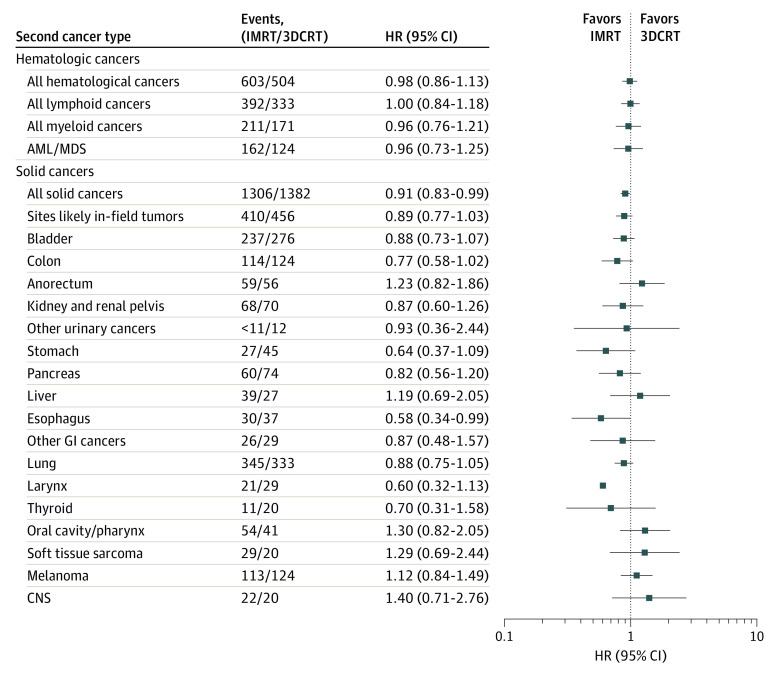
Results: The study included 65 235 2-year first primary prostate cancer survivors (median [range] age, 72 [66-82] years; 82.2% White patients) and 45 811 5-year survivors with similar demographic characteristics (median [range] age, 72 [66-79] years; 82.4% White patients). Among 2-year prostate cancer survivors (median [range] follow-up, 4.6 [0.003-12.0] years), 1107 second hematologic cancers were diagnosed (IMRT, 603; 3DCRT, 504). Radiotherapy type was not associated with second hematologic cancers overall or any specific types evaluated. Among 5-year survivors (median [range] follow-up, 3.1 [0.003-9.0] years), 2688 men were diagnosed with a second primary solid cancer (IMRT, 1306; 3DCRT, 1382). The overall HR for IMRT vs 3DCRT was 0.91 (95% CI, 0.83-0.99). This inverse association was restricted to the earlier calendar year period of prostate cancer diagnosis (HR2002-2005 = 0.85; 95% CI, 0.76-0.94; HR2006-2010 = 1.14; 95% CI, 0.96-1.36), with a similar pattern observed for colon cancer (HR2002-2005 = 0.66; 95% CI, 0.46-0.94; HR2006-2010 = 1.06; 95% CI, 0.59-1.88).
Conclusions and relevance: The results of this large, population-based cohort study suggest that IMRT for prostate cancer is not associated with an increased risk of second primary cancers, either solid or hematologic, and any inverse associations may be associated with calendar year of treatment.
Conflict of interest statement
Figures
References
-
- Berrington de Gonzalez A, Bouville A, Rajaraman P. Ionizing Radiation. In: Thun M, Linet MS, Cerhan JR, Haiman CA, Schottenfeld D, eds. Cancer Epidemiology and Prevention. Oxford University Press; 2018.
Publication types
MeSH terms
Grants and funding
LinkOut - more resources
Full Text Sources
Medical