. 2023 Jun 8;13(1):9341.
doi: 10.1038/s41598-023-36523-4.

RNA activation in ticks

Affiliations

RNA activation in ticks

Kofi Dadzie Kwofie et al. Sci Rep. .

Abstract

RNA activation (RNAa) is a burgeoning area of research in which double-stranded RNAs (dsRNAs) or small activating RNAs mediate the upregulation of specific genes by targeting the promoter sequence and/or AU-rich elements in the 3'- untranslated region (3'-UTR) of mRNA molecules. So far, studies on the phenomenon have been limited to mammals, plants, bacteria, Caenorhabditis elegans, and recently, Aedes aegypti. However, it is yet to be applied in other arthropods, including ticks, despite the ubiquitous presence of argonaute 2 protein, which is an indispensable requirement for the formation of RNA-induced transcriptional activation complex to enable a dsRNA-mediated gene activation. In this study, we demonstrated for the first time the possible presence of RNAa phenomenon in the tick vector, Haemaphysalis longicornis (Asian longhorned tick). We targeted the 3'-UTR of a novel endochitinase-like gene (HlemCHT) identified previously in H. longicornis eggs for dsRNA-mediated gene activation. Our results showed an increased gene expression in eggs of H. longicornis endochitinase-dsRNA-injected (dsHlemCHT) ticks on day-13 post-oviposition. Furthermore, we observed that eggs of dsHlemCHT ticks exhibited relatively early egg development and hatching, suggesting a dsRNA-mediated activation of the HlemCHT gene in the eggs. This is the first attempt to provide evidence of RNAa in ticks. Although further studies are required to elucidate the detailed mechanism by which RNAa occurs in ticks, the outcome of this study provides new opportunities for the use of RNAa as a gene overexpression tool in future studies on tick biology, to reduce the global burden of ticks and tick-borne diseases.


Conflict of interest statement

The authors declare no competing interests.

Figures
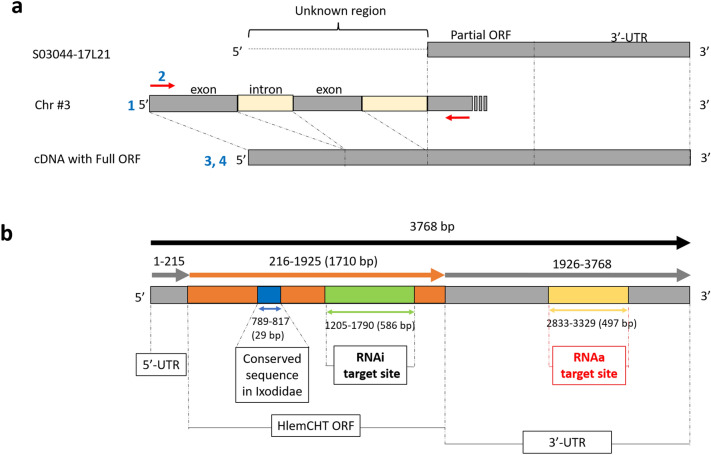
Figure 1
Figure 1
Full-length ORF of HlemCHT cDNA. (a) Strategy for obtaining full-length ORF of HlemCHT. (1) Predicted exons and introns on the upstream sequence of the putative endochitinase-like gene (S03044-17L21 identified in the cDNA library, namely, HlemCHT) were retrieved from Chromosome 3 (Chr #3) after a nucleotide BLAST search of a partial ORF sequence against both local and NCBI nr databases of Haemaphysalis longicornis genome. (2) Forward and reverse primers (Red arrows) were designed to target sequences before the predicted starting methionine, and sequences at about 150 bp downstream from the end of the partial ORF fragment respectively. (3) Amplified cDNA was sequenced after cloning into a vector. (4) Assembly of newly sequenced 5ʹ-cDNA fragment and already existing cDNA fragment into a contig sequence was done using CAP3 Sequence Assembly Program to obtain the full-length ORF. (b) HlemCHT gene structure showing the positions the RNAi target site (Green) within the full-length ORF (Orange) and the RNAa target site (Yellow) at the 3′-UTR. Also, within the ORF is a conserved sequence (Blue) in other ixodid tick species’ endochitinase-like genes.
Figure 2
Figure 2
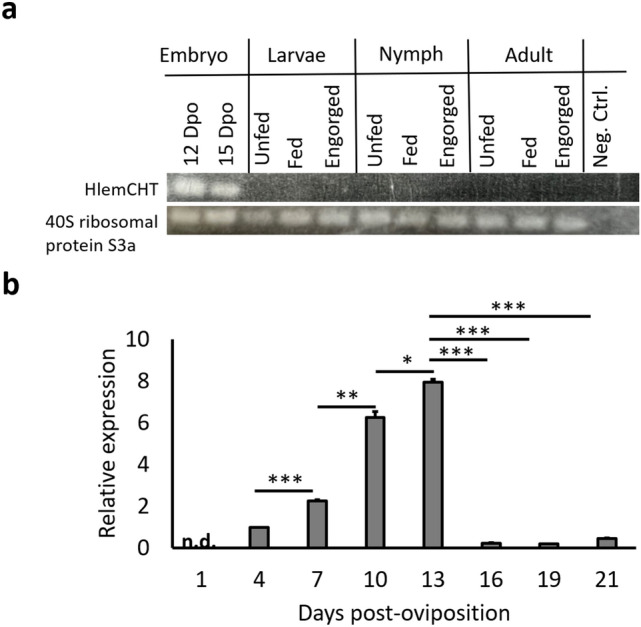
Normal expression of HlemCHT in H. longicornis. (a) RT-PCR analysis of HlemCHT in different developmental stages of H. longicornis. Analysis was performed using total RNA from eggs (12 and 15 Dpo), the whole body of larvae (unfed, partially fed, engorged), nymph (unfed, partially fed, engorged), and adult (unfed, partially fed, engorged). H. longicornis 40S ribosomal protein S3a was used as an internal control. PCR products were analysed on 1.5% agarose gel and stained with ethidium bromide for viewing. Original gels are presented in Supplementary Fig. S1. (b) RT-qPCR analysis of HlemCHT during embryogenesis of tick eggs. The expression of each mRNA was normalized to the expression of 40S ribosomal protein S3a measured in same RNA preparation. The relative expression values are represented as “means ± SD”. Error bars represent the SEM of 4 replicates. *Indicates a difference at P < 0.05; **designates P < 0.005; ***designates P < 0.001. The results shown are from a single experiment and are representative of three independent experiments. n.d. not determined.
Figure 3
Figure 3
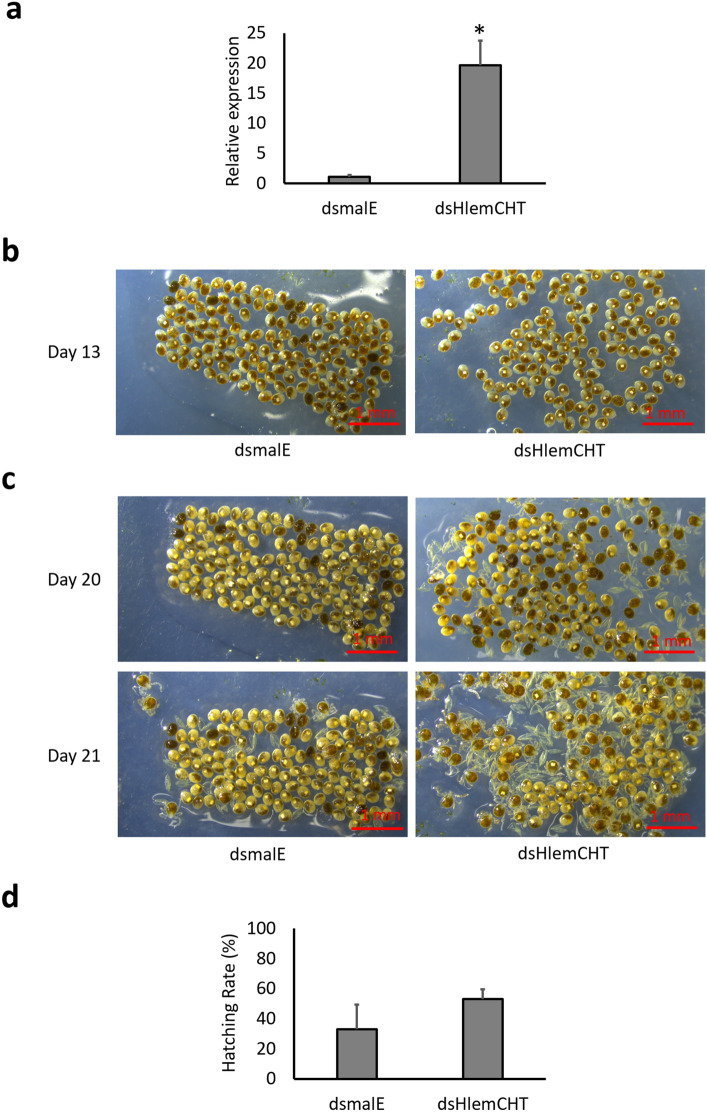
Confirmation of HlemCHT activation by dsRNA targeting the 3ʹ-UTR. (a) Relative gene expression of HlemCHT at 13 days post-oviposition (dpo). Data is represented by a histogram. Relative expression of the H. longicornis 40S ribosomal gene was used to normalize the HlemCHT gene expression data. Error bars represent the SEM of 4 replicates. *P = 0.0145. (b) Representative stereomicroscopic images of dsRNA-derived eggs at 13 dpo. (c) Representative stereomicroscopic images of dsRNA-derived eggs hatching at 20 and 21 dpo. (d) Histogram showing the comparison of the hatching rate of dsHlemCHT-derived eggs, as against eggs of dsEc-malE at 21 dpo. Error bars represent the SEM of 4 replicates. The results shown are from a single experiment and are representative of three independent experiments.
Figure 4
Figure 4
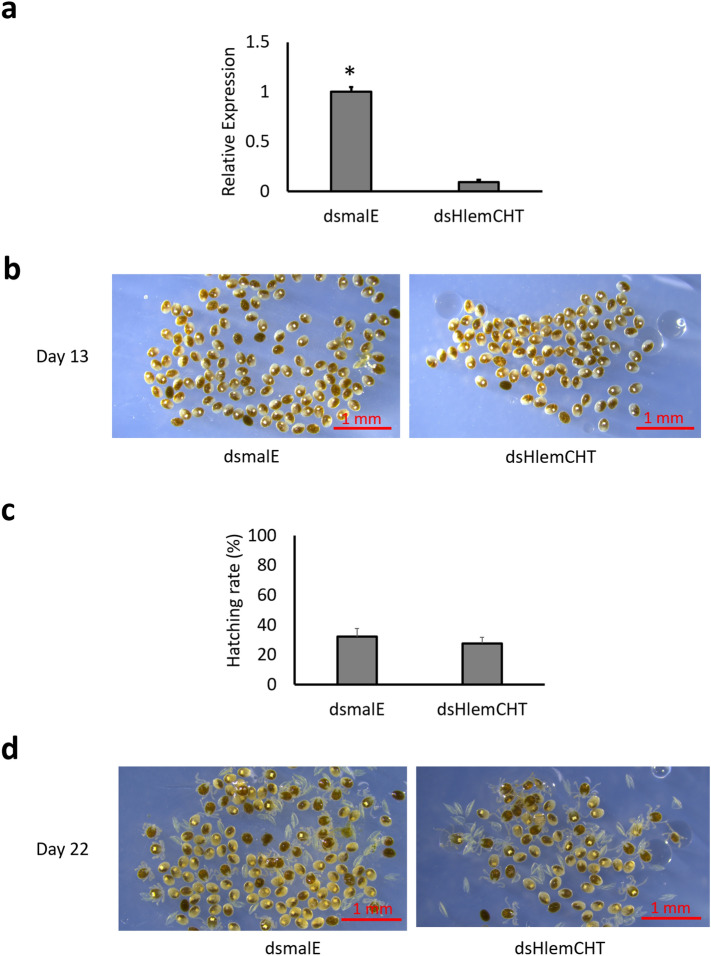
Confirmation of HlemCHT suppression by dsRNA targeting the ORF. (a) Relative gene expression of HlemCHT at 13 days post-oviposition (dpo). Data is represented by a histogram. Relative expression of the H. longicornis 40S ribosomal gene S3a was used to normalize the HlemCHT gene expression data. Error bars represent the SEM of 4 replicates. *P = 0.0001. (b) Representative stereomicroscopic images of dsRNA-injected tick eggs at 13 dpo. (c) Histogram showing the comparison of the hatching rate of dsHlemCHT-derived eggs, as against eggs of dsEc-malE at 22 dpo. Error bars represent the SEM of 4 replicates (d) Representative stereomicroscopic images of dsRNA-derived eggs hatching at 22 dpo. The results shown are from a single experiment and are representative of three independent experiments.

References

    1. Zhao, X. Y., Voutila, J., Habib, N. A. & Reebye, V. RNA Activation. Innov. Med. 241–249. 10.1007/978-4-431-55651-0_20 (2015). - PubMed
    1. Fröhlich KS, Vogel J. Activation of gene expression by small RNA. Curr. Opin. Microbiol. 2009;12:674–682. doi: 10.1016/j.mib.2009.09.009. - DOI - PubMed
    1. Jiao AL, Slack FJ. RNA-mediated gene activation. Epigenetics. 2014;9:27–36. doi: 10.4161/epi.26942. - DOI - PMC - PubMed
    1. Vaschetto LM. RNA activation: A diamond in the rough for genome engineers. J. Cell. Biochem. 2018;119:247–249. doi: 10.1002/jcb.26228. - DOI - PubMed
    1. Zotti M, et al. RNA interference technology in crop protection against arthropod pests, pathogens and nematodes. Pest. Manag. Sci. 2018;74:1239–1250. doi: 10.1002/ps.4813. - DOI - PubMed

Publication types