


Comparison of bacterial profiles in human milk from mothers of term and preterm infants
- PMID: 37291566
- PMCID: PMC10248331
- DOI: 10.1186/s13006-023-00563-3
Comparison of bacterial profiles in human milk from mothers of term and preterm infants
Abstract
Background: Reducing the disposal of donated human milk (HM) is important for efficient management of human milk banks (HMBs). The presence of bacteria growth is the main factor that contributes to the disposal of donated HM. The bacterial profile in HM is suspected to differ between term and preterm mothers, with HM from preterm mothers containing more bacteria. Thus, elucidation of the causes of bacterial growth in preterm and term HM may help to reduce the disposal of donated preterm HM. This study compared the bacterial profiles of HM between mothers of term infants and mothers of preterm infants.
Methods: This pilot study was conducted in the first Japanese HMB, which was initiated in 2017. This study analyzed 214 human milk samples (term: 75, preterm: 139) donated by 47 registered donors (term: 31, preterm: 16) from January to November 2021. Bacterial culture results in term and preterm HM were retrospectively reviewed in May 2022. Differences in total bacterial count and bacterial species count per batch were analyzed using the Mann-Whitney U test. Bacterial loads were analyzed using the Chi-square test or Fisher's exact test.
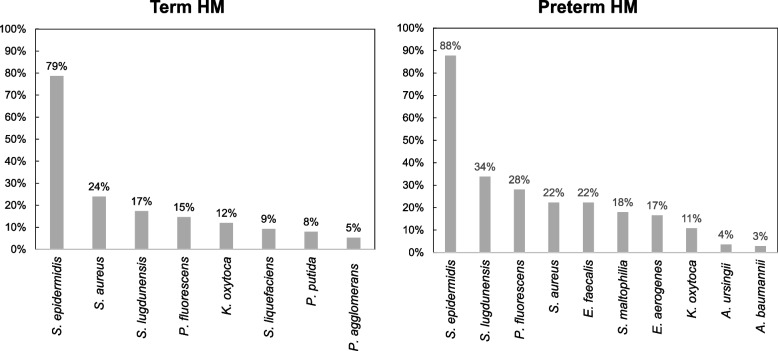
Results: The disposal rate did not significantly differ between term and preterm groups (p = 0.77), but the total amount of disposal was greater in the preterm group (p < 0.01). Coagulase-negative Staphylococci, Staphylococcus aureus, and Pseudomonas fluorescens were frequently found in both types of HM. Serratia liquefaciens (p < 0.001) and two other bacteria were present in term HM; a total of five types of bacteria, including Enterococcus faecalis and Enterobacter aerogenes (p < 0.001) were present in preterm HM. The median (interquartile range) total bacterial counts were 3,930 (435-23,365) colony-forming units (CFU)/mL for term HM and 26,700 (4,050-334,650) CFU/mL for preterm HM (p < 0.001).
Conclusions: This study revealed that HM from preterm mothers had a higher total bacterial count and different types of bacteria than HM from term mothers. Additionally, preterm infants can receive nosocomial-infection-causing bacteria in the NICU through their mother's milk. Enhanced hygiene instructions for preterm mothers may reduce the disposal of valuable preterm human milk, along with the risk of HM pathogen transmission to infants in NICUs.
Keywords: Bacteriological test; Donor milk; Human milk; Human milk microbiota; Neonatal intensive care unit.
© 2023. The Author(s).
Conflict of interest statement
The authors declare no competing interests.
Figures
Similar articles
-
Three Years of Human Milk Banking: Assessing the Impact on Lactation Rates at Discharge in VLBW Preterm Infants in an Italian Reference NICU.Nutrients. 2025 Apr 25;17(9):1440. doi: 10.3390/nu17091440. Nutrients. 2025. PMID: 40362750 Free PMC article.
-
Evidence-Based Methods That Promote Human Milk Feeding of Preterm Infants: An Expert Review.Clin Perinatol. 2017 Mar;44(1):1-22. doi: 10.1016/j.clp.2016.11.005. Epub 2016 Dec 27. Clin Perinatol. 2017. PMID: 28159199 Free PMC article. Review.
-
[Levels of human milk oligosaccharides in breast milk of mothers delivering preterm infants of different gestational ages and their effects on early growth and development].Zhonghua Yu Fang Yi Xue Za Zhi. 2021 Sep 6;55(9):1067-1076. doi: 10.3760/cma.j.cn112150-20210513-00468. Zhonghua Yu Fang Yi Xue Za Zhi. 2021. PMID: 34619923 Chinese.
-
A Pilot Study on Donor Human Milk Microbiota: A Comparison with Preterm Human Milk Microbiota and the Effect of Pasteurization.Nutrients. 2022 Jun 15;14(12):2483. doi: 10.3390/nu14122483. Nutrients. 2022. PMID: 35745213 Free PMC article.
-
Benefits of donor milk in the feeding of preterm infants.Early Hum Dev. 2013 Oct;89 Suppl 2:S3-6. doi: 10.1016/j.earlhumdev.2013.07.008. Epub 2013 Aug 6. Early Hum Dev. 2013. PMID: 23932110 Review.
Cited by
-
Validation of a Real-Time PCR Assay for Fully Automated Detection of Bacillus cereus in Donor Human Milk.Microorganisms. 2025 Jul 11;13(7):1640. doi: 10.3390/microorganisms13071640. Microorganisms. 2025. PMID: 40732149 Free PMC article.
-
Human Milk Microbiome from Polish Women Giving Birth via Vaginal Delivery-Pilot Study.Biology (Basel). 2025 Mar 25;14(4):332. doi: 10.3390/biology14040332. Biology (Basel). 2025. PMID: 40282197 Free PMC article.
-
Residents or Tourists: Is the Lactating Mammary Gland Colonized by Residential Microbiota?Microorganisms. 2024 May 17;12(5):1009. doi: 10.3390/microorganisms12051009. Microorganisms. 2024. PMID: 38792838 Free PMC article. Review.
References
-
- Llanos MA, Mena NP, Uauy DR. Tendencias actuales en la nutrición del recién nacido prematuro. Rev Chil Pediatr. 2004;75(2):107–121. doi: 10.4067/S0370-41062004000200002. - DOI
MeSH terms
LinkOut - more resources
Full Text Sources
Medical
