Review
. 2023 Mar-Apr;27(2):107-114.
doi: 10.4103/ijem.ijem_458_22. Epub 2023 Apr 14.

Diabetic Foot Ulcer in India: Aetiological Trends and Bacterial Diversity

Affiliations
Review

Diabetic Foot Ulcer in India: Aetiological Trends and Bacterial Diversity

Dipak S Kale et al. Indian J Endocrinol Metab. 2023 Mar-Apr.

Abstract

Diabetes is one of the most prevalent epidemic metabolic disorders, responsible for a significant amount of physical, psychological and economic loss in human society. Diabetic foot ulcer (DFU) is one of the extreme pathophysiological consequences of diabetes. Bacterial infection is the most important cause of chronic DFU. Bacterial species or their biofilms show multidrug resistance, which complicates DFU and consequently leads to amputation of the infected part. Since the Indian population comprises diverse ethnic and cultural groups, this could influence the aetiology of diabetic foot infections and bacterial diversity. We reviewed 56 articles published from 2005 to 2022 on the microbiology of DFU and extracted the data on study location, number of patients analysed in the study, pathophysiological complications, age of the patients, sex of the patient, type of bacteria, type of infection (mono or polymicrobial), predominant bacteria (Gram-positive or Gram-negative), predominant isolates and multiple drug resistance (tested or not). We analysed data and described aetiological trends in diabetic foot infections and bacterial diversity. The study revealed that Gram-negative bacteria are predominant as compared to Gram-positive bacteria in individuals with diabetes with DFU in India. Escherichia coli, Pseudomonas aeruginosa, Klebsiella sp. and Proteus sp. were the most predominant Gram-negative bacteria, while Staphylococcus aureus and Enterococcus sp. were the major Gram-positive bacteria in DFU. We discuss bacterial infections in DFU in the context of bacterial diversity, sampling methods, demography and aetiology.

Keywords: Bacterial diversity; Gram-negative bacteria; aetiology; diabetic foot ulcer; epidemiology.


Conflict of interest statement

There are no conflicts of interest.

Figures
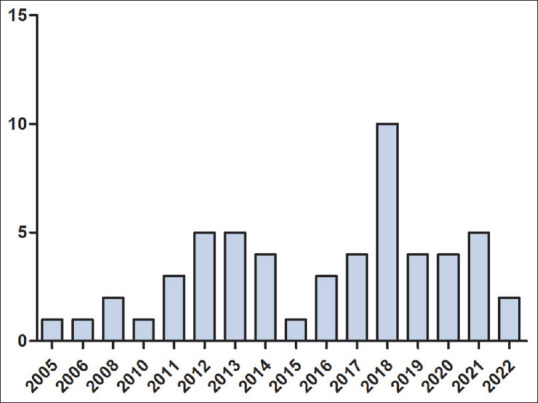
Figure 1
Figure 1
The chronological (year-wise) trend in the number of studies (total 56 studies)
Figure 2
Figure 2
Relative region-wise studies on the microbiology of diabetic foot ulcers in India. SI: South India, NI: North India, WI: West India, EI: East India and N-EI: North-East India
Figure 3
Figure 3
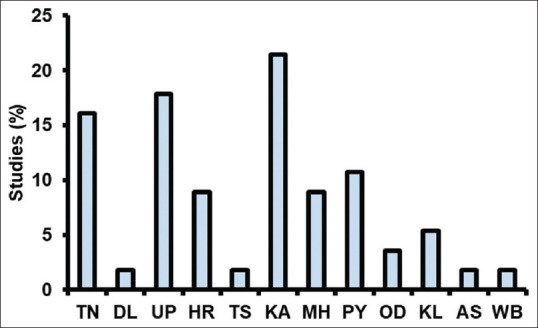
State-wise studies (%) on microbiology of diabetic foot ulcers in India. TN: Tamil Nadu, DL: Delhi, UP: Uttar Pradesh, HR: Haryana, TS: Telangana, KA: Karnataka, MH: Maharashtra, PY: Pondicherry, OD: Odisha, KL: Kerala and AS: Assam
Figure 4
Figure 4
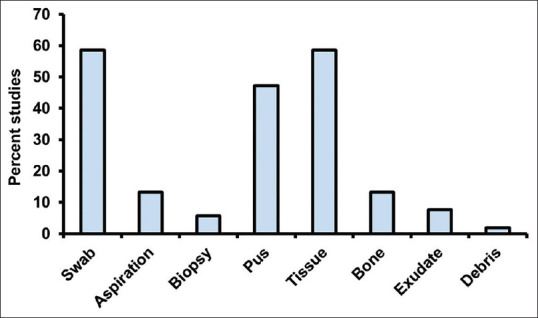
Methods employed for bacterial sampling from diabetic foot ulcers in a total of 53 studies
Figure 5
Figure 5
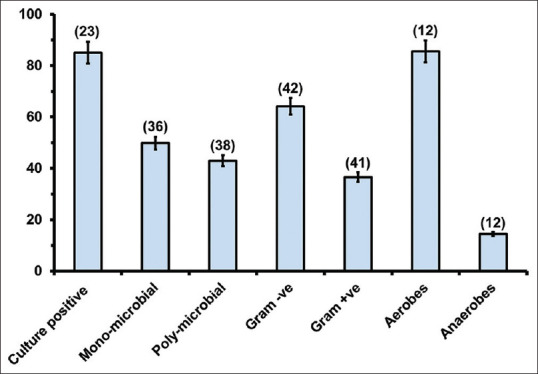
The proportion (mean ± SE) of the number of cases with bacterial infection, mono-microbial infections, polymicrobial infections, Gram-positive and Gram-negative isolates, aerobic and anaerobic isolates. Numbers in parenthesis indicate the number of studies considered for the respective analysis
Figure 6
Figure 6
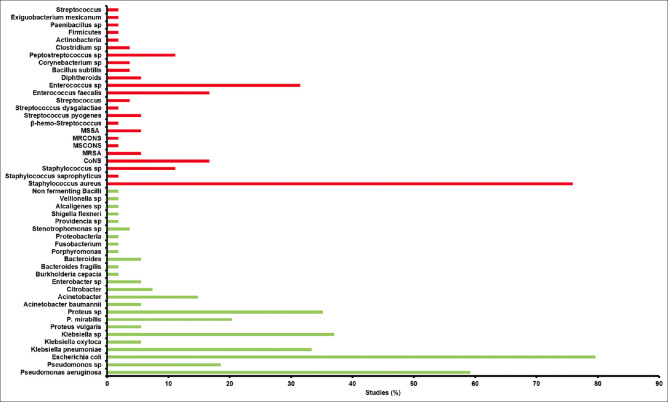
Predominant isolates reported in a total 54 studies. Predominant isolates are considered those with more than 5% of the total isolates in individual studies. The graph represents the number of studies (%) in which a particular bacterium was predominantly isolated. MRSA: methicillin-resistant Staphylococcus aureus, CoNS: coagulase-negative Staphylococcus, MSCONS: methicillin-sensitive coagulase-negative staphylococci, MRCONS: methicillin-resistant coagulase-negative staphylococci, MSSA: methicillin-susceptible Staphylococcus aureus

References

    1. Pradeepa R, Mohan V. Epidemiology of type 2 diabetes in India. Indian J Ophthalmol. 2021;69:2932–8. - PMC - PubMed
    1. Reed J, Bain S, Kanamarlapudi V. A review of current trends with type 2 diabetes epidemiology, aetiology, pathogenesis, treatments and future perspectives. Diabetes Metab Syndr Obes. 2021;14:3567–602. - PMC - PubMed
    1. Sun H, Saeedi P, Karuranga S, Pinkepank M, Ogurtsova K, Duncan BB, et al. IDF Diabetes Atlas:Global, regional and country-level diabetes prevalence estimates for 2021 and projections for 2045. Diabetes Res Clin Pract. 2022;183:109119. - PMC - PubMed
    1. Tinajero MG, Malik VS. An update on the epidemiology of type 2 diabetes. Endocrinol Metab Clin North Am. 2021;50:337–55. - PubMed
    1. Grunfeld C. Diabetic foot ulcers:Etiology, treatment, and prevention. Adv Intern Med. 1992;37:103–32. - PubMed