


This is a preprint.
Immersive scene representation in human visual cortex with ultra-wide angle neuroimaging
- PMID: 37292806
- PMCID: PMC10245572
- DOI: 10.1101/2023.05.14.540275
Immersive scene representation in human visual cortex with ultra-wide angle neuroimaging
Update in
-
Immersive scene representation in human visual cortex with ultra-wide-angle neuroimaging.Nat Commun. 2024 Jun 28;15(1):5477. doi: 10.1038/s41467-024-49669-0. Nat Commun. 2024. PMID: 38942766 Free PMC article.
Abstract
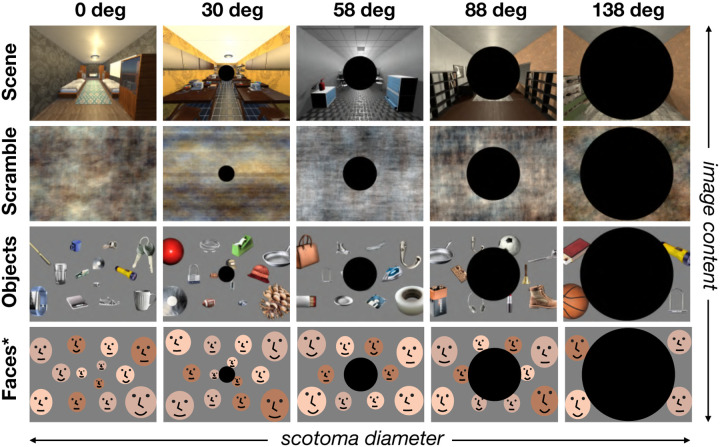
While humans experience the visual environment in a panoramic 220° view, traditional functional MRI setups are limited to display images like postcards in the central 10-15° of the visual field. Thus, it remains unknown how a scene is represented in the brain when perceived across the full visual field. Here, we developed a novel method for ultra-wide angle visual presentation and probed for signatures of immersive scene representation. To accomplish this, we bounced the projected image off angled-mirrors directly onto a custom-built curved screen, creating an unobstructed view of 175°. Scene images were created from custom-built virtual environments with a compatible wide field-of-view to avoid perceptual distortion. We found that immersive scene representation drives medial cortex with far-peripheral preferences, but surprisingly had little effect on classic scene regions. That is, scene regions showed relatively minimal modulation over dramatic changes of visual size. Further, we found that scene and face-selective regions maintain their content preferences even under conditions of central scotoma, when only the extreme far-peripheral visual field is stimulated. These results highlight that not all far-peripheral information is automatically integrated into the computations of scene regions, and that there are routes to high-level visual areas that do not require direct stimulation of the central visual field. Broadly, this work provides new clarifying evidence on content vs. peripheral preferences in scene representation, and opens new neuroimaging research avenues to understand immersive visual representation.
Keywords: cortical organization; functional MRI; peripheral vision; scene representation.
Conflict of interest statement
Declaration of Interests The authors declare no competing interests.
Figures




References
-
- Baldassano C., Fei-Fei L., and Beck D. M. Pinpointing the peripheral bias in neural scene-processing networks during natural viewing. Journal of Vision 16, 2 (2016), 9–9. - PubMed
Publication types
Grants and funding
LinkOut - more resources
Full Text Sources
