[Preprint]. 2024 May 22:2023.05.26.542102.
doi: 10.1101/2023.05.26.542102.

Development of a genetically encoded sensor for probing endogenous nociceptin opioid peptide release

Affiliations

Development of a genetically encoded sensor for probing endogenous nociceptin opioid peptide release

Xuehan Zhou et al. bioRxiv. .

Update in

Abstract

Nociceptin/orphanin-FQ (N/OFQ) is a recently appreciated critical opioid peptide with key regulatory functions in several central behavioral processes including motivation, stress, feeding, and sleep. The functional relevance of N/OFQ action in the mammalian brain remains unclear due to a lack of high-resolution approaches to detect this neuropeptide with appropriate spatial and temporal resolution. Here we develop and characterize NOPLight, a genetically encoded sensor that sensitively reports changes in endogenous N/OFQ release. We characterized the affinity, pharmacological profile, spectral properties, kinetics, ligand selectivity, and potential interaction with intracellular signal transducers of NOPLight in vitro. Its functionality was established in acute brain slices by exogeneous N/OFQ application and chemogenetic induction of endogenous N/OFQ release from PNOC neurons. In vivo studies with fibre photometry enabled direct recording of NOPLight binding to exogenous N/OFQ receptor ligands, as well as detection of endogenous N/OFQ release within the paranigral ventral tegmental area (pnVTA) during natural behaviors and chemogenetic activation of PNOC neurons. In summary, we show here that NOPLight can be used to detect N/OFQ opioid peptide signal dynamics in tissue and freely behaving animals.


Figures
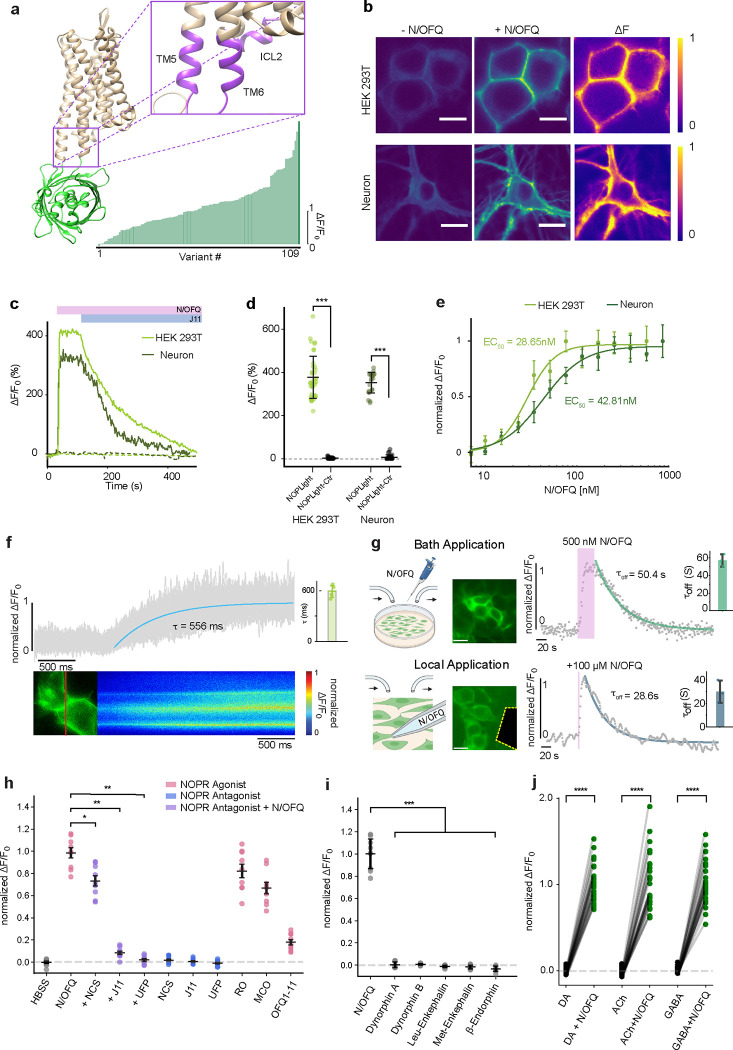
FIGURE 1
FIGURE 1. Development and in vitro characterization of NOPLight.
a. Upper left: RoseTTAFold predicted structural model of NOPLight. Upper right: zoom in of receptor and cpGFP linker region. Residues of site-directed mutagenesis highlighted in purple. Lower panel: Summary of maximal ΔF/F0 in response to 10 μM N/OFQ of HEK293T cells expressing each of the 109 variants screened in this study. (n ≥ 3 cells for each variant. Dark green bar: NOPLight). b. Representative images of HEK 293T cells (top; scale bars, 10 μm) and neurons (bottom; scale bars, 20 μm) expressing NOPLight before (left) and after (middle) application f 1 μM N/OFQ. Corresponding normalized pixelwise ΔF shown on the right. c. Representative fluorescent-fold change (ΔF/F0) of HEK 293T cell (light green traces) and neurons (dark green traces) expressing NOPLight (solid line) or NOPLight-ctr (dotted line) in response to 1 μM N/OFQ, followed by competition of 10 μM J-113397, a NOPR antagonist. d. Quantification of maximal ΔF/F0 of NOPLight (green) or NOPLight-ctr (gray) expressing HEK293T cells and neurons in response to 1 μM N/OFQ. (n = 38, 30, 22, 27 cells from >3 independent experiments, left to right respectively. Data shown as mean ± s.t.d.) ***P<0.0001. P = 1.003 × 10⁻¹² and 1.262 × 10⁻⁹ (One-sided Mann-whitney U test) for the response of NOPLight compared to NOPLight-ctr in HEK 293T cells and neurons. e. Normalized maximal ΔF/F0 response of HEK 293T cells (light green) and neurons (dark green) expressing NOPLight to different concentrations of N/OFQ (Data shown as mean ± s.d.) and respective dose response curve fitted with a three parameter Hill equation. n = 3 independent experiments with > 5 cells each. f. Time plot of normalized single NOPLight pixel ΔF/F0 (gray) from a representative line-scan (upper right). Pixel average ΔF/F0 were fitted with a mono-exponential function (blue trace) and the deduced time constant (τ). Corresponding cell image (red: line scanned) and time profile of all pixels on the line scanned are shown directly under the time plot. Upper right inset: quantification of time constant (τ) from four independent experiments. g. Left: schematic representation of the experimental set-ups; middle: Representative images of HEK 293T cells (scale bars, 20 μm), right: time plot of of normalized single NOPLight ΔF/F0 from a representative experiment (gray) with fitted mono-exponential decay function (green and blue) with the deduced time constant (τoff). Shaded pink bar represents the application of N/OFQ. Upper inset: quantification of time constant (τoff) from three independent experiments. h. Maximal ΔF/F0 response in NOPLight expressing HEK293T cells to the application of different drug(s) (NCS: Nocistatin; J11: J-113397; UFP: UFP-101; RO: Ro 64–6198; MCO: MCOPPB; OFQ1–11: Orphanin FQ (1–11)). Response to N/OFQ in the presence of each antagonist was compared to where only N/OFQ was applied by a pairwise Mann-Whitney rank test with post hoc Bonferroni correction (*P<0.01, **P<0.005.P = 0.024, Nocistatin; 0.0012, J-113397; 0.0012, UFP 101;) i. Maximal ΔF/F0 response in NOPLight expressing HEK293T cells to the application of endogenous opioid ligands (1 μM). Response to each ligand was compared to the response to N/OFQ by a pairwise Mann-Whitney rank test with post hoc Bonferroni correction (**P<0.005, P = 0.003, Dynorphin A; 0.003, Dynorphin B; 0.003, Leu-Enkephalin ; 0.003, Met-Enkephalin ; 0.003, β-endorphin.) j. Maximal ΔF/F0 response in NOPLight expressing HEK293T cells to the application of fast neurotransmitters (DA: dopamine, ACh: acetylcholine, GABA: gamma-Aminobutyric acid at 1 mM) normalized to its maximal ΔF/F0 response to N/OFQ (1 μM). n = 29–30 cells from 3 independent experiments. ****P<0.0001.
FIGURE 2
FIGURE 2. Ex vivo characterization of NOPLight.
a. Expression of NOPLight in the ARC. Scale bar, 200 μm. Insets, scale bars, 50 μm. b-f. Change in NOPLight fluorescence measured in ARC neurons in response to bath-applied N/OFQ or release of chemogenetically-activated PNOC neurons. The fluorescence was detected from 0.15–0.2 mm2 ROIs in the ARC. Each experiment was performed in a different brain slices. b. NOPLight responses of a single ROI to increasing N/OFQ concentrations. c. Concentration-response relation showing the N/OFQ (black trace) effect on N/OFQ fluorescence of NOPLight-expressing cells in the ARC. The grey trace shows the concentration-response relation for the ligand insensitive mutant sensor (NOPLight-ctr, grey trace). Data are shown as mean ± SEM. Inset, mean fluorescence increase in response to different concentrations of N/OFQ. Color code as in b. ARC, arcuate nucleus of the hypothalamus. d. Experimental schematic for chemogenetic experiments in brain slices. e. Representative immunohistochemical image showing DREADD (hM3Dq) expression in PNOC neurons of the ARC as well as pan-neuronal expression of NOPLight. Scale bar, 100 μm. Magnification of inset is shown on right. Scale bar, 20 μm. f. Perforated patch clamp recordings from a hM3Dq-expressing PNOC neuron showing the effect of 10 min CNO application (3 μM) on action potential frequency. Left, rate histogram (bin width 60s). Right, representative sections of the original recording corresponding to the times indicated by blue and red color code. g-i. Changes (mean ± SEM) in NOPLight fluorescence measured in the ARC in response to activation of hM3Dq-expressing PNOC neurons by 10 min bath-application of 3 μM clozapine N-oxide (CNO) (g) and 100 nM and 500 nM N/OFQ (h). g. The upper and lower panel show the same data. The traces in the upper panel are aligned to the CNO application, the traces in the lower panel are aligned to the response onset. The recordings in g and h were performed from the same brain slices. The n-values in h are lower than in g because some recordings were terminated for technical reasons. Bars indicate the application of CNO and N/OFQ, respectively. Scale bars apply to g and h. i. Box plots showing the maximal fluorescence changes upon applications of CNO and N/OFQ, respectively. The numbers in brackets represents the numbers of experiments (brain slices). N-values indicate the number of animals.
FIGURE 3
FIGURE 3. Characterization of NOPLight response in vivo to pharmacological agonism and antagonism.
a. Schematic of fibre photometry setup. Coronal brain cartoon of viral injection of NOPLight and fibre implant in the VTA. b. Representative image showing expression of DAPI (blue) and NOPLight (green) with fibre placement in VTA. c. Left: Averaged traces of NOPLight fluorescence after systemic (i.p.) injection of vehicle (black) or 1, 5, or 10 mg/kg of selective NOPR agonist Ro 64–6198. Right: Mean NOPLight fluorescence 20–25 min after Ro 64–6198 injection increases dose-dependently (two-tailed Mann-Whitney test, ****p<0.0001, n = 5–16 mice). Data represented as mean ± SEM. d. Left: Averaged traces of NOPLight fluorescence after systemic injection of Ro 64–6198 (i.p.) and/or 10 mg/kg of selective NOPR antagonist LY2940094 (o.g.). LY2940094 was administered to the LY + RO group 30 min prior to photometry recording. Right: A significant increase in NOPLight fluorescence 20–25 minutes following injection of Ro 64–6198 (two-tailed Mann-Whitney test, *p<0.05, n = 4 mice) is blocked by NOPR antagonist pre-treatment (two-tailed Mann-Whitney test, # p<0.05, n = 4 mice). Data represented as mean ± SEM. e. Left: Averaged traces of NOPLight fluorescence after systemic (i.p.) injection of Ro 64–6198 and/or 10 mg/kg of selective NOPR antagonist J-113397. J-113397 was administered to the J11 + RO group 30 min prior to photometry recording. Right: NOPR antagonist pre-treatment blocks Ro 64–6198 induced increases in NOPLight fluorescence (two-tailed Mann-Whitney test, ## p<0.01, #### p<0.0001, **** p<0.0001, n = 4–9 mice). Data represented as mean ± SEM f. Top: Coronal brain cartoon of viral injection of FLEX-NOPLight (left) or NOPLight-ctr (right) and fibre implant in the VTA. Bottom: Representative image showing expression of DAPI (blue) and FLEX-NOPLight (left, green) or NOPLight-ctr (right, green) with fibre placement in VTA. g. Averaged traces of NOPLight (green), FLEX-NOPLight (blue) or NOPLight-ctr (gray) fluorescence after systemic (i.p.) injection of 10 mg/kg Ro 64–6198 (n = 3–16 mice). Data represented as mean ± SEM. h. Mean fluorescence of each NOPLight variant 20–25 min after systemic injection of Ro 64–6198 (two-tailed Mann-Whitney test, # p<0.05, #### p<0.0001, n = 3–16 mice). Data represented as mean ± SEM.
FIGURE 4
FIGURE 4. NOPLight detects chemogenetically evoked endogenous N/OFQ release in vivo.
a. Schematic of fibre photometry setup. Coronal brain cartoon of viral co-injection of FLEX-NOPLight with either DIO-hM3D(Gq) or mCherry and fibre implant in the VTA of PNOC Cre mice. b. Left: Representative traces of FLEX-NOPLight fluorescence after systemic (i.p.) injection of 5 mg/kg CNO in hM3D(Gq) (green) or control (red) animals. Right: Mean FLEX-NOPLight fluorescence 40–45 min after CNO injection is significantly elevated relative to pre-injection baseline period (BL) in hM3D(Gq) but not control mice (two-tailed Wilcoxon test, *p<0.05, n = 8 mice, hM3D(Gq); 3 mice, control). Data represented as mean ± SEM. c. Left: FLEX-NOPLight fluorescence averaged before injection (i.p.) of 5 mg/kg CNO (0–10 min), and in 5 min bins following the injection.10 mg/kg of selective NOPR antagonist LY2940094 was administered (o.g.) to the LY + CNO group 30 min prior to photometry recording (two-way repeated-measures ANOVA with Bonferroni’s post hoc test, *p<0.05, **p<0.01, n = 3–8 mice). Right: NOPR antagonist pre-treatment prevents CNO induced increases in FLEX-NOPLight fluorescence (two-tailed Mann-Whitney test, # p<0.05, n = 3–8 mice). Data represented as mean ± SEM.
FIGURE 5
FIGURE 5. NOPLight in vivo reports bidirectional changes in endogenous N/OFQ released during consummatory and aversive behaviors.
a. Schematic of fibre photometry setup. Coronal brain cartoon of viral injection of NOPLight and fibre implant in the VTA of WT mice (n = 7). b. Top: Cartoon depicting setup used for the head-fixed cued sucrose recordings. Bottom: Trial structure for head-fixed cued sucrose sessions. Mice were pre-treated with 20 mg/kg of selective NOPR antagonist J-113397 or vehicle (i.p.) 30 minutes prior to the session. During the session, mice were presented with 15 trials were a 5s tone preceded 5s of access to a 10% sucrose solution, with a 5-minute null ‘baseline’ period at the beginning and end of the recording. c. Averaged traces of NOPLight fluorescence following pre-treatment with vehicle (green) or J-113397 (blue). Traces are aligned to the start of the 5s tone (magenta, shaded) that precedes 5s of access to a 10% sucrose solution (brown, shaded). Data represented as mean ± SEM. d. Average number of licks made during sessions that followed vehicle (green) or J-113397 (blue) pre-treatment (two-tailed Wilcoxon test, ns: not significant, n = 7 mice). e. Heat map of NOPLight fluorescence corresponding to the average traces in c for vehicle (left, green) and J-113397 (right, blue) sessions. f. Area under the curve (AUC) for the averaged traces from c, calculated over 5-second intervals before/during/after cued-sucrose events. NOPLight fluorescence in the VTA is significantly decreased during and immediately after cued access to 10% sucrose solution (two-tailed Wilcoxon test, **p<0.01, n = 7 mice). Pre-treatment with 20 mg/kg J-113397 blocks this decrease in NOPLight signal (two-tailed Mann-Whitney test, ## p<0.01, n = 7 mice). Data represented as mean ± SEM. g. Top: Schematic of fibre photometry setup. Middle: Coronal brain cartoon depicting fibre implant with viral injection of either DIO-GCaMP6m (dark green), FLEX-NOPLight (light green), or NOPLight-ctr (gray) into the VTA of Pnoc-Cre (n = 4), Oprl1-Cre (n = 3), or WT (n = 8) mice, respectively. Bottom: Trial structure for tail lift sessions. h. Averaged trace of pnVTAPnoc GCaMP6m activity during a 10s tail lift. Data represented as mean ± SEM. i. Area under the curve (AUC) for photometry trace from h, calculated over 5-second intervals before/during/after tail lift events (two-tailed Wilcoxon test, ***p<0.001, ****p<0.0001, n = 4 mice). Data represented as mean ± SEM. j. Averaged trace of FLEX NOPLight (green) and NOPLight-ctr (gray) fluorescence during a 10s tail lift. Data represented as mean ± SEM. k. Area under the curve (AUC) for photometry traces from j, calculated over 5-second intervals before/during/after tail lift events. FLEX-NOPLight fluorescence increases during the tail lift (two-tailed Wilcoxon test, **p<0.01, n = 3 mice). NOPLight-ctr fluorescence does not change during the tail lift (two-tailed Mann-Whitney test, # p<0.05, n = 3–8 mice). Data represented as mean ± SEM.
FIGURE 6
FIGURE 6. NOPLight detection of endogenous VTA N/OFQ release during high effort reward-seeking.
a. Schematic of fibre photometry setup. Coronal brain cartoon of viral injection of NOPLight and fibre implant in the VTA of WT mice (n = 4). Representative image showing expression of DAPI (blue) and NOPLight (green) with fibre placement in VTA. b. Left: Cartoon depicting operant box setup for the progressive ratio (PR) test. Right: Trial structure for sucrose pellet delivery during the progressive ratio paradigm. c. Top: Averaged trace of NOPLight signal for all mice (n = 4), aligned to rewarded active nose pokes (ANPs) made during the PR test. Only active nose pokes that resulted in reward delivery are included. Epoch shown includes the 5s light cue (yellow, shaded) that precedes reward delivery. Time to pellet retrieval and duration of consumption period averaged across all animals (brown, shaded). Data represented as mean ± SEM. Bottom: Corresponding heat map, where each row corresponds to an individual, reinforced ANP epoch. d. Top: Averaged trace of NOPLight signal for all mice (n = 4), aligned to non-rewarded ANPs made during the PR test. Data represented as mean ± SEM. Bottom: Corresponding heat map, where each row corresponds to an individual, non-reinforced ANP epoch. e. NOPLight fluorescence averaged over 5-second intervals for rewarded (green) and non-rewarded (blue) ANP epochs. Time to pellet retrieval and duration of consumption period averaged across all rewarded trials (brown, shaded). In comparison to the relatively stable NOPLight signal detected across non-rewarded ANP trials, NOPLight signal across rewarded ANP trials decreases during reward consumption then increases immediately post-consumption (two-way repeated-measures ANOVA with Bonferroni’s post hoc test, *p<0.05, **p<0.01, ***p<0.001, n = 4 mice). Data represented as mean ± SEM. f-g. Area under the curve (AUC) for photometry traces from c and d respectively, calculated over 5-second intervals before/during/after rewarded (f) and non-rewarded (g) active nose pokes (two-tailed Wilcoxon test, *p<0.05, **p<0.01, ***p<0.001, n = 4 mice). Data represented as mean ± SEM.

References

    1. Meunier JC, Mollereau C, Toll L, et al. Isolation and structure of the endogenous agonist of opioid receptor-like ORL1 receptor. Nature. 1995;377(6549):532–535. doi: 10.1038/377532a0 - DOI - PubMed
    1. Reinscheid RK, Nothacker HP, Bourson A, et al. Orphanin FQ: a neuropeptide that activates an opioidlike G protein-coupled receptor. Science (New York, N.Y.). 1995;270(5237):792–794. doi: 10.1126/science.270.5237.792 - DOI - PubMed
    1. Wang Y, Zhuang Y, DiBerto JF, et al. Structures of the entire human opioid receptor family. Cell. 2023;186(2):413–427.e17. doi: 10.1016/j.cell.2022.12.026 - DOI - PubMed
    1. Thompson AA, Liu W, Chun E, et al. Structure of the nociceptin/orphanin FQ receptor in complex with a peptide mimetic. Nature. 2012;485(7398):395–399. doi: 10.1038/nature11085 - DOI - PMC - PubMed
    1. Toll L, Bruchas MR, Calo’ G, Cox BM, Zaveri NT. Nociceptin/Orphanin FQ Receptor Structure, Signaling, Ligands, Functions, and Interactions with Opioid Systems. Pharmacological Reviews. 2016;68(2):419–457. doi: 10.1124/pr.114.009209 - DOI - PMC - PubMed

Publication types
