


Discrete Ricci curvatures capture age-related changes in human brain functional connectivity networks
- PMID: 37293668
- PMCID: PMC10244515
- DOI: 10.3389/fnagi.2023.1120846
Discrete Ricci curvatures capture age-related changes in human brain functional connectivity networks
Abstract
Introduction: Geometry-inspired notions of discrete Ricci curvature have been successfully used as markers of disrupted brain connectivity in neuropsychiatric disorders, but their ability to characterize age-related changes in functional connectivity is unexplored.
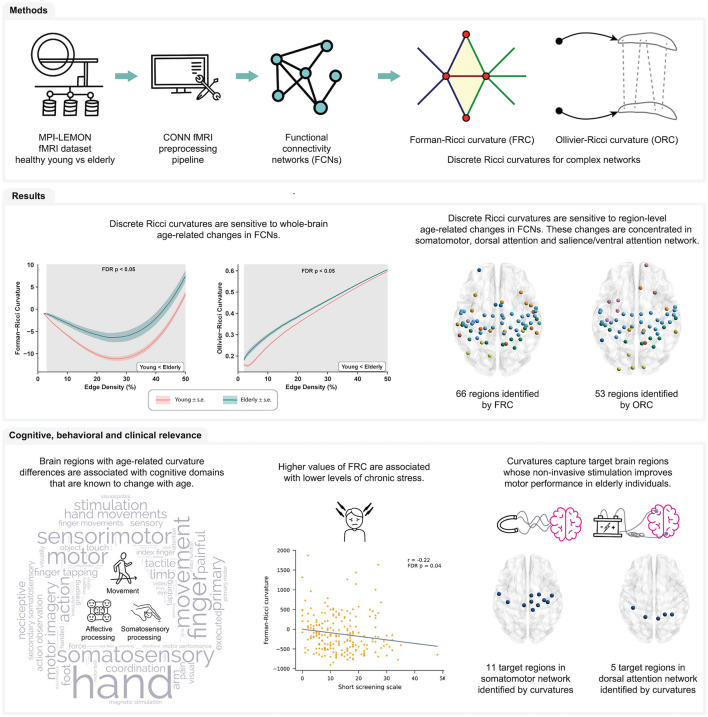
Methods: We apply Forman-Ricci curvature and Ollivier-Ricci curvature to compare functional connectivity networks of healthy young and older subjects from the Max Planck Institute Leipzig Study for Mind-Body-Emotion Interactions (MPI-LEMON) dataset (N = 225).
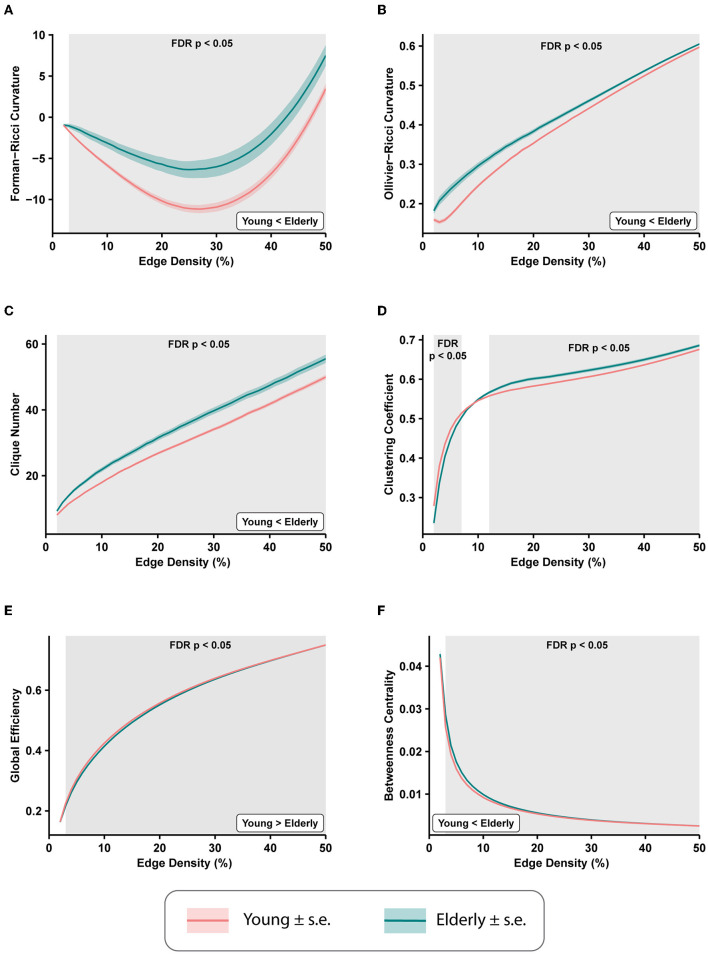
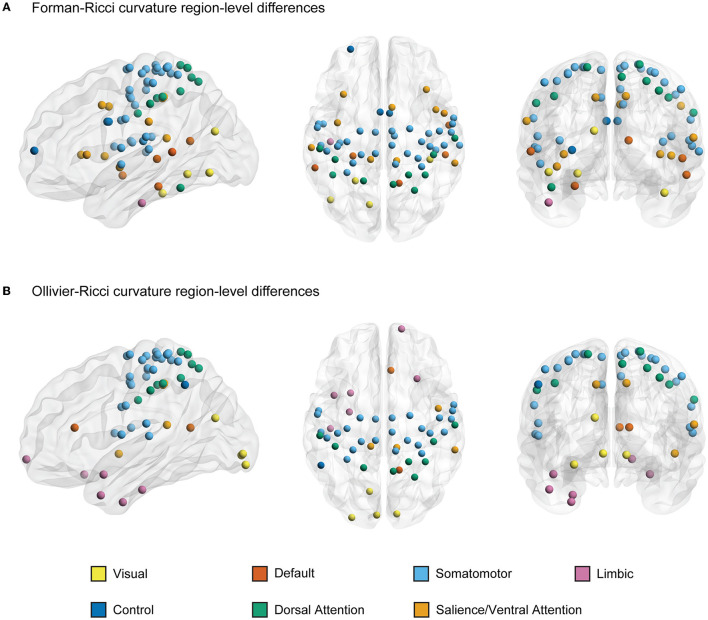
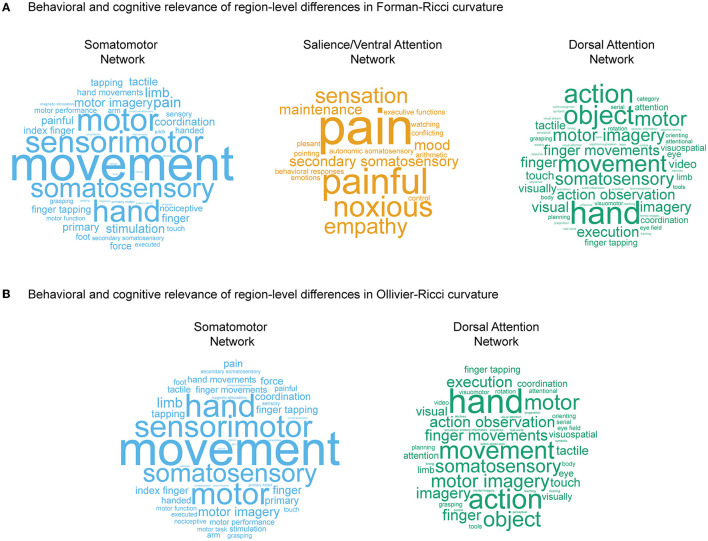
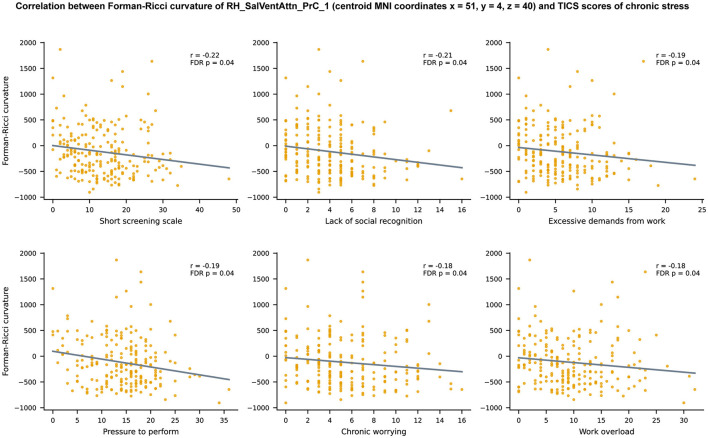
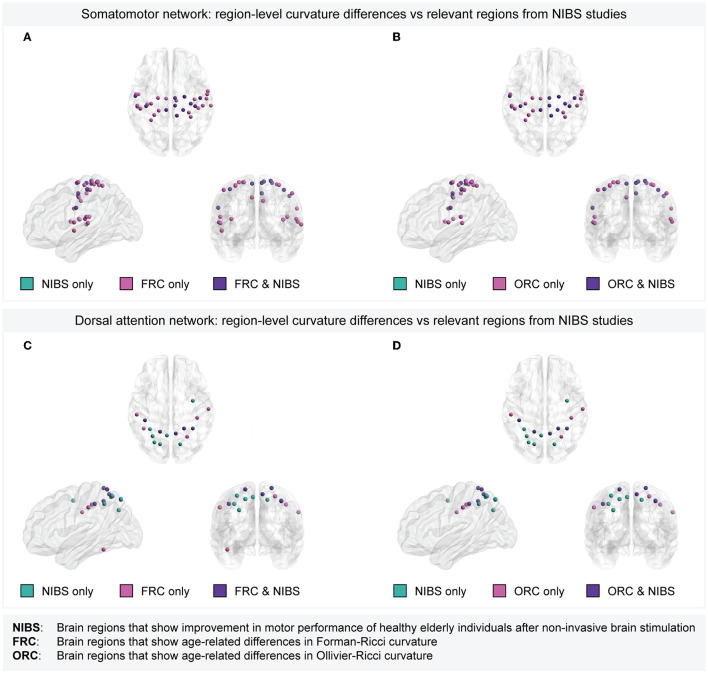
Results: We found that both Forman-Ricci curvature and Ollivier-Ricci curvature can capture whole-brain and region-level age-related differences in functional connectivity. Meta-analysis decoding demonstrated that those brain regions with age-related curvature differences were associated with cognitive domains known to manifest age-related changes-movement, affective processing, and somatosensory processing. Moreover, the curvature values of some brain regions showing age-related differences exhibited correlations with behavioral scores of affective processing. Finally, we found an overlap between brain regions showing age-related curvature differences and those brain regions whose non-invasive stimulation resulted in improved movement performance in older adults.
Discussion: Our results suggest that both Forman-Ricci curvature and Ollivier-Ricci curvature correctly identify brain regions that are known to be functionally or clinically relevant. Our results add to a growing body of evidence demonstrating the sensitivity of discrete Ricci curvature measures to changes in the organization of functional connectivity networks, both in health and disease.
Keywords: Forman-Ricci curvature; MPI-LEMON; Ollivier-Ricci curvature; functional connectivity networks; healthy aging; motor performance; non-invasive brain stimulation; resting-state fMRI.
Copyright © 2023 Yadav, Elumalai, Williams, Jost and Samal.
Conflict of interest statement
The authors declare that the research was conducted in the absence of any commercial or financial relationships that could be construed as a potential conflict of interest.
Figures
References
-
- Addis D. R., Barense M., Duarte A. (2015). The Wiley Handbook on the Cognitive Neuroscience of Memory. John Wiley & Sons. 10.1002/9781118332634 - DOI
LinkOut - more resources
Full Text Sources
