Review
. 2023 Jun 9;72(S1):S1-S9.
doi: 10.33549/physiolres.935018.

Mechanisms of Cardiovascular Changes of Phototherapy in Newborns with Hyperbilirubinemia

Affiliations
Review

Mechanisms of Cardiovascular Changes of Phototherapy in Newborns with Hyperbilirubinemia

K Javorka et al. Physiol Res. .

Abstract

During phototherapy of jaundiced newborns, vasodilation occurs in the skin circulation compensated by vasoconstriction in the renal and mesenteric circulation. Furthermore, there is a slight decrease in cardiac systolic volume, and blood pressure, as well as an increase in heart rate and discrete changes in the heart rate variability (HRV). The primary change during phototherapy is the skin vasodilation mediated by multiple mechanisms: 1) Passive vasodilation induced by direct skin heating effect of the body surface and subcutaneous blood vessels, modified by myogenic autoregulation. 2) Active vasodilation mediated via the mechanism provided by axon reflexes through nerve C-fibers and humoral mechanism via nitric oxide (NO) and endothelin 1 (ET-1). During and after phototherapy is a rise in the NO:ET-1 ratio. 3) Regulation of the skin circulation through the sympathetic nerves is unique, but their role in skin vasodilation during phototherapy was not studied. 4) Special mechanism is a photorelaxation independent of the skin heating. Melanopsin (opsin 4) - is thought to play a major role in systemic vascular photorelaxation. Signalling cascade of the photorelaxation is specific, independent of endothelium and NO. The increased skin blood flow during phototherapy is enabled by the restriction of blood flow in the renal and mesenteric circulation. An increase in heart rate indicates activation of the sympathetic system as is seen in the measures of the HRV. High-pressure, as well as low-pressure baroreflexes, may play important role in these adaptation responses. The integrated complex and specific mechanism responsible for the hemodynamic changes during phototherapy confirm adequate and functioning regulation of the neonatal cardiovascular system, including baroreflexes.


Conflict of interest statement

Conflict of Interest

There is no conflict of interest.

Figures

Fig. 1
Fig. 1
Mechanisms involved in the skin vasodilation induced by thermal influx during neonatal phototherapy.
Fig. 2
Fig. 2
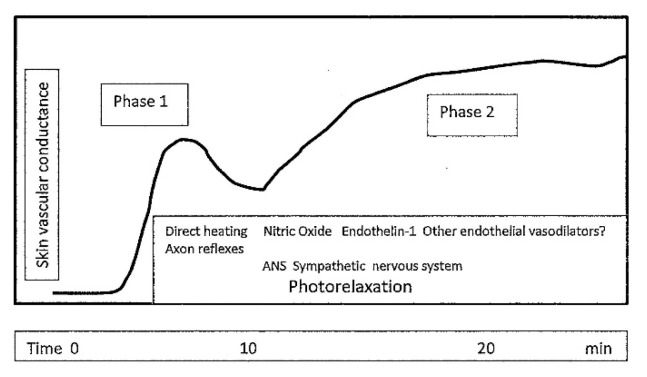
The scheme of changes in skin vascular conductance during local warming (in healthy human adults). The first phase is due to the effect of direct local heating and axon reflexes, the second phase depends mainly on humoral regulation. Autonomic nervous system – sympathetic innervating skin vessels and photorelaxation can play a role during both phases. (Modified according to Charkoudian et al. [22].
Fig. 3
Fig. 3
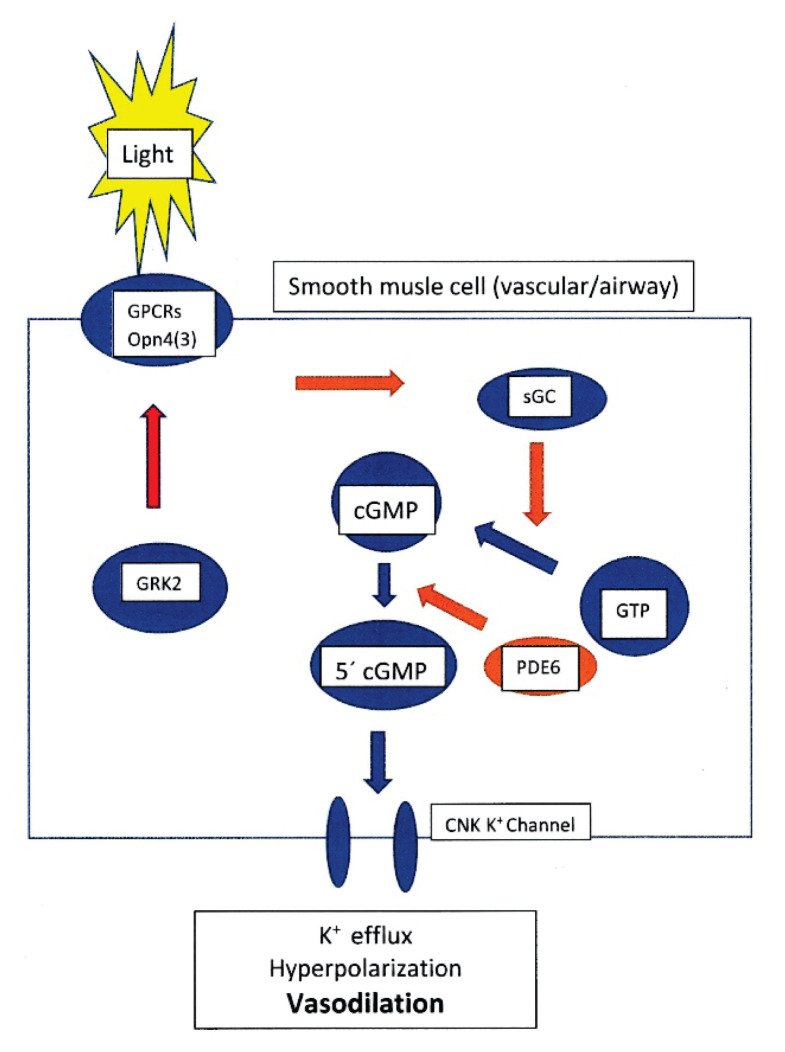
Simplified scheme of suggested signal transduction mechanism of the melanopsin (Opn4) and/or opsin 3 (Opn3) in photorelaxation of the vascular/airway smooth muscle cells. (Modified according to Sikka et al. [39], Barreto Ortiz et al. [44]). GPCRs – G protein coupled receptors opsin 4/3; sGC – soluble guanylate cyclase; GTP – Guanosine-5′-triphosphate; cGMP – cyclic guanosine monophosphate; PDE6 – phosphodiesterase 6; 5′cGMP – Guanosine 3’,5’-cyclic monophosphate. GRK2 – G protein receptor kinase (βARK 1 – beta-adrenergic receptor kinase) modulates opsins activity and inhibits the activation of the opsins (Opn4, 3).
Fig. 4
Fig. 4
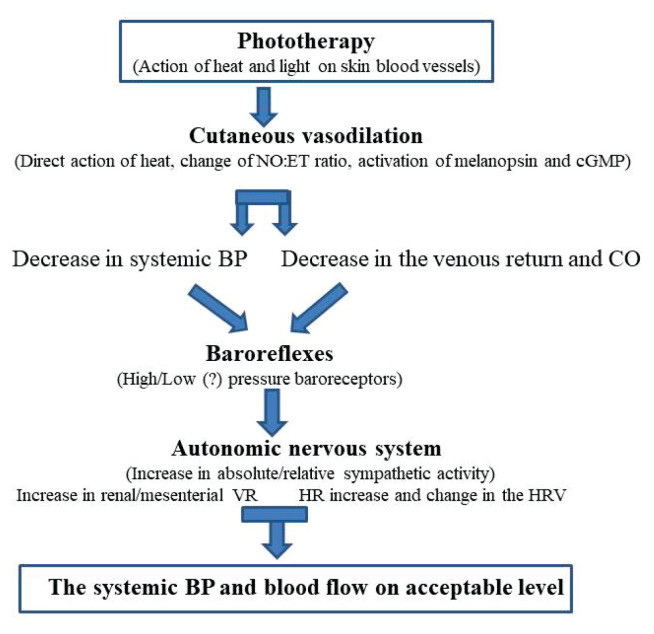
Scheme of cardiovascular effects and some of their mechanisms during phototherapy of jaundiced newborns. NO – nitric oxide, ET – endothelin 1, cGMP – cyclic guanosine monophosphate, BP – systemic blood pressure, CO – cardiac output, VR – vascular resistance, HR – heart rate, HRV – heart rate variability.

References

    1. Hansen TWR. Phototherapy for neonatal jaundice--therapeutic effects on more than one level? Semin Perinatol. 2010;34:231–34. doi: 10.1053/j.semperi.2010.02.008. - DOI - PubMed
    1. Dvořák A, Pospíšilová K, Žížalová K, Capková N, Muchová L, Vecka M, Vrzáčková N, Křížová J, Zelenka J, Vítek L. The effects of bilirubin and lumirubin on metabolic and oxidative stress markers. Front Pharmacol. 2021;12:567001. doi: 10.3389/fphar.2021.567001. - DOI - PMC - PubMed
    1. Bhutani VK. Committee on Fetus and Newborn; American Academy of Pediatrics. Phototherapy to prevent severe neonatal hyperbilirubinemia in the newborn infant 35 or more weeks of gestation. Pediatrics. 2011;128:e1046–e1052. doi: 10.1542/peds.2011-1494. - DOI - PMC - PubMed
    1. Wu PYK, Wong WH, Hodgman JE, Levan N. Changes in blood flow in the skin and muscle with phototherapy. Pediatr Res. 1974;8:257–62. doi: 10.1203/00006450-197404000-00007. - DOI - PubMed
    1. Walther FJ, Wu PY, Siassi B. Cardiac output changes in newborns with hyperbilirubinemia treated with phototherapy. Pediatrics. 1985;76:918–921. doi: 10.1542/peds.76.6.918. - DOI - PubMed