


Interfacility Transfer of Uninsured vs Insured Patients With ST-Segment Elevation Myocardial Infarction in California
- PMID: 37294567
- PMCID: PMC10257096
- DOI: 10.1001/jamanetworkopen.2023.17831
Interfacility Transfer of Uninsured vs Insured Patients With ST-Segment Elevation Myocardial Infarction in California
Erratum in
-
Error in Methods Section.JAMA Netw Open. 2023 Jul 3;6(7):e2326207. doi: 10.1001/jamanetworkopen.2023.26207. JAMA Netw Open. 2023. PMID: 37450307 Free PMC article. No abstract available.
Abstract
Importance: Insurance status has been associated with whether patients with ST-segment elevation myocardial infarction (STEMI) presenting to emergency departments are transferred to other facilities, but whether the facility's percutaneous coronary intervention capabilities mediate this association is unknown.
Objective: To examine whether uninsured patients with STEMI were more likely than patients with insurance to experience interfacility transfer.
Design, setting, and participants: This observational cohort study compared patients with STEMI with and without insurance who presented to California emergency departments between January 1, 2010, and December 31, 2019, using the Patient Discharge Database and Emergency Department Discharge Database from the California Department of Health Care Access and Information. Statistical analyses were completed in April 2023.
Exposures: Primary exposures were lack of insurance and facility percutaneous coronary intervention capabilities.
Main outcomes and measures: The primary outcome was transfer status from the presenting emergency department of a percutaneous coronary intervention-capable hospital, defined as a facility performing 36 percutaneous coronary interventions per year. Multivariable logistic regression models with multiple robustness checks were performed to determine the association of insurance status with the odds of transfer.
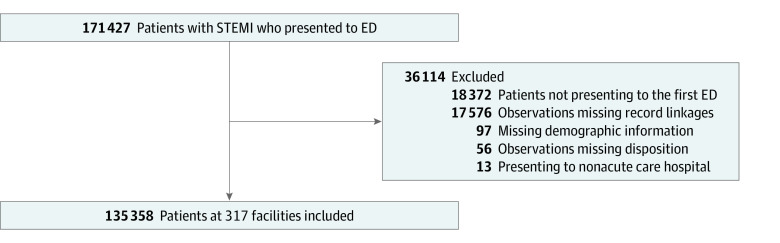
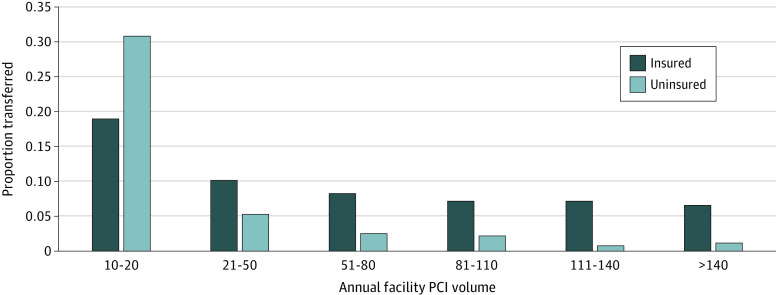
Results: This study included 135 358 patients with STEMI, of whom 32 841 patients (24.2%) were transferred (mean [SD] age, 64 [14] years; 10 100 women [30.8%]; 2542 Asian individuals [7.7%]; 2053 Black individuals [6.3%]; 8285 Hispanic individuals [25.2%]; 18 650 White individuals [56.8%]). After adjusting for time trends, patient factors, and transferring hospital characteristics (including percutaneous coronary intervention capabilities), patients who were uninsured had lower odds of experiencing interfacility transfer than those with insurance (adjusted odds ratio, 0.93; 95% CI, 0.88-0.98; P = .01).
Conclusions and relevance: After accounting for a facility's percutaneous coronary intervention capabilities, lack of insurance was associated with lower odds of emergency department transfer for patients with STEMI. These findings warrant further investigation to understand the characteristics of facilities and outcomes for uninsured patients with STEMI.
Conflict of interest statement
Figures
References
-
- O’Gara PT, Kushner FG, Ascheim DD, et al. ; American College of Cardiology Foundation/American Heart Association Task Force on Practice Guidelines . 2013 ACCF/AHA guideline for the management of ST-elevation myocardial infarction: a report of the American College of Cardiology Foundation/American Heart Association Task Force on Practice Guidelines. Circulation. 2013;127(4):e362-e425. doi:10.1161/CIR.0b013e3182742c84 - DOI - PubMed
Publication types
MeSH terms
Grants and funding
LinkOut - more resources
Full Text Sources
Miscellaneous
