


Obstructed hemivagina and ipsilateral renal agenesis (OHVIRA) syndrome: A case report
- PMID: 37295244
- PMCID: PMC10310910
- DOI: 10.1016/j.ijscr.2023.108368
Obstructed hemivagina and ipsilateral renal agenesis (OHVIRA) syndrome: A case report
Abstract
Introduction: Obstructed hemivagina and ipsilateral renal agenesis (OHVIRA) is a rare urogenital malformation. The clinical symptoms of OHVIRA include uterine morphology abnormality, persistent vaginal discharge, and renal anomaly or agenesis. Delayed diagnosis can lead to complications, such as pelvic inflammatory disease, adhesion to the oviduct, and endometriosis.
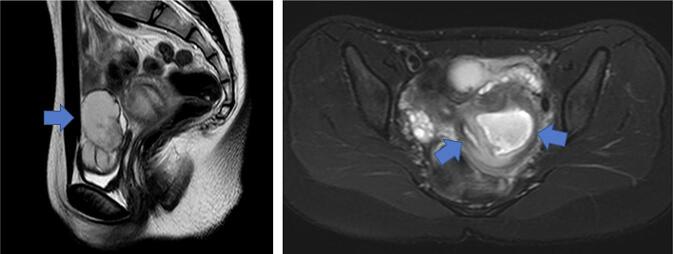
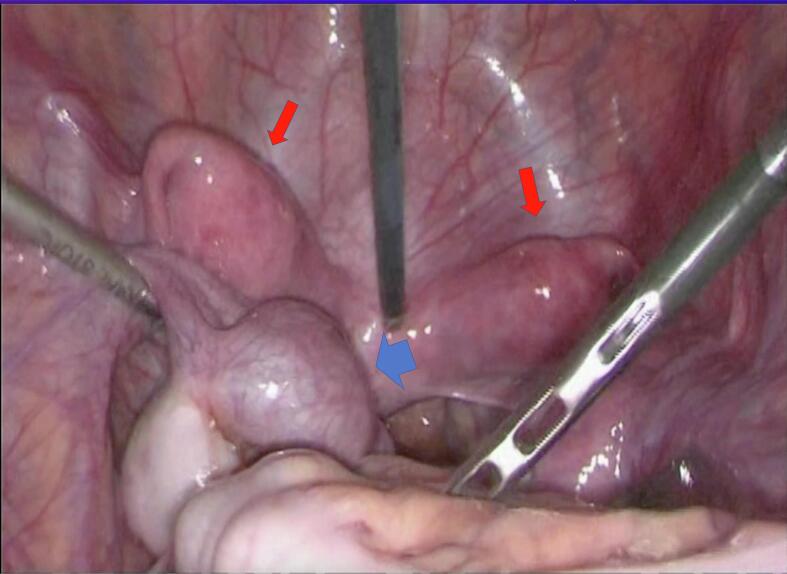
Presentation of case: We report the case of a 12-year-old girl who presented with severe dysmenorrhea and abnormal vaginal discharge. The patient was diagnosed with OHVIRA based on magnetic resonance imaging findings. The patient underwent combined transvaginal and laparoscopic surgery for drainage of hematocolpos and adhesiolysis of the pelvic cavity. The patient had an uncomplicated recovery and normal menstrual cycle after surgery.
Discussion: OHVIRA is a rare syndrome, of which delayed diagnosis may result in the development of endometriosis.
Conclusion: We report that a combined laparoscopic and transvaginal approach was useful for treating OHVIRA with oviductal hematoma.
Keywords: Congenital abnormalities; Gonadal dysgenesis; Laparoscopy; Solitary kidney; Urogenital abnormalities.
Copyright © 2023 The Authors. Published by Elsevier Ltd.. All rights reserved.
Conflict of interest statement
Declaration of competing interest None declared.
Figures


References
-
- Grimbizis G.F., Gordts S., Di Spiezio Sardo A., Brucker S., De Angelis C., Gergolet M., Li T.C., Tanos V., Brölmann H., Gianaroli L., Campo R. The ESHRE-ESGE consensus on the classification of female genital tract congenital anomalies. Hum. Reprod. 2013;28:2032–2044. doi: 10.1093/humrep/det098. - DOI - PMC - PubMed
Publication types
LinkOut - more resources
Full Text Sources
Research Materials
