


Systematic detection of tertiary structural modules in large RNAs and RNP interfaces by Tb-seq
- PMID: 37296103
- PMCID: PMC10255950
- DOI: 10.1038/s41467-023-38623-1
Systematic detection of tertiary structural modules in large RNAs and RNP interfaces by Tb-seq
Abstract
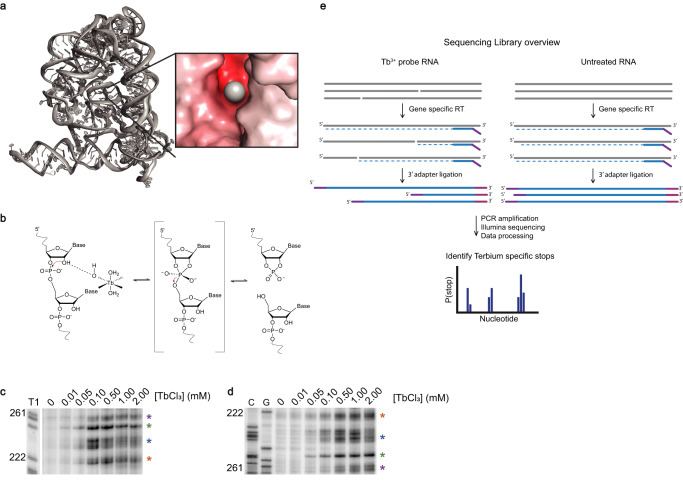
Compact RNA structural motifs control many aspects of gene expression, but we lack methods for finding these structures in the vast expanse of multi-kilobase RNAs. To adopt specific 3-D shapes, many RNA modules must compress their RNA backbones together, bringing negatively charged phosphates into close proximity. This is often accomplished by recruiting multivalent cations (usually Mg2+), which stabilize these sites and neutralize regions of local negative charge. Coordinated lanthanide ions, such as terbium (III) (Tb3+), can also be recruited to these sites, where they induce efficient RNA cleavage, thereby revealing compact RNA 3-D modules. Until now, Tb3+ cleavage sites were monitored via low-throughput biochemical methods only applicable to small RNAs. Here we present Tb-seq, a high-throughput sequencing method for detecting compact tertiary structures in large RNAs. Tb-seq detects sharp backbone turns found in RNA tertiary structures and RNP interfaces, providing a way to scan transcriptomes for stable structural modules and potential riboregulatory motifs.
© 2023. The Author(s).
Conflict of interest statement
A patent application on MarathonRT has been filed by Yale University. Yale university has submitted a patent application pertaining to work outlined in this study. Inventors include A.M.P, S.P and M.D.S. C.B.W is a consultant for Exscientia. The remaining authors declare no competing interests.
Figures

References
Publication types
MeSH terms
Substances
Grants and funding
LinkOut - more resources
Full Text Sources
Other Literature Sources
