Review
. 2023 May 31;12(11):1523.
doi: 10.3390/cells12111523.

Current State and Future Directions in the Therapy of ALS

Affiliations
Review

Current State and Future Directions in the Therapy of ALS

Laura Tzeplaeff et al. Cells. .

Abstract

Amyotrophic lateral sclerosis (ALS) is a rapidly progressive neurodegenerative disorder affecting upper and lower motor neurons, with death resulting mainly from respiratory failure three to five years after symptom onset. As the exact underlying causative pathological pathway is unclear and potentially diverse, finding a suitable therapy to slow down or possibly stop disease progression remains challenging. Varying by country Riluzole, Edaravone, and Sodium phenylbutyrate/Taurursodiol are the only drugs currently approved in ALS treatment for their moderate effect on disease progression. Even though curative treatment options, able to prevent or stop disease progression, are still unknown, recent breakthroughs, especially in the field of targeting genetic disease forms, raise hope for improved care and therapy for ALS patients. In this review, we aim to summarize the current state of ALS therapy, including medication as well as supportive therapy, and discuss the ongoing developments and prospects in the field. Furthermore, we highlight the rationale behind the intense research on biomarkers and genetic testing as a feasible way to improve the classification of ALS patients towards personalized medicine.

Keywords: ALS; MND; amyotrophic lateral sclerosis; clinical trials; medication; motor neuron disease; personalized medicine; supportive therapy; therapy.


Conflict of interest statement

The authors declare no conflict of interest.

Figures
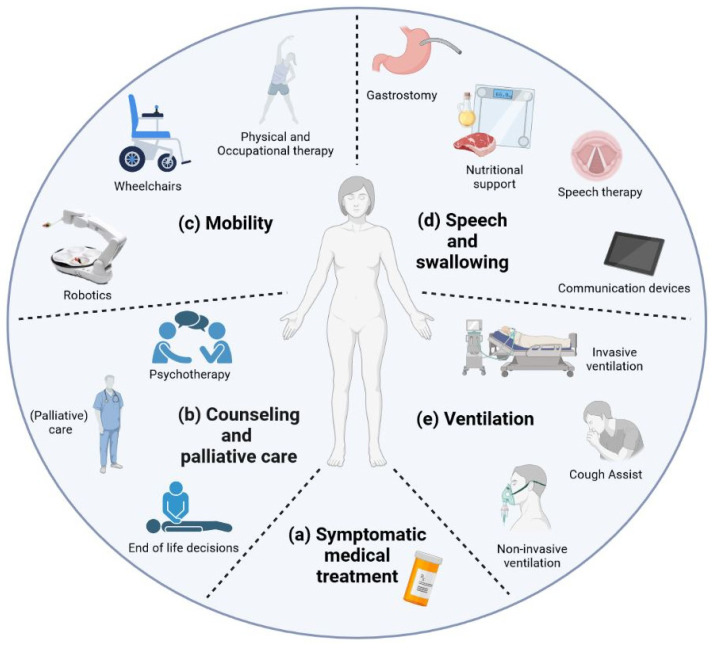
Figure 1
Figure 1
Schematic overview of supportive therapy for patients with ALS: Different aspects are highlighted: (a) Symptomatic medical treatment, (b) Counseling and palliative care, (c) Mobility, (d) Speech and swallowing, and (e) Ventilation. Created by Meret Herdick with “BioRender.com”.
Figure 2
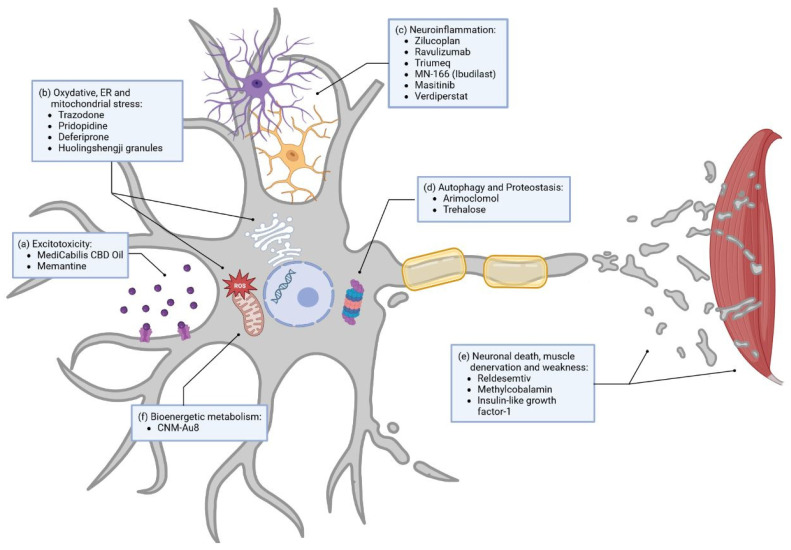
Figure 2
Small molecules in phase II/III and III clinical trials, grouped by mode of action: (a) Excitotoxicity, (b) Oxidative, ER, and mitochondrial stress, (c) Neuroinflammation, (d) Autophagy and Proteostasis, (e) Neuronal death, muscle denervation and weakness, and (f) Bioenergetic metabolism. ER: Endoplasmic reticulum. Created by Laura Tzeplaeff with “BioRender.com”.
Figure 3
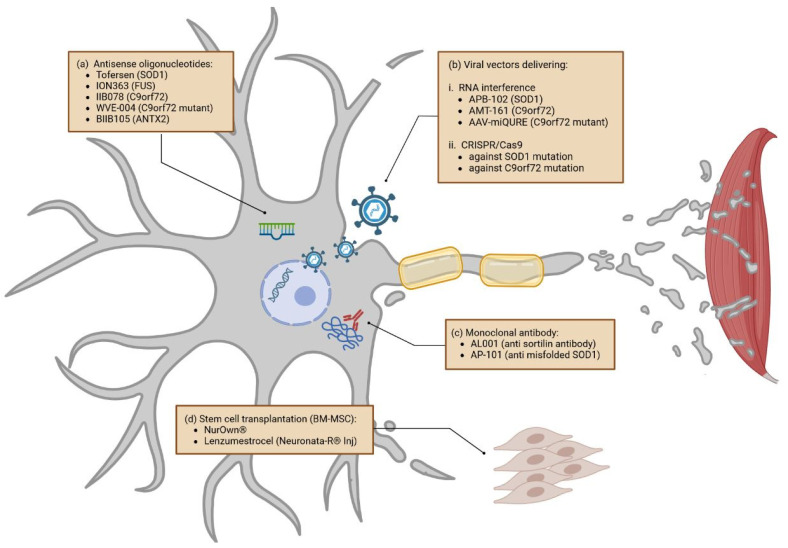
Figure 3
Gene, antibody, and stem-cell therapeutic approaches: (a) Antisense oligonucleotides, (b) Viral vectors delivering RNA interference or CRISPER/Cas9, (c) Monoclonal antibody, and (d) Stem cell transplantation. ANTX2: Ataxin-2; BM-MSC: bone-marrow-derived mesenchymal stem cells; C9orf72: Chromosome 9 open reading frame 72; FUS: Fused in sarcoma; SOD1: Superoxide dismutase 1. Created by Laura Tzeplaeff with “BioRender.com”.
Figure 4
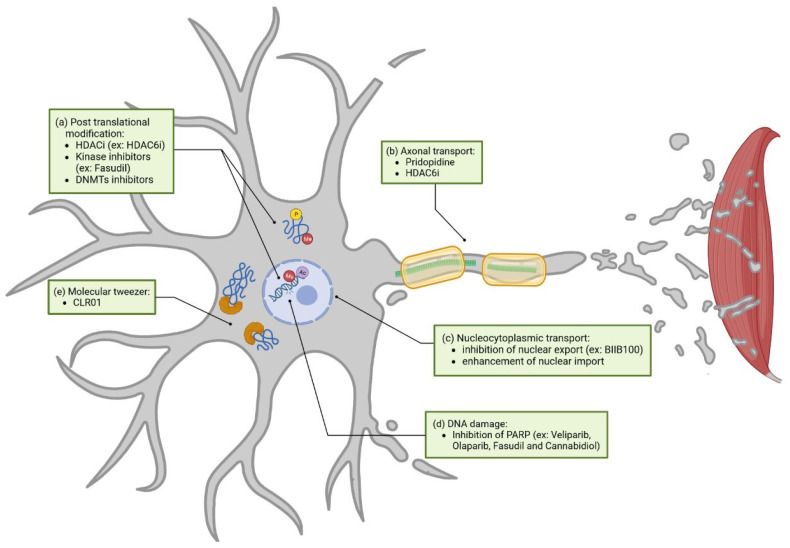
Figure 4
Future strategies and approaches: (a) Post-translational modification, (b) Axonal transport, (c) Nucleocytoplasmic transport, (d) DNA damage, and (e) Molecular tweezer. DNMTs: DNA methyltransferases; HDACi: histone deacetylase inhibitors; PARP: Poly ADP-ribose polymerase. Created by Laura Tzeplaeff with “BioRender.com”.

References

    1. Swinnen B., Robberecht W. The phenotypic variability of amyotrophic lateral sclerosis. Nat. Rev. Neurol. 2014;10:661–670. doi: 10.1038/nrneurol.2014.184. - DOI - PubMed
    1. Masrori P., Van Damme P. Amyotrophic lateral sclerosis: A clinical review. Eur. J. Neurol. 2020;27:1918–1929. doi: 10.1111/ene.14393. - DOI - PMC - PubMed
    1. Paganoni S., Macklin E.A., Hendrix S., Berry J.D., Elliott M.A., Maiser S., Karam C., Caress J.B., Owegi M.A., Quick A., et al. Trial of Sodium Phenylbutyrate-Taurursodiol for Amyotrophic Lateral Sclerosis. N. Engl. J. Med. 2020;383:919–930. doi: 10.1056/NEJMoa1916945. - DOI - PMC - PubMed
    1. Bensimon G., Lacomblez L., Meininger V. A controlled trial of riluzole in amyotrophic lateral sclerosis. ALS/Riluzole Study Group. N. Engl. J. Med. 1994;330:585–591. doi: 10.1056/NEJM199403033300901. - DOI - PubMed
    1. Abe K., Itoyama Y., Sobue G., Tsuji S., Aoki M., Doyu M., Hamada C., Kondo K., Yoneoka T., Akimoto M., et al. Confirmatory double-blind, parallel-group, placebo-controlled study of efficacy and safety of edaravone (MCI-186) in amyotrophic lateral sclerosis patients. Amyotroph. Lateral Scler. Front. Degener. 2014;15:610–617. doi: 10.3109/21678421.2014.959024. - DOI - PMC - PubMed

Publication types