


Overview of Molecular Detection Technologies for MET in Lung Cancer
- PMID: 37296895
- PMCID: PMC10251963
- DOI: 10.3390/cancers15112932
Overview of Molecular Detection Technologies for MET in Lung Cancer
Abstract
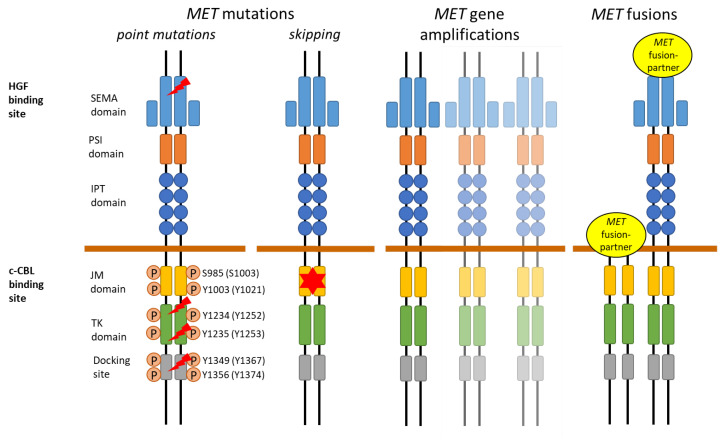
MET tyrosine kinase receptor pathway activation has become an important actionable target in solid tumors. Aberrations in the MET proto-oncogene, including MET overexpression, the activation of MET mutations, MET mutations that lead to MET exon 14 skipping, MET gene amplifications, and MET fusions, are known to be primary and secondary oncogenic drivers in cancer; these aberrations have evolved as predictive biomarkers in clinical diagnostics. Thus, the detection of all known MET aberrations in daily clinical care is essential. In this review, current molecular technologies for the detection of the different MET aberrations are highlighted, including the benefits and drawbacks. In the future, another focus will be on the standardization of detection technologies for the delivery of reliable, quick, and affordable tests in clinical molecular diagnostics.
Keywords: MET; MET exon 14 skipping mutation; MET fusion; MET gene amplification; NSCLC.
Conflict of interest statement
Carina Heydt has received honoraria from AstraZeneca, BMS, Illumina, and Molecular Health; Michaela Angelika Ihle has received honoraria from AstraZeneca, BMS, Novartis, and Merck; Sabine Merkelbach-Bruse has received honoraria and travel support from Amgen, AstraZeneca, Bayer, BMS, GSK, Janssen, Merck, MSD, Molecular Health, Novartis, Pfizer, QuIP, Roche, and Targos.
Figures
References
Publication types
LinkOut - more resources
Full Text Sources
Other Literature Sources
Miscellaneous
