


Food-Waste Valorisation: Synergistic Effects of Enabling Technologies and Eutectic Solvents on the Recovery of Bioactives from Violet Potato Peels
- PMID: 37297459
- PMCID: PMC10252353
- DOI: 10.3390/foods12112214
Food-Waste Valorisation: Synergistic Effects of Enabling Technologies and Eutectic Solvents on the Recovery of Bioactives from Violet Potato Peels
Abstract
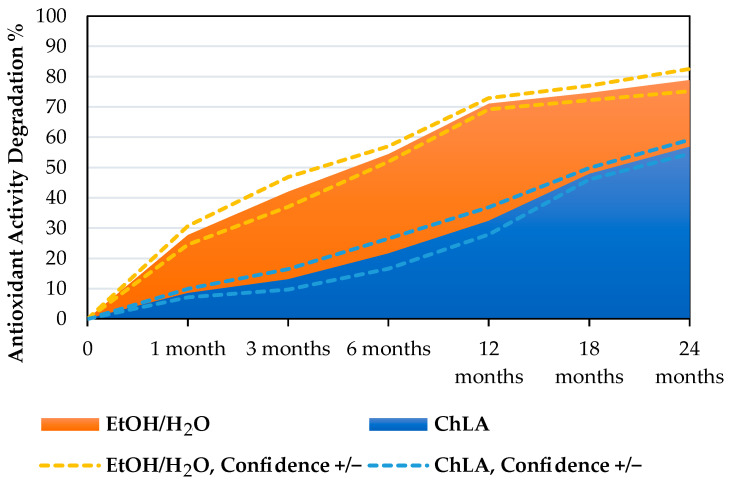
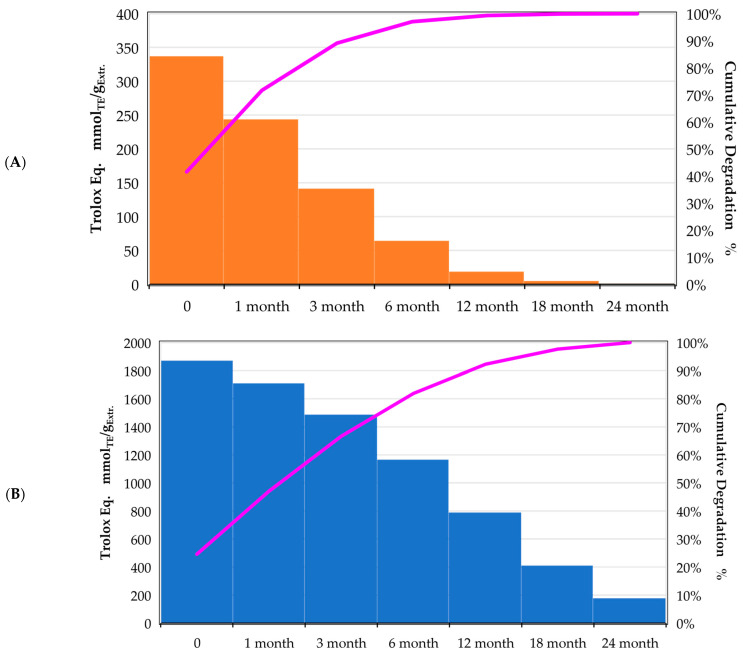
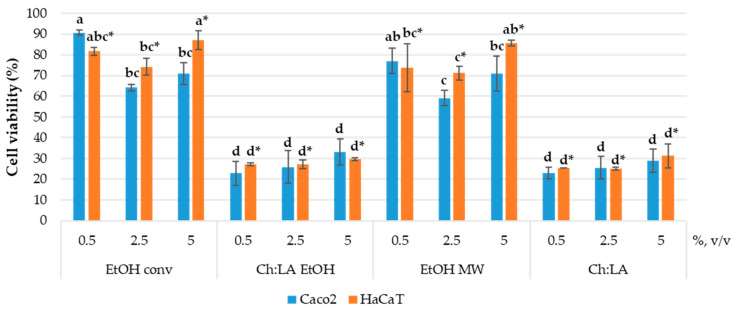
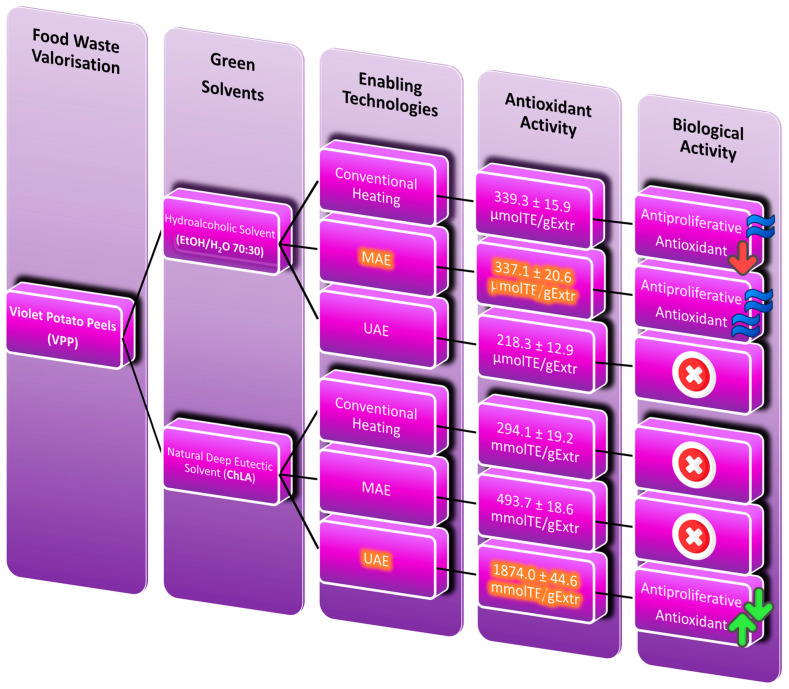
The recovery of valuable bioactive compounds from the main underutilised by-products of the food industry is one of the greatest challenges to be addressed in circular economy. Potato peels are the largest waste generated during potato processing. However, they could be a potential source of valuable bioactive compounds, such as polyphenols, that can be reused as natural antioxidants. Currently, environmentally benign enabling technologies and new types of non-toxic organic solvents for the extraction of bioactive compounds may dramatically improve the sustainability of these processes. This paper focuses on the potential inherent in the valorisation of violet potato peels (VPPs) by recovering antioxidants using natural deep eutectic solvents (NaDES) under ultrasound (US)- and microwave (MW)-assisted extraction. Both the enabling technologies provided performances that were superior to those of conventional extractions in terms of antioxidant activity determined by the DPPH· (2,2-diphenyl-1-picrylhydrazyl) assay. In particular, the most promising approach using NaDES is proven to be the acoustic cavitation with a Trolox eq. of 1874.0 mmolTE/gExtr (40 °C, 500 W, 30 min), vs. the 510.1 mmolTE/gExtr of hydroalcoholic extraction (80 °C, 4 h). The shelf-life of both hydroalcoholic and NaDES-VPPs extracts have been assessed over a period of 24 months, and found that NaDES granted a 5.6-fold shelf-life extension. Finally, the antiproliferative activity of both hydroalcoholic and NaDES-VPPs extracts was evaluated in vitro using the MTS assay on human tumour Caco-2 cells and normal human keratinocyte cells (HaCaT). In particular, NaDES-VPPs extracts exhibited a significantly more pronounced antiproliferative activity compared to the ethanolic extracts without a noteworthy difference between effects on the two cell lines.
Keywords: Solanum tuberosum; antioxidant activity; green extraction; microwave-assisted extraction; phenolic compounds; potato peel valorisation; shelf life; ultrasound-assisted extraction.
Conflict of interest statement
The authors declare no conflict of interest.
Figures
References
-
- [(accessed on 20 April 2023)]. Available online: http://fao.org/faostat/
-
- Oreopoulou V., Russ W. Utilization of by-Products and Treatment of Waste in the Food Industry. Springer; New York, NY, USA: 2007.
-
- Jeswani H.K., Figueroa-Torres G., Azapagic A. The extent of food waste generation in the UK and its environmental impacts. Sustain. Prod. Consum. 2021;26:532–547. doi: 10.1016/j.spc.2020.12.021. - DOI
-
- Tawila M.A., Omer H.A.A., Gad S.M. Partial replacing of concentrate feed mixture by potato processing waste in sheep rations. Am.-Eurasia J. Agric. Environ. Sci. 2008;4:156–164.
LinkOut - more resources
Full Text Sources
