


The Epigenetics of Migraine
- PMID: 37298078
- PMCID: PMC10252316
- DOI: 10.3390/ijms24119127
The Epigenetics of Migraine
Abstract
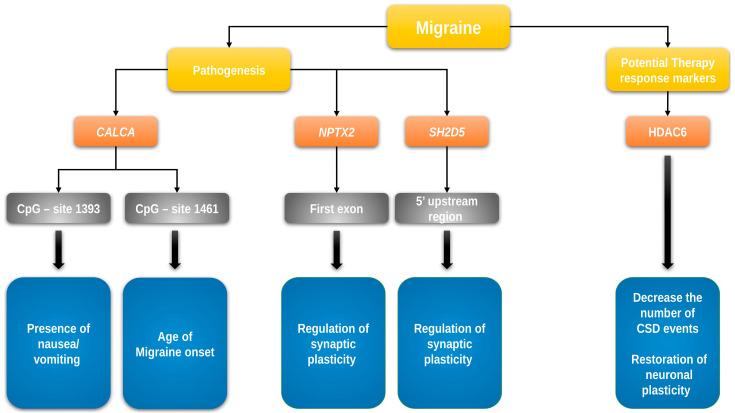
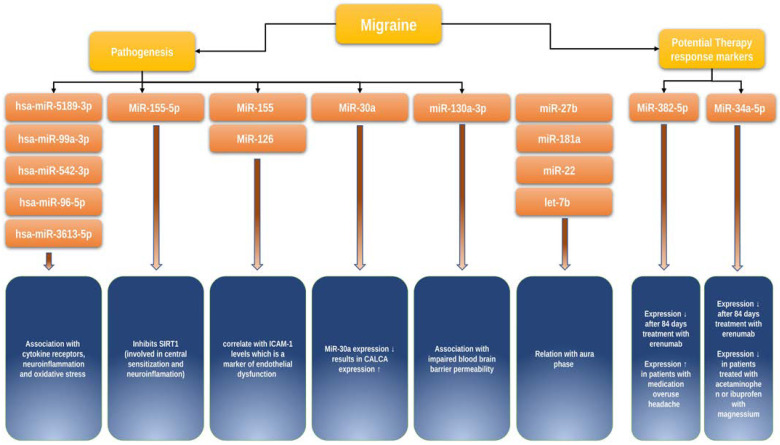
Migraine is a complex neurological disorder and a major cause of disability. A wide range of different drug classes such as triptans, antidepressants, anticonvulsants, analgesics, and beta-blockers are used in acute and preventive migraine therapy. Despite a considerable progress in the development of novel and targeted therapeutic interventions during recent years, e.g., drugs that inhibit the calcitonin gene-related peptide (CGRP) pathway, therapy success rates are still unsatisfactory. The diversity of drug classes used in migraine therapy partly reflects the limited perception of migraine pathophysiology. Genetics seems to explain only to a minor extent the susceptibility and pathophysiological aspects of migraine. While the role of genetics in migraine has been extensively studied in the past, the interest in studying the role of gene regulatory mechanisms in migraine pathophysiology is recently evolving. A better understanding of the causes and consequences of migraine-associated epigenetic changes could help to better understand migraine risk, pathogenesis, development, course, diagnosis, and prognosis. Additionally, it could be a promising avenue to discover new therapeutic targets for migraine treatment and monitoring. In this review, we summarize the state of the art regarding epigenetic findings in relation to migraine pathogenesis and potential therapeutic targets, with a focus on DNA methylation, histone acetylation, and microRNA-dependent regulation. Several genes and their methylation patterns such as CALCA (migraine symptoms and age of migraine onset), RAMP1, NPTX2, and SH2D5 (migraine chronification) and microRNA molecules such as miR-34a-5p and miR-382-5p (treatment response) seem especially worthy of further study regarding their role in migraine pathogenesis, course, and therapy. Additionally, changes in genes including COMT, GIT2, ZNF234, and SOCS1 have been linked to migraine progression to medication overuse headache (MOH), and several microRNA molecules such as let-7a-5p, let-7b-5p, let-7f-5p, miR-155, miR-126, let-7g, hsa-miR-34a-5p, hsa-miR-375, miR-181a, let-7b, miR-22, and miR-155-5p have been implicated with migraine pathophysiology. Epigenetic changes could be a potential tool for a better understanding of migraine pathophysiology and the identification of new therapeutic possibilities. However, further studies with larger sample sizes are needed to verify these early findings and to be able to establish epigenetic targets as disease predictors or therapeutic targets.
Keywords: DNA methylation; circRNA; epigenetics; histone acetylation; microRNA; migraine.
Conflict of interest statement
The authors declare no conflict of interest.
Figures
References
-
- Vos T., Abajobir A.A., Abate K.H., Abbafati C., Abbas K.M., Abd-Allah F., Abdulkader R.S., Abdulle A.M., Abebo T.A., Abera S.F., et al. Global, Regional, and National Incidence, Prevalence, and Years Lived with Disability for 328 Diseases and Injuries for 195 Countries, 1990–2016: A Systematic Analysis for the Global Burden of Disease Study 2016. Lancet. 2017;390:1211–1259. doi: 10.1016/S0140-6736(17)32154-2. - DOI - PMC - PubMed
-
- Cvetković V.V. Is the management of migraine and tension headache in Croatia satisfactory? Acta Med. Croat. 2013;67:415–424. - PubMed
Publication types
MeSH terms
Substances
Grants and funding
LinkOut - more resources
Full Text Sources
Medical
Research Materials
Miscellaneous
