


Presence, Location and Conservation of Putative G-Quadruplex Forming Sequences in Arboviruses Infecting Humans
- PMID: 37298474
- PMCID: PMC10253674
- DOI: 10.3390/ijms24119523
Presence, Location and Conservation of Putative G-Quadruplex Forming Sequences in Arboviruses Infecting Humans
Abstract
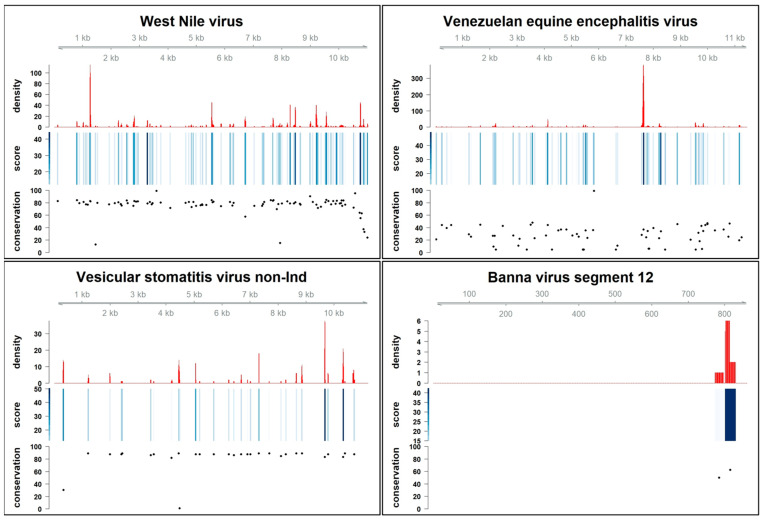
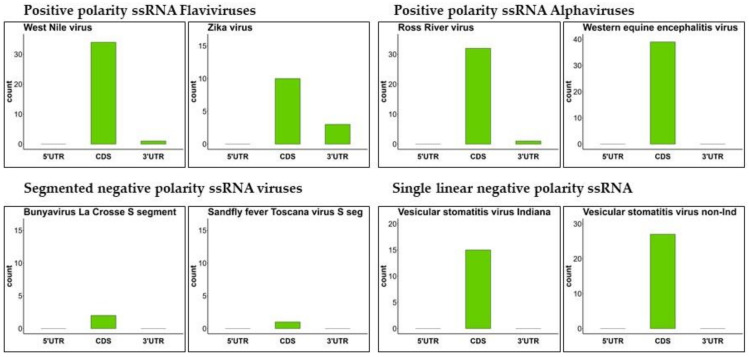
Guanine quadruplexes (G4s) are non-canonical nucleic acid structures formed by guanine (G)-rich tracts that assemble into a core of stacked planar tetrads. G4s are found in the human genome and in the genomes of human pathogens, where they are involved in the regulation of gene expression and genome replication. G4s have been proposed as novel pharmacological targets in humans and their exploitation for antiviral therapy is an emerging research topic. Here, we report on the presence, conservation and localization of putative G4-forming sequences (PQSs) in human arboviruses. The prediction of PQSs was performed on more than twelve thousand viral genomes, belonging to forty different arboviruses that infect humans, and revealed that the abundance of PQSs in arboviruses is not related to the genomic GC content, but depends on the type of nucleic acid that constitutes the viral genome. Positive-strand ssRNA arboviruses, especially Flaviviruses, are significantly enriched in highly conserved PQSs, located in coding sequences (CDSs) or untranslated regions (UTRs). In contrast, negative-strand ssRNA and dsRNA arboviruses contain few conserved PQSs. Our analyses also revealed the presence of bulged PQSs, accounting for 17-26% of the total predicted PQSs. The data presented highlight the presence of highly conserved PQS in human arboviruses and present non-canonical nucleic acid-structures as promising therapeutic targets in arbovirus infections.
Keywords: G-quadruplex; arthropod-borne viruses; innovative targeting; prediction of non-canonical RNA structures.
Conflict of interest statement
The authors declare no conflict of interest.
Figures
References
-
- Vector-Borne Diseases. [(accessed on 1 February 2023)]. Available online: https://www.ecdc.europa.eu/en/climate-change/climate-change-europe/vecto....
-
- Vector-Borne Diseases. [(accessed on 1 February 2023)]. Available online: https://www.who.int/news-room/fact-sheets/detail/vector-borne-diseases.
MeSH terms
Grants and funding
LinkOut - more resources
Full Text Sources
Miscellaneous
