Review
. 2023 May 31;24(11):9584.
doi: 10.3390/ijms24119584.

An Update on Familial Mediterranean Fever

Affiliations
Review

An Update on Familial Mediterranean Fever

Maddalena Lancieri et al. Int J Mol Sci. .

Abstract

(1) Background: Familial Mediterranean Fever (FMF) is the prototypal autoinflammatory disease, characterized by recurrent bursts of neutrophilic inflammation. (2) Methods: In this study we look at the most recent literature on this condition and integrate it with novel information on treatment resistance and compliance. (3) Results: The canonical clinical presentation of FMF is in children with self-limited episodes of fever and polyserositis, associated with severe long-term complications, such as renal amyloidosis. It has been described anecdotally since ancient times, however only recently it has been characterized more accurately. We propose an updated overview on the main aspects of pathophysiology, genetics, diagnosis and treatment of this intriguing disease. (4) Conclusions: Overall, this review presents the all the main aspects, including real life outcome of the latest recommendation on treatment resistance of FMF, a disease, that not only helped understanding the pathophysiology of the auto inflammatory process but also the functioning of the innate immune system itself.

Keywords: Familial Mediterranean Fever; Interlukin-1 Inhibitors; autoinflammatory disease; children; colchicine; colchicine resistance.


Conflict of interest statement

M.G.: speaker fees, consultancies and unrestricted grants from Novartis and SOBI; RC speaker fees from Novartis and SOBI, SV speaker fees from SOBI.

Figures
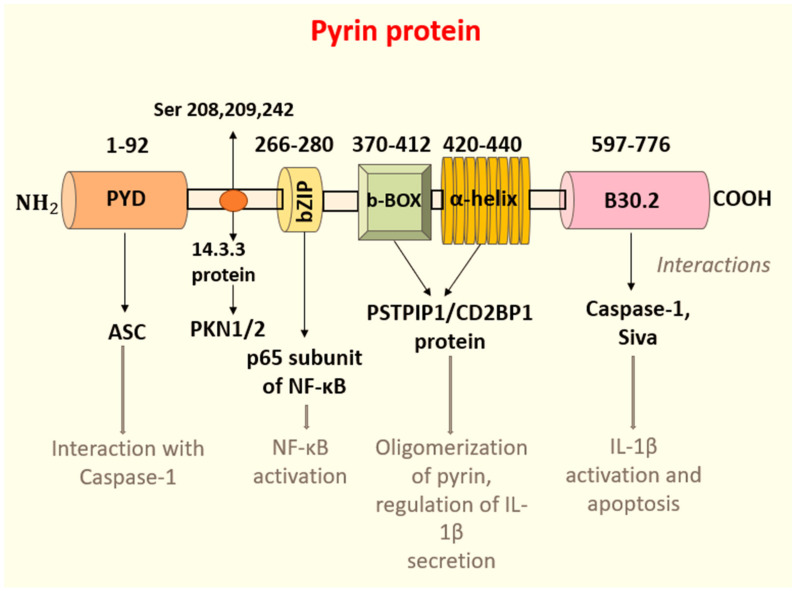
Figure 1
Figure 1
Schematic representation showing the pyrin protein. Pyrin is an approximately 95 kDa protein made up of five domains: a PYD or PYRIN domain (1–92), bZIP transcription factor domain (266–280), B–box zinc finger (370–412), α–helix coiled–coil domain (420–440), and a C–terminal B30.2 domain (597–776). The N–terminal PYD domain is responsible for the interaction with ASC (apoptosis–associated speck–like protein with a caspase recruitment domain), which, in turn, mediates the CARD (caspase recruitment domain) CARD homotypic interface with caspase–1. The bZIP transcription factor basic domain promotes NF–kB activation via the interaction with its subunit p65. The B–box zinc finger and the α–helix domain are involved in the oligomerization of pyrin and the regulation of IL–1β secretion. The B30.2 domain harbours most of the FMF–causing mutation and is functionally important in the activation of the pyrin inflammasome. B30.2 interacts with caspase–1 and pro–apoptotic protein Siva. Three residues of pyrin, serines 208, 209, and 242, are responsible for interacting with the 14.3.3 regulatory molecule that participates in the phosphorylation via PKN 1/2 (serine/threonine protein kinase C–related kinase 1/2).
Figure 2
Figure 2
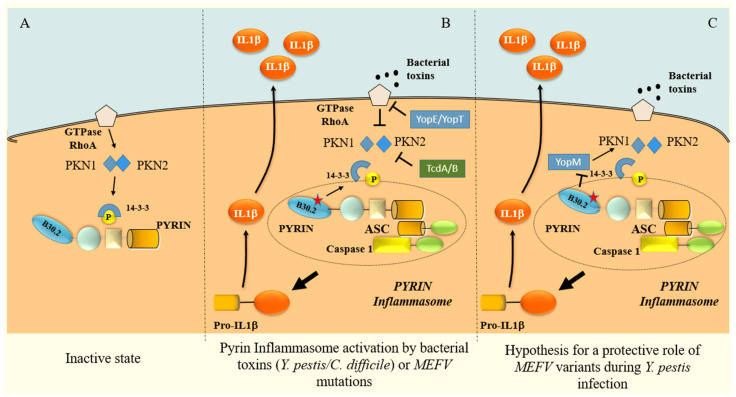
(A) Phosphorylated pyrin in an inactive state. In the steady-state condition, RhoA promotes the inactive configuration of pyrin by inducing its phosphorylation, mediated by the serine–threonine kinases PKN1 and PKN2. B30.2 domain mutations are likely to control pyrin phosphorylation by inhibiting the binding of kinases to pyrin [19]. (B) Pyrin inflammasome assembly promoted by exotoxins or pathogenic MEVF mutations. Toxins produced by some bacteria (i.e., YopE and YopT from Yersinia pestis) directly inactivate RhoA; other toxins, such as TcdA/B from C. difficile, directly inactivate PKN1 and PKN2. The final result is the inhibition of PKN1 and PKN2 activation with the consequent dephosphorylation of pyrin. Pathogenic MEFV mutations of exon 10 (B30.2 domain) interfere with the binding of the 14-3-3 protein to pyrin, leading the pyrin protein to be more susceptible to dephosphorylation. Dephosphorylated pyrin is active and able to interact with ASC and caspase-1, forming the pyrin inflammasome. IL-1β is cleaved to its active form as a result of the autocatalysis and activation of two precursors molecules of caspase-1. (C) Hypothesis for the possible protective role of the MEFV mutation during Yersinia pestis infection. The Y. pestis-induced virulence factor YopM directly inhibits pyrin inflammasome formation by promoting PNK1/2-mediated pyrin phosphorylation. MEFV mutations on the B30.2 domain attenuate the pyrin–YopM interaction, thus interfering with YopM anti-inflammatory activity.
Figure 3
Figure 3
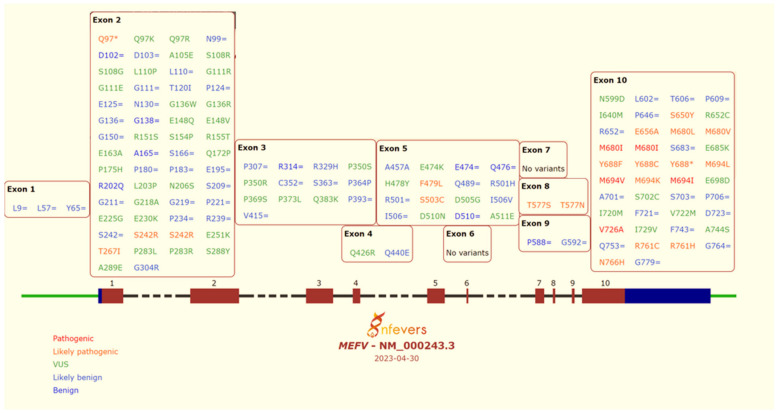
MEFV mutational spectrum based on the free source INFEVER online database. In red and orange are marked, respectively, pathogenic and likely pathogenic mutations; in green are marked VUS (variance of unknown significance); and in light blue and blue are marked likely benign and benign variants. Hot spots for pathogenic mutations are found on exons 2 and 10.
Figure 4
Figure 4
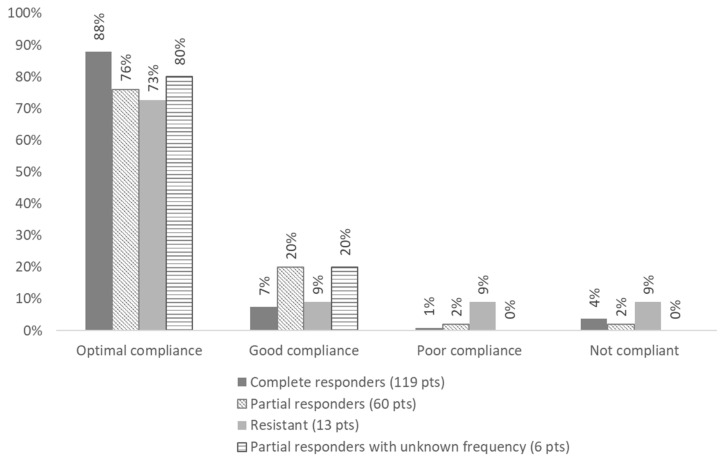
Compliance with colchicine treatment according to disease activity. Optimal compliance (compliant with >90% of prescriptions). Good compliance (compliant with 50–89% of prescriptions). Poor compliance (compliant with less than 50% of prescriptions) [125].
Figure 5
Figure 5
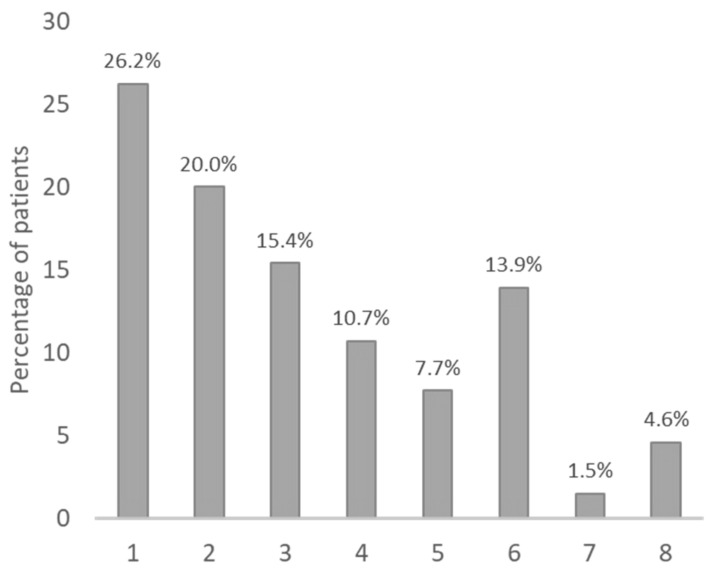
Number of episodes/year in patients with incomplete response to colchicine and less than one episode/month (partial responders) [128].
Figure 6
Figure 6
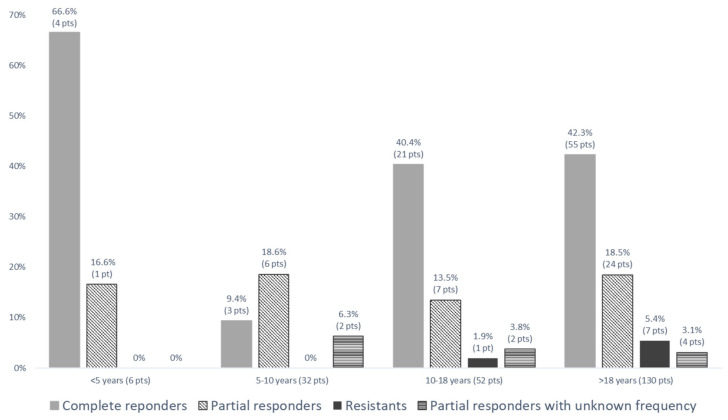
Colchicine response by age group in patients still receiving equal or less than the starting dose [128].

References

    1. Alghamdi M. Familial Mediterranean Fever, Review of the Literature. Clin. Rheumatol. 2017;36:1707–1713. doi: 10.1007/s10067-017-3715-5. - DOI - PubMed
    1. French FMF Consortium A Candidate Gene for Familial Mediterranean Fever. Nat. Genet. 1997;17:25–31. doi: 10.1038/ng0997-25. - DOI - PubMed
    1. Siegal S. Benign Paroxysmal Peritonitis. Gastroenterology. 1949;12:234–247. doi: 10.1016/S0016-5085(49)80034-5. - DOI - PubMed
    1. Goldfinger S.E. Colchicine for Familial Mediterranean Fever. N. Engl. J. Med. 1972;287:1302. doi: 10.1056/NEJM197212212872514. - DOI - PubMed
    1. Zemer D., Revach M., Pras M., Modan B., Schor S., Sohar E., Gafni J. A Controlled Trial of Colchicine in Preventing Attacks of Familial Mediterranean Fever. N. Engl. J. Med. 1974;191:932–934. doi: 10.1056/NEJM197410312911803. - DOI - PubMed

MeSH terms