. 2023 Jun 4;24(11):9742.
doi: 10.3390/ijms24119742.

Exploring the Potential of Sulfonamide-Dihydropyridine Hybrids as Multitargeted Ligands for Alzheimer's Disease Treatment

Affiliations

Exploring the Potential of Sulfonamide-Dihydropyridine Hybrids as Multitargeted Ligands for Alzheimer's Disease Treatment

Imen Dakhlaoui et al. Int J Mol Sci. .

Abstract

Alzheimer's disease (AD) is a multifactorial neurodegenerative disease that has a heavy social and economic impact on all societies and for which there is still no cure. Multitarget-directed ligands (MTDLs) seem to be a promising therapeutic strategy for finding an effective treatment for this disease. For this purpose, new MTDLs were designed and synthesized in three steps by simple and cost-efficient procedures targeting calcium channel blockade, cholinesterase inhibition, and antioxidant activity. The biological and physicochemical results collected in this study allowed us the identification two sulfonamide-dihydropyridine hybrids showing simultaneous cholinesterase inhibition, calcium channel blockade, antioxidant capacity and Nrf2-ARE activating effect, that deserve to be further investigated for AD therapy.

Keywords: Hantzsch reaction; Nrf2; calcium channel antagonism; cholinesterase inhibition; multitarget directed ligands.


Conflict of interest statement

The authors declare no conflict of interest.

Figures

Figure 1
Figure 1
Design of Sulfonamide−Dihydropyridine Hybrids.
Scheme 1
Scheme 1
Synthesis of Multi-Target-Directed Ligands 4a–i.
Figure 2
Figure 2
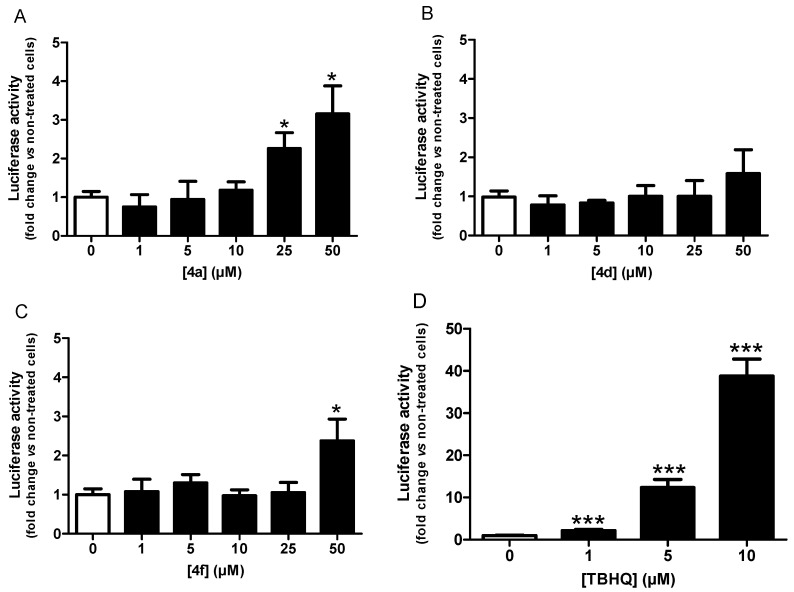
Nrf2 transcriptional activation potencies of compounds 4a (A), 4d (B), 4f (C) and reference compound TBHQ (D). Data are means ± SEM of at least four different experiments. * p ≤ 0.05 and *** p ≤ 0.001 with respect to control cells.
Figure 3
Figure 3
Docked pose of inhibitors 4a and 4f at the active site of EeAChE. Compounds are rendered as balls and sticks (carbon atoms in pink (4a), in blue (4f)) and the side chain conformations of the mobile residues are illustrated in the same colour as ligand. The catalytic triad (CT) is coloured in green, the oxyanion hole (OH) in magenta, the anionic subsite (AS) in orange, except Trp86, the acyl binding pocket (ABP) in yellow and PAS in light blue.
Figure 4
Figure 4
Docked pose of inhibitors 4a and 4f at the active site of EeAChE. (a) 2D representation of the amino acids in the binding site interacting with the ligand 4a (pink). (b) 2D representation of the amino acids in the binding site interacting with the ligand 4f (blue).
Figure 5
Figure 5
Proposed binding mode for compounds 4a and 4f inside gorge cavity of eqBChE. (a) Compound 4a is coloured brown. (b) Compound 4f is coloured pink. Different subsites of the active site were coloured: CAS in green, OH in red, in violet CBS, ABP in yellow and PAS in blue.
Figure 6
Figure 6
2D-representation of interactions established by compounds 4a and 4f with eqBChE. (a) Compound 4a is coloured in brown. (b) Compound 4f is coloured in pink.

References

    1. Querfurth H.W., LaFerla F.M. Alzheimer’s Disease. N. Engl. J. Med. 2010;362:329–344. doi: 10.1056/NEJMra0909142. - DOI - PubMed
    1. Bartus R.T., Dean R.L., 3rd, Beer B., Lippa A.S. The Cholinergic Hypothesis of Geriatric Memory Dysfunction. Science. 1982;217:408–414. doi: 10.1126/science.7046051. - DOI - PubMed
    1. Benilova I., Karran E., De Strooper B. The Toxic Aβ Oligomer and Alzheimer’s Disease: An Emperor in Need of Clothes. Nat. Neurosci. 2012;15:349–357. doi: 10.1038/nn.3028. - DOI - PubMed
    1. Hamley I.W. The Amyloid Beta Peptide: A Chemist’s Perspective. Role in Alzheimer’s and Fibrillization. Chem. Rev. 2012;112:5147–5192. doi: 10.1021/cr3000994. - DOI - PubMed
    1. Murphy M.P., LeVine H., 3rd Alzheimer’s Disease and the Amyloid-β Peptide. J. Alzheimers Dis. 2010;19:311–323. doi: 10.3233/JAD-2010-1221. - DOI - PMC - PubMed

MeSH terms