


Broccoli, Kale, and Radish Sprouts: Key Phytochemical Constituents and DPPH Free Radical Scavenging Activity
- PMID: 37298743
- PMCID: PMC10254352
- DOI: 10.3390/molecules28114266
Broccoli, Kale, and Radish Sprouts: Key Phytochemical Constituents and DPPH Free Radical Scavenging Activity
Abstract
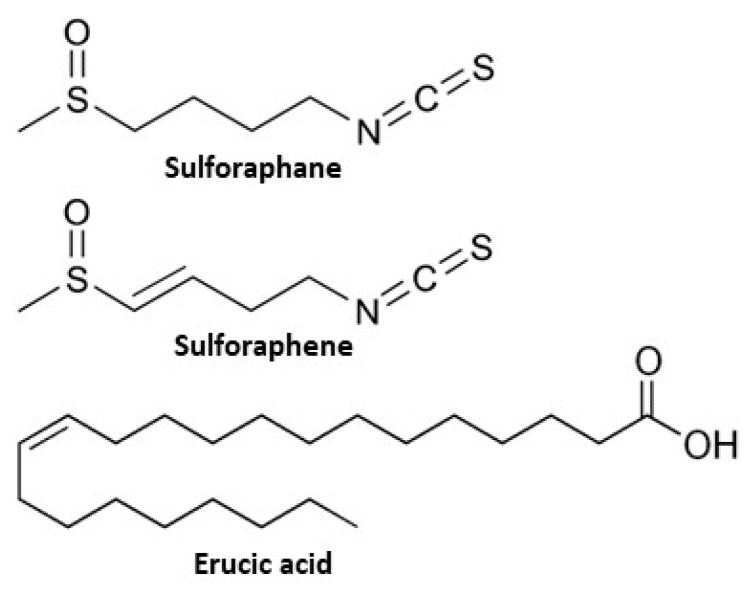
Our research group previously found that broccoli sprouts possess neuroprotective effects during pregnancy. The active compound has been identified as sulforaphane (SFA), obtained from glucosinolate and glucoraphanin, which are also present in other crucifers, including kale. Sulforaphene (SFE), obtained from glucoraphenin in radish, also has numerous biological benefits, some of which supersede those of sulforaphane. It is likely that other components, such as phenolics, contribute to the biological activity of cruciferous vegetables. Notwithstanding their beneficial phytochemicals, crucifers are known to contain erucic acid, an antinutritional fatty acid. The aim of this research was to phytochemically examine broccoli, kale, and radish sprouts to determine good sources of SFA and SFE to inform future studies of the neuroprotective activity of cruciferous sprouts on the fetal brain, as well as product development. Three broccoli: Johnny's Sprouting Broccoli (JSB), Gypsy F1 (GYP), and Mumm's Sprouting Broccoli (MUM), one kale: Johnny's Toscano Kale (JTK), and three radish cultivars: Black Spanish Round (BSR), Miyashige (MIY), and Nero Tunda (NT), were analyzed. We first quantified the glucosinolate, isothiocyanate, phenolics, and DPPH free radical scavenging activity (AOC) of one-day-old dark- and light-grown sprouts by HPLC. Radish cultivars generally had the highest glucosinolate and isothiocyanate contents, and kale had higher glucoraphanin and significantly higher sulforaphane content than the broccoli cultivars. Lighting conditions did not significantly affect the phytochemistry of the one-day-old sprouts. Based on phytochemistry and economic factors, JSB, JTK, and BSR were chosen for further sprouting for three, five, and seven days and subsequently analyzed. The three-day-old JTK and radish cultivars were identified to be the best sources of SFA and SFE, respectively, both yielding the highest levels of the respective compound while retaining high levels of phenolics and AOC and markedly lower erucic acid levels compared to one-day-old sprouts.
Keywords: antioxidant activity; broccoli; cruciferous; erucic acid; glucosinolates; kale; radish; sulforaphane (SFA); sulforaphene (SFE); total phenolics.
Conflict of interest statement
The authors declare no conflict of interest.
Figures


References
-
- Connolly E.L., Sim M., Travica N., Marx W., Beasy G., Lynch G.S., Bondonno C.P., Lewis J.R., Hodgson J.M., Blekkenhorst L.C. Glucosinolates from Cruciferous Vegetables and Their Potential Role in Chronic Disease: Investigating the Preclinical and Clinical Evidence. Front. Pharmacol. 2021;12:767975. doi: 10.3389/fphar.2021.767975. - DOI - PMC - PubMed
-
- Costa-Pérez A., Núñez-Gómez V., Baenas N., Di Pede G., Achour M., Manach C., Mena P., Del Rio D., García-Viguera C., Moreno D.A., et al. Systematic Review on the Metabolic Interest of Glucosinolates and Their Bioactive Derivatives for Human Health. Nutrients. 2023;15:1424. doi: 10.3390/nu15061424. - DOI - PMC - PubMed
MeSH terms
Substances
LinkOut - more resources
Full Text Sources
Research Materials
