


Synthetic Study toward Triterpenes from the Schisandraceae Family of Natural Products
- PMID: 37298943
- PMCID: PMC10254518
- DOI: 10.3390/molecules28114468
Synthetic Study toward Triterpenes from the Schisandraceae Family of Natural Products
Abstract
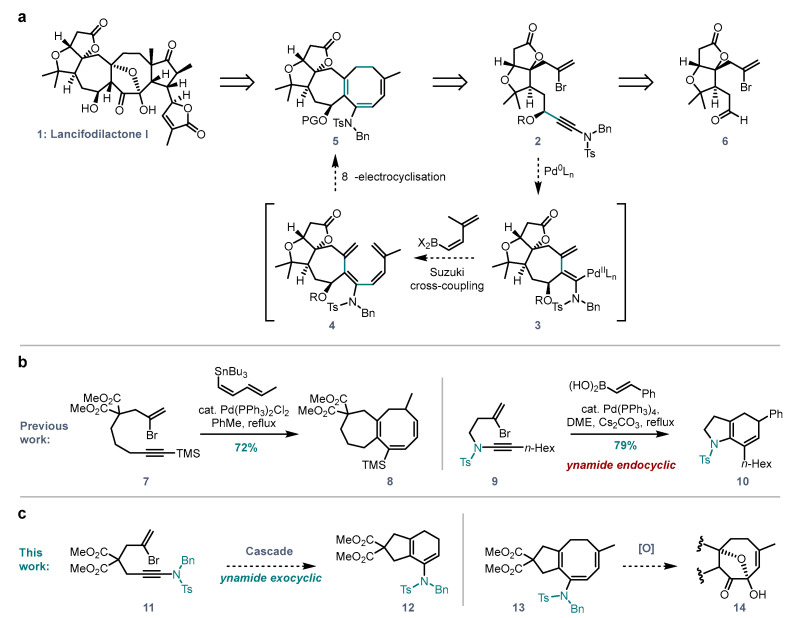
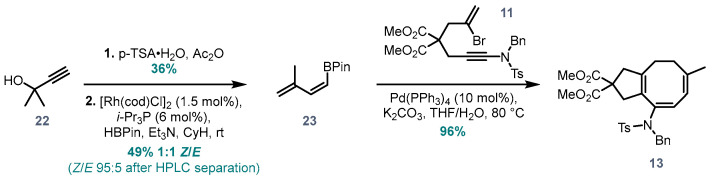
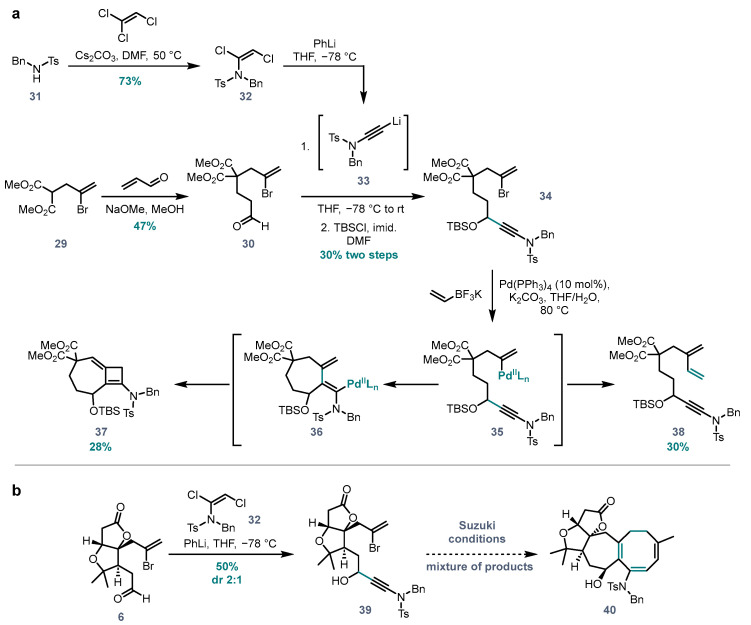
Triterpenoid natural products from the Schisandraceae family have long presented a significant synthetic challenge. Lancifodilactone I, a member of the family not previously synthesized, was identified as a key natural product target, from which many other members could be synthesized. We envisaged that the core ring system of lancifodilactone I could be accessed by a strategy involving palladium-catalysed cascade cyclisation of a bromoenynamide, via carbopalladation, Suzuki coupling and 8π-electrocyclisation, to synthesize the core 7,8-fused ring system. Exploration of this strategy on model systems resulted in efficient syntheses of 5,6- and 5,8-fused systems in high yields, which represent the first such cyclisation where the ynamide nitrogen atom is 'external' to the forming ring system. The enamide functionality resident in the cascade cyclisation product was found to be less nucleophilic than the accompanying tri-/tetrasubstituted alkene(s), enabling regioselective oxidations. Application of this strategy to 7,6-, and 7,8-fused systems, and ultimately the 'real' substrate, was ultimately thwarted by the difficulty of 7-membered ring closure, leading to side product formation. Nevertheless, a tandem bromoenynamide carbopalladation, Suzuki coupling and 6/8π-electrocyclisation was shown to be a highly efficient tactic for the formation of bicyclic enamides, which may find applications in other synthetic contexts.
Keywords: Suzuki coupling; cascade reaction; electrocyclisation; medium ring synthesis; natural products; total synthesis; ynamides.
Conflict of interest statement
The authors declare no conflict of interest.
Figures


References
Grants and funding
LinkOut - more resources
Full Text Sources
