Review
. 2023 Jun 5;28(11):4564.
doi: 10.3390/molecules28114564.

1,3-Butadiynamides the Ethynylogous Ynamides: Synthesis, Properties and Applications in Heterocyclic Chemistry

Affiliations
Review

1,3-Butadiynamides the Ethynylogous Ynamides: Synthesis, Properties and Applications in Heterocyclic Chemistry

Illia Lenko et al. Molecules. .

Abstract

1,3-butadiynamides-the ethynylogous variants of ynamides-receive considerable attention as precursors of complex molecular scaffolds for organic and heterocyclic chemistry. The synthetic potential of these C4-building blocks reveals itself in sophisticated transition-metal catalyzed annulation reactions and in metal-free or silver-mediated HDDA (Hexa-dehydro-Diels-Alder) cycloadditions. 1,3-Butadiynamides also gain significance as optoelectronic materials and in less explored views on their unique helical twisted frontier molecular orbitals (Hel-FMOs). The present account summarizes different methodologies for the synthesis of 1,3-butadiynamides followed by the description of their molecular structure and electronic properties. Finally, the surprisingly rich chemistry of 1,3-butadiynamides as versatile C4-building blocks in heterocyclic chemistry is reviewed by compiling their exciting reactivity, specificity and opportunities for organic synthesis. Besides chemical transformations and use in synthesis, a focus is set on the mechanistic understanding of the chemistry of 1,3-butadiynamides-suggesting that 1,3-butadiynamides are not just simple alkynes. These ethynylogous variants of ynamides have their own molecular character and chemical reactivity and reflect a new class of remarkably useful compounds.

Keywords: 1,3-diynamides; Hexa-dehydro-Diels–Alder (HDDA) reaction; alkynes; annulation reactions; carbazoles; cycloaddition cascade reactions; helical twisted frontier molecular orbitals (Hel-FMO); heterocycles; homogeneous catalysis; indoles; quinolines; ynamides.


Conflict of interest statement

The authors declare no conflict of interest.

Figures

Figure 1
Figure 1
Mesomeric resonance structures of ynamines, ynamides and 1,3-butadiynamides.
Scheme 1
Scheme 1
Retrosynthesis of 1,3-butadiynamide.
Scheme 2
Scheme 2
Symmetrical substituted 1,3-diynamides via oxidative Glaser–Hay coupling.
Scheme 3
Scheme 3
1,3-Butadiynamides via Cadiot–Chodkiewicz cross-coupling reaction.
Scheme 4
Scheme 4
Synthesis of oxazolidine-2-one-derived 1,3-butadiynamides.
Scheme 5
Scheme 5
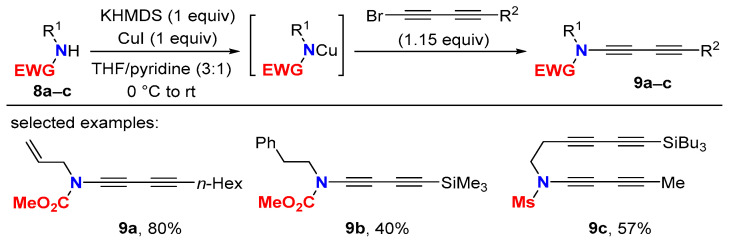
Synthesis of 1,3-butadiynamide via Cu-mediated C-N bond formation.
Scheme 6
Scheme 6
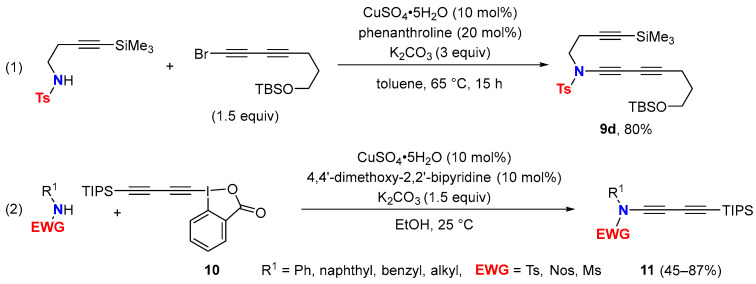
Copper-catalyzed synthesis of 1,3-butadiynamides.
Scheme 7
Scheme 7
Modification of the 1,3-butadiynamide C-terminus.
Figure 2
Figure 2
Helical twisted molecular orbitals in extended conjugated oligoynamides.
Figure 3
Figure 3
Correlation of the number of alkyne units in ynamides with the magnitude of change of dipole moment from ground to Franck–Condon excited state Δaμ.
Scheme 8
Scheme 8
Regio- and stereoselective hydrohalogenation of 1,3-butadiynamide.
Scheme 9
Scheme 9
Radical germylzincation towards stereodefined ynenamides.
Scheme 10
Scheme 10
Gold-catalyzed synthesis of 2,5-diamidopyrroles.
Scheme 11
Scheme 11
Gold-catalyzed synthesis of a 1,2,5-trisubstituted pyrrole with phenylhydrazine.
Scheme 12
Scheme 12
Copper-catalyzed synthesis of 2,5-diamidopyrroles.
Scheme 13
Scheme 13
Copper-catalyzed synthesis of diazepines derived from 1,3-diynamides.
Scheme 14
Scheme 14
Gold- or copper-catalyzed synthesis of 2,5-diamidofurans.
Scheme 15
Scheme 15
Metal-catalyst-free synthesis of 2-amido- and 2,5-diamidothiophenes.
Scheme 16
Scheme 16
Synthesis of a terthiophene.
Scheme 17
Scheme 17
Intramolecular [4+2] cycloaddition with 1,3-butadiynamides to give 7-alkynyl indolines via DHDA reaction.
Scheme 18
Scheme 18
Intermolecular azide-alkyne [3+2] cycloaddition with 1,3-butadiynamides to give 4-alkynyl triazoles.
Scheme 19
Scheme 19
Intermolecular [3+2] cycloaddition of aminide 40 to 1,3-butadiynamide 3k to give 5-alkynyloxazole 41.
Scheme 20
Scheme 20
Au(I)-catalyzed 1,4-oxidation of 1,3-butadiynamides.
Scheme 21
Scheme 21
Au(I)- and Au(III)-mediated oxidative cyclization of 5-hydroxy-1,3-butadiynamides.
Scheme 22
Scheme 22
Proposed mechanism for the Au-catalyzed oxidative formation of cyclic ketones.
Scheme 23
Scheme 23
Gold-catalyzed synthesis of sulfone-containing pyrrolo[2,1-a]tetrahydroisoquinolines.
Scheme 24
Scheme 24
Proposed mechanism for the gold-catalyzed transformation of 1,3-butadiynamides into sulfone-containing pyrrolo[2,1-a]tetrahydroisoquinolines.
Scheme 25
Scheme 25
Gold(I)-catalyzed para-toluenesulfonic acid (PTSA) promoted the cycloisomerization of 1,3-diynamides to α,β-unsaturated ketones.
Scheme 26
Scheme 26
Gold-catalyzed formal HDDA/carboalkoxylation reaction cascade.
Scheme 27
Scheme 27
Proposed mechanism for the Au-catalyzed carboalkoxylation reaction cascade.
Scheme 28
Scheme 28
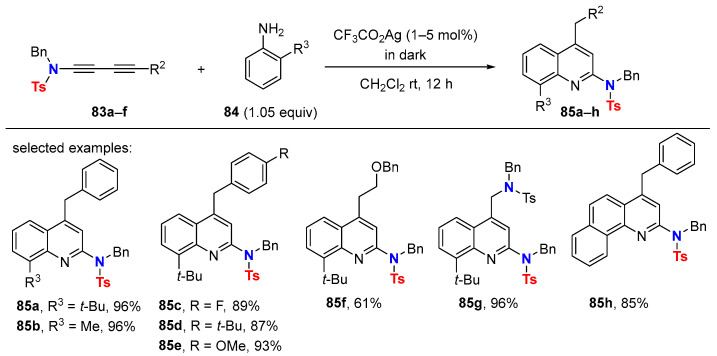
Ag(I)-catalyzed synthesis of 2-amidoquinolines.
Scheme 29
Scheme 29
Proposed mechanism for the Ag(I)-catalyzed synthesis of 2-amidoquinolines.
Scheme 30
Scheme 30
Au(I)-catalyzed synthesis of 2-aminopyrrolo[1,2-b]pyridazines.
Scheme 31
Scheme 31
Cu(II)/Zn(II)-catalyzed synthesis of 1H-pyrrolo[3,2-c]quinolines.
Scheme 32
Scheme 32
Proposed mechanism of Cu(II)/Zn(II)-catalyzed synthesis of 1H-pyrrolo[3,2-c]quinolines.
Scheme 33
Scheme 33
Gold-catalyzed reaction between 1,3-butadiynamides and anthranils.
Scheme 34
Scheme 34
Proposed mechanism for Au(I)-catalyzed reaction of 1,3-butadiynamides with anthranil.
Scheme 35
Scheme 35
Au(I)-catalyzed synthesis of furo[2,3-c]isoquinolines.
Scheme 36
Scheme 36
Proposed mechanism for the synthesis of furo[2,3-c]isoquinolines.
Scheme 37
Scheme 37
Gold-catalyzed synthesis of 6H-furo[3′,2′:5,6]pyrido[3,4-b]indoles.
Scheme 38
Scheme 38
Gold-catalyzed synthesis of polycyclic product 127.
Scheme 39
Scheme 39
Proposed mechanism for the synthesis of 127.
Scheme 40
Scheme 40
Au(I)-catalyzed reaction of 2,4-dimethoxyphenyl-tethered 1,3-butadiynamide 132 with pyridine N-oxide (114).
Scheme 41
Scheme 41
Au(I)-catalyzed reaction of 2,5-dimethoxyphenyl-tethered 1,3-butadiynamides 136 with pyridine N-oxide (114).
Scheme 42
Scheme 42
Proposed mechanism for the Au(I)-catalyzed reaction of 2,5-dimethoxyphenyl-tethered 1,3-butadiynamides 136 with pyridine N-oxide (114).
Scheme 43
Scheme 43
Divergent Pd-catalyzed reaction cascades towards indole and quinoline motifs.
Scheme 44
Scheme 44
Proposed mechanism for the Pd-catalyzed divergent synthesis of either 2-amino-3-alkynyl-indoles (path a) or 2-amino-4-alkenylquinolines via [4]cumulenimine intermediate (path b).
Scheme 45
Scheme 45
Regioselective “trapping reactions” of 1,3-butadiynamide-derived arynes.
Scheme 46
Scheme 46
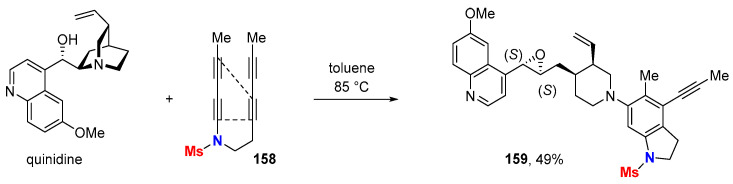
Reaction of a HDDA-generated aryne with quinidine.
Scheme 47
Scheme 47
Mechanistic pathway of the formation of a single HDDA-generated aryne from 1,3-butadiynamide-derived substrates.
Scheme 48
Scheme 48
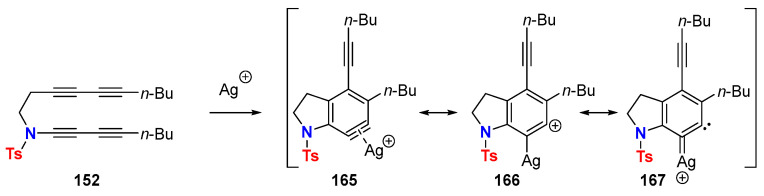
Ag(I)-complexed aryne species in silver-catalyzed HDDA reactions.
Scheme 49
Scheme 49
Biaryl vs. diaryl ether synthesis through aryne reactions with phenols.
Scheme 50
Scheme 50
Intermolecular Alder-ene reactions with 1,3-butadiynamide-derived arynes.
Scheme 51
Scheme 51
Alder-ene reactions of 1,3-butadiynamide-(179ab)-derived arynes 180ab.
Scheme 52
Scheme 52
Intramolecular Alder-ene reactions or [2+2] cycloadditions with ynamide-derived tetraynes tethered with an allene.
Scheme 53
Scheme 53
Synthesis of pentacyclic products via HDDA-aryne-mediated arene dearomatization reaction.
Scheme 54
Scheme 54
Main intermediates of the proposed mechanistic pathway.
Scheme 55
Scheme 55
Domino HDDA reactions towards polyacenes.
Scheme 56
Scheme 56
Tertiary amine addition onto HDDA-generated aryne.
Scheme 57
Scheme 57
Three-component reactions of HDDA-generated benzynes with (bi)cyclic tertiary amines and protic nucleophiles.
Scheme 58
Scheme 58
Reaction of HDDA-generated arynes with six-membered N-heteroaromatics.
Scheme 59
Scheme 59
Trapping of HDDA-generated benzynes with (1) diaziridines and (2) arylhydrazines.
Scheme 60
Scheme 60
Trapping of HDDA-generated benzynes with a C,N-diarylimine.
Scheme 61
Scheme 61
Intramolecular reaction of HDDA-generated benzynes from 1,3-butadiynamides tethered with a silyl ether.
Scheme 62
Scheme 62
Diversity of HDDA–aryne reaction modes with glycidol derivatives via Pinacol-like rearrangements or oxirane fragmentation.
Scheme 63
Scheme 63
Catching HDDA-generated arynes with conjugated enals towards benzopyran structures.
Scheme 64
Scheme 64
Synthesis of dimeric dibenzofuran helicenes.
Scheme 65
Scheme 65
Mechanistic rationale for the formation of dibenzohelicene 247.
Scheme 66
Scheme 66
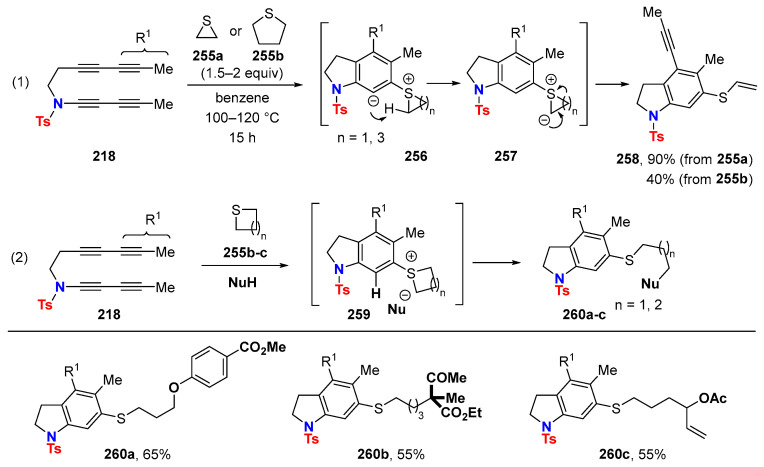
Reaction of HDDA-generated arynes with cyclic sulfides.
Scheme 67
Scheme 67
Reaction of HDDA-generated arynes with aromatic thioamides.
Scheme 68
Scheme 68
Trapping of HDDA-generated arynes with NHC-boranes.
Scheme 69
Scheme 69
Reaction of HDDA-generated aryne via silver-catalyzed alkane C-H insertion.
Scheme 70
Scheme 70
Intramolecular trapping of HDDA-generated aryne from silyl-substituted substrates.
Scheme 71
Scheme 71
Intermolecular hydroarylation of silver-complexed HDDA-generated arynes.
Scheme 72
Scheme 72
Reaction of silver-complexed HDDA-generated arynes with nitriles.
Scheme 73
Scheme 73
Synthesis of phenolic compounds from HDDA-generated arynes.
Scheme 74
Scheme 74
Silver-mediated fluorination, trifluoromethylation and trifluoromethylthiolation of HDDA-generated arynes.
Scheme 75
Scheme 75
Ruthenium-catalyzed hydrohalogenation of HDDA-generated arynes.
Scheme 76
Scheme 76
Copper-catalyzed bromo- and hydroalkynylation of HDDA-generated arynes.
Scheme 77
Scheme 77
Proposed mechanism of copper-catalyzed bromoalkynylation and hydroalkynylation of HDDA-generated arynes.
Scheme 78
Scheme 78
Different outcomes of the reaction of HDDA-generated aryne with homopropargyl alcohol with and without copper catalyst.

References

    1. Witulski B., Stengel T. N-Functionalized 1-Alkynylamides: New Building Blocks for Transition Metal Mediated Inter- and Intramolecular [2+2+1] Cycloadditions. Angew. Chem. Int. Ed. 1998;37:489–492. doi: 10.1002/(SICI)1521-3773(19980302)37:4<489::AID-ANIE489>3.0.CO;2-N. - DOI - PubMed
    1. Iftikhar R., Mazhar A., Iqbal M.S., Khan F.Z., Askary S.H., Sibtain H. Ring Forming Transformation of Ynamides via Cycloaddition. RSC. Adv. 2023;13:10715–10756. doi: 10.1039/D3RA00139C. - DOI - PMC - PubMed
    1. Hu Y.-C., Zhao Y., Wan B., Chen Q.-A. Reactivity of Ynamides in Catalytic Intermolecular Annulations. Chem. Soc. Rev. 2021;50:2582–2625. doi: 10.1039/D0CS00283F. - DOI - PubMed
    1. Shandilya S., Gogoi M.P., Dutta S., Sahoo A.K. Gold-Catalyzed Transformation of Ynamides. Chem. Rec. 2021;21:4123–4149. doi: 10.1002/tcr.202100159. - DOI - PubMed
    1. Campeau D., Rayo D.F.L., Mansour A., Muratov K., Gagosz F. Gold-Catalyzed Reactions of Specially Activated Alkynes, Allenes and Alkenes. Chem. Rev. 2021;121:8756–8867. doi: 10.1021/acs.chemrev.0c00788. - DOI - PubMed

LinkOut - more resources