


Gut-Brain Interaction Disorders and Anorexia Nervosa: Psychopathological Asset, Disgust, and Gastrointestinal Symptoms
- PMID: 37299464
- PMCID: PMC10255922
- DOI: 10.3390/nu15112501
Gut-Brain Interaction Disorders and Anorexia Nervosa: Psychopathological Asset, Disgust, and Gastrointestinal Symptoms
Abstract
Background: Gastrointestinal (GI) symptoms are very common in subjects with eating disorders (EDs). This study aimed to (a) investigate the prevalence of gut-brain interaction disorders (DGBIs) in anorexia nervosa (AN) patients, according to ROME IV criteria; and (b) explore AN psychopathological assets and disgust that might impact GI symptoms.
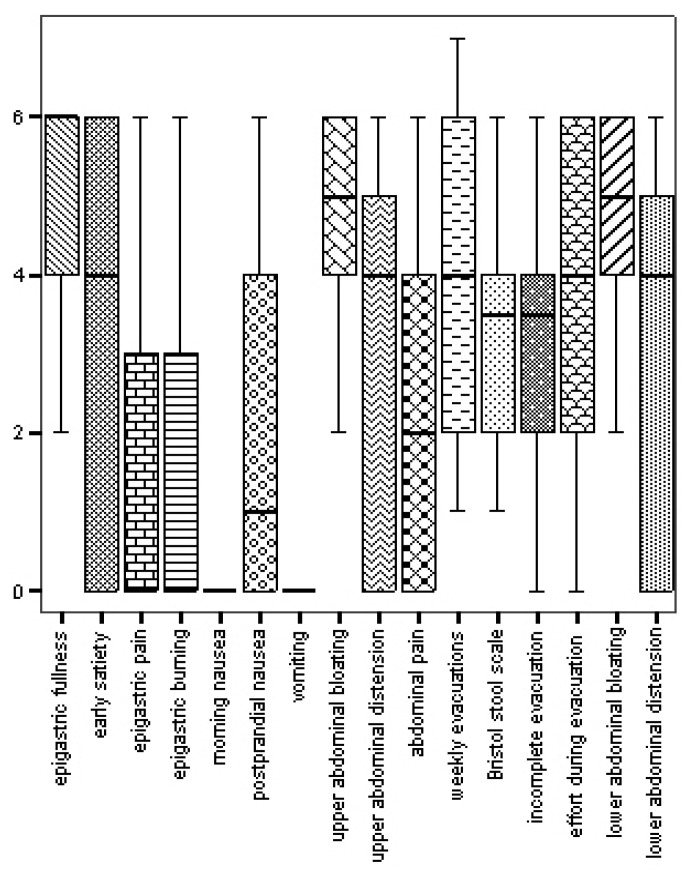
Methods: Thirty-eight female patients consecutively diagnosed with untreated AN (age 19.32 ± 5.59) in an outpatient clinic devoted to EDs underwent Eating Disorder Inventory-3 (EDI-3), Hospital Anxiety and Depression Scale (HADS), Social Phobia Anxiety Scale (SPAS), Body Uneasiness Test (BUT), and Disgust Scale (DS) questionnaires. The presence of DGBIs was evaluated and GI symptoms were assessed using a standardized intensity-frequency questionnaire.
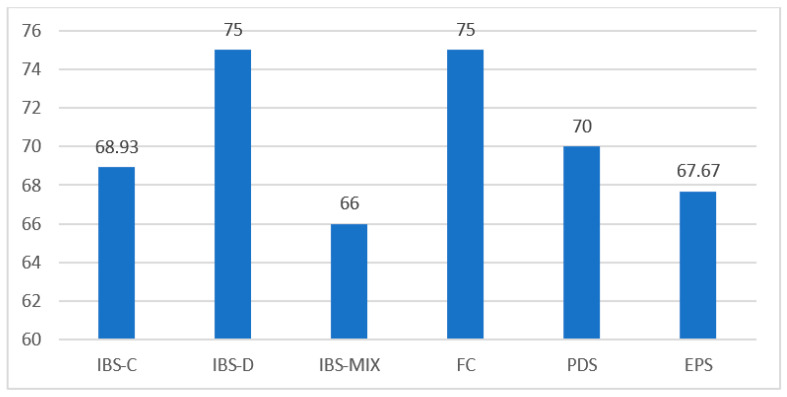
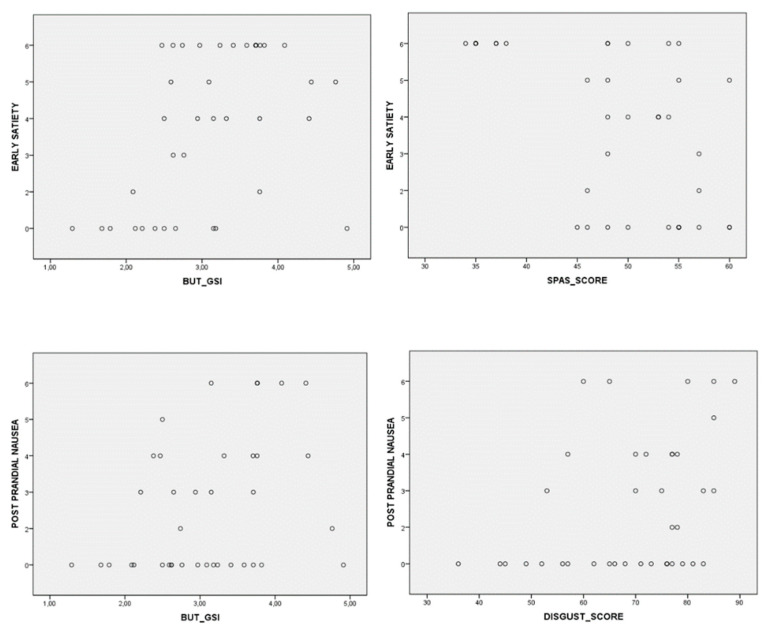
Results: A total of 94.7% of our sample met the diagnostic criteria for functional dyspepsia (FD), of which 88.8% presented the postprandial distress syndrome (PDS) subtype and 41.6% presented the epigastric pain syndrome (EPS) subtype. In addition, 52.6% of the sample met the diagnostic criteria for irritable bowel syndrome (IBS), while for functional constipation (FC), prevalence reached 7.9%. All participants presented a pathological score on the disgust scale. Significant correlations were found between several GI symptoms and psychopathological asset and disgust.
Conclusions: AN is a multifactorial disorder. It is necessary to implement studies with an integrated approach, taking into account DGBIs, as well as to monitor the emotional-cognitive structure that acts as a factor in maintaining the disorder.
Keywords: DGBI; ROME IV criteria; anorexia nervosa; body distortion; disgust.
Conflict of interest statement
The authors declare no conflict of interest.
Figures
Similar articles
-
Prevalence of functional dyspepsia and its subgroups in patients with eating disorders.World J Gastroenterol. 2012 Aug 28;18(32):4379-85. doi: 10.3748/wjg.v18.i32.4379. World J Gastroenterol. 2012. PMID: 22969202 Free PMC article.
-
Prevalence of Rome IV Pediatric Diagnostic Questionnaire-Assessed Disorder of Gut-Brain Interaction, Psychopathological Comorbidities and Consumption of Ultra-Processed Food in Pediatric Anorexia Nervosa.Nutrients. 2024 Mar 13;16(6):817. doi: 10.3390/nu16060817. Nutrients. 2024. PMID: 38542728 Free PMC article.
-
Frequency and risk factors of functional gastro-intestinal disorders in a rural Indian population.J Gastroenterol Hepatol. 2017 Feb;32(2):378-387. doi: 10.1111/jgh.13465. J Gastroenterol Hepatol. 2017. PMID: 27262283
-
Asia-Pacific guidelines for managing functional dyspepsia overlapping with other gastrointestinal symptoms.J Gastroenterol Hepatol. 2023 Feb;38(2):197-209. doi: 10.1111/jgh.16046. Epub 2022 Nov 28. J Gastroenterol Hepatol. 2023. PMID: 36321167 Review.
-
Irritable bowel syndrome and functional dyspepsia in patients with eating disorders - a systematic review.Eur Eat Disord Rev. 2021 Sep;29(5):692-719. doi: 10.1002/erv.2847. Epub 2021 Jun 4. Eur Eat Disord Rev. 2021. PMID: 34086385
Cited by
-
Global trends in research related to functional dyspepsia and anxiety or depression over the past two decades: a bibliometric analysis.Front Neurosci. 2023 Nov 2;17:1218001. doi: 10.3389/fnins.2023.1218001. eCollection 2023. Front Neurosci. 2023. PMID: 38027507 Free PMC article.
-
The Ten Dietary Commandments for Patients with Irritable Bowel Syndrome: A Narrative Review with Pragmatic Indications.Nutrients. 2025 Jul 30;17(15):2496. doi: 10.3390/nu17152496. Nutrients. 2025. PMID: 40806081 Free PMC article. Review.
-
Patterns of Medical Diagnoses Before and After a Diagnosis of Anorexia Nervosa: A Danish Nationwide Cohort Study.Int J Eat Disord. 2025 Mar;58(3):624-634. doi: 10.1002/eat.24340. Epub 2025 Jan 6. Int J Eat Disord. 2025. PMID: 39763082 Free PMC article.
-
Unveiling the dark side of eating disorders: evidence on the role of dark triad and body uneasiness in youth.Front Psychol. 2024 Dec 16;15:1437510. doi: 10.3389/fpsyg.2024.1437510. eCollection 2024. Front Psychol. 2024. PMID: 39737235 Free PMC article.
-
Phase-Transitions in Disgust During Self-Initiated Eating Among Adolescents With Anorexia Nervosa and Related Low-Weight Eating Disorders and Matched Controls.Int J Eat Disord. 2024 Oct;57(10):2088-2097. doi: 10.1002/eat.24254. Epub 2024 Jul 3. Int J Eat Disord. 2024. PMID: 38958505
References
-
- American Psychiatric Association . Diagnostic and Statistical Manual of Mental Disorders: DSM-5. American Psychiatric Association; Washington, DC, USA: 2013.
MeSH terms
LinkOut - more resources
Full Text Sources
Medical
Miscellaneous
