


Collagen Peptide Exerts an Anti-Obesity Effect by Influencing the Firmicutes/Bacteroidetes Ratio in the Gut
- PMID: 37299573
- PMCID: PMC10255498
- DOI: 10.3390/nu15112610
Collagen Peptide Exerts an Anti-Obesity Effect by Influencing the Firmicutes/Bacteroidetes Ratio in the Gut
Abstract
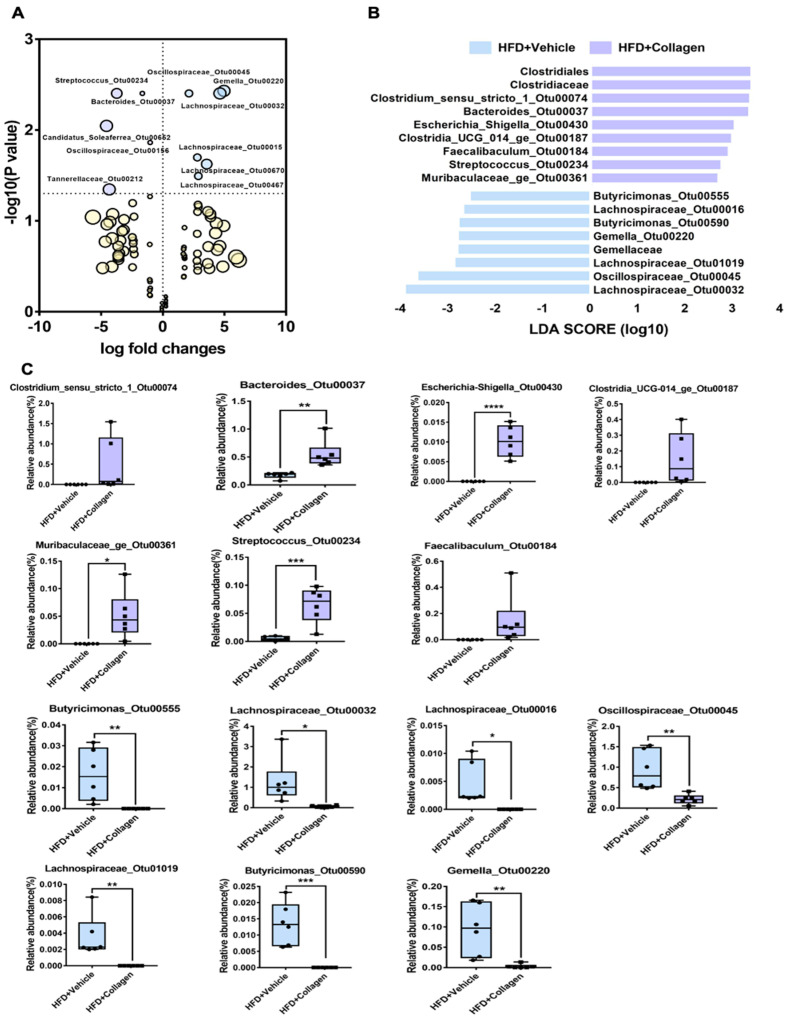
Alterations in the intestinal microbial flora are known to cause various diseases, and many people routinely consume probiotics or prebiotics to balance intestinal microorganisms and the growth of beneficial bacteria. In this study, we selected a peptide from fish (tilapia) skin that induces significant changes in the intestinal microflora of mice and reduces the Firmicutes/Bacteroidetes ratio, which is linked to obesity. We attempted to verify the anti-obesity effect of selected fish collagen peptides in a high-fat-diet-based obese mouse model. As anticipated, the collagen peptide co-administered with a high-fat diet significantly inhibited the increase in the Firmicutes/Bacteroidetes ratio. It increased specific bacterial taxa, including Clostridium_sensu_stricto_1, Faecalibaculum, Bacteroides, and Streptococcus, known for their anti-obesity effects. Consequently, alterations in the gut microbiota resulted in the activation of metabolic pathways, such as polysaccharide degradation and essential amino acid synthesis, which are associated with obesity inhibition. In addition, collagen peptide also effectively reduced all obesity signs caused by a high-fat diet, such as abdominal fat accumulation, high blood glucose levels, and weight gain. Ingestion of collagen peptides derived from fish skin induced significant changes in the intestinal microflora and is a potential auxiliary therapeutic agent to suppress the onset of obesity.
Keywords: Firmicutes/Bacteroidetes ratio; anti-obesity effect; collagen peptide; intestinal microbial flora; prebiotics.
Conflict of interest statement
The authors declare no competing financial interest.
Figures




References
-
- Sokol H., Pigneur B., Watterlot L., Lakhdari O., Bermudez-Humaran L.G., Gratadoux J.J., Blugeon S., Bridonneau C., Furet J.P., Corthier G., et al. Faecalibacterium prausnitzii is an anti-inflammatory commensal bacterium identified by gut microbiota analysis of Crohn disease patients. Proc. Natl. Acad. Sci. USA. 2008;105:16731–16736. doi: 10.1073/pnas.0804812105. - DOI - PMC - PubMed
-
- Schirmer M., Franzosa E.A., Lloyd-Price J., McIver L.J., Schwager R., Poon T.W., Ananthakrishnan A.N., Andrews E., Barron G., Lake K., et al. Dynamics of metatranscription in the inflammatory bowel disease gut microbiome. Nat. Microbiol. 2018;3:337–346. doi: 10.1038/s41564-017-0089-z. - DOI - PMC - PubMed
-
- Kudelka M.R., Hinrichs B.H., Darby T., Moreno C.S., Nishio H., Cutler C.E., Wang J., Wu H., Zeng J., Wang Y., et al. Cosmc is an X-linked inflammatory bowel disease risk gene that spatially regulates gut microbiota and contributes to sex-specific risk. Proc. Natl. Acad. Sci. USA. 2016;113:14787–14792. doi: 10.1073/pnas.1612158114. - DOI - PMC - PubMed
MeSH terms
Substances
Grants and funding
LinkOut - more resources
Full Text Sources
