


Integration of IoT-Enabled Technologies and Artificial Intelligence (AI) for Smart City Scenario: Recent Advancements and Future Trends
- PMID: 37299934
- PMCID: PMC10256108
- DOI: 10.3390/s23115206
Integration of IoT-Enabled Technologies and Artificial Intelligence (AI) for Smart City Scenario: Recent Advancements and Future Trends
Abstract
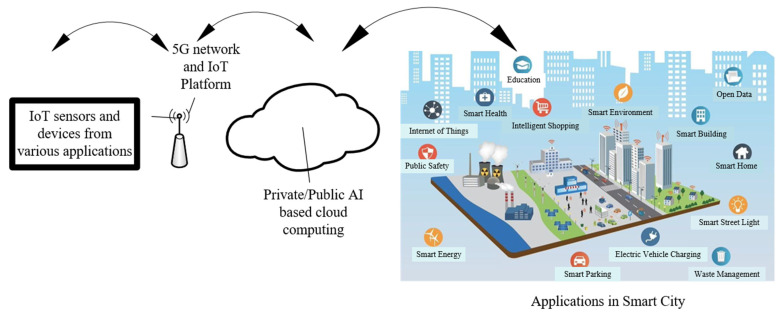
As the global population grows, and urbanization becomes more prevalent, cities often struggle to provide convenient, secure, and sustainable lifestyles due to the lack of necessary smart technologies. Fortunately, the Internet of Things (IoT) has emerged as a solution to this challenge by connecting physical objects using electronics, sensors, software, and communication networks. This has transformed smart city infrastructures, introducing various technologies that enhance sustainability, productivity, and comfort for urban dwellers. By leveraging Artificial Intelligence (AI) to analyze the vast amount of IoT data available, new opportunities are emerging to design and manage futuristic smart cities. In this review article, we provide an overview of smart cities, defining their characteristics and exploring the architecture of IoT. A detailed analysis of various wireless communication technologies employed in smart city applications is presented, with extensive research conducted to determine the most appropriate communication technologies for specific use cases. The article also sheds light on different AI algorithms and their suitability for smart city applications. Furthermore, the integration of IoT and AI in smart city scenarios is discussed, emphasizing the potential contributions of 5G networks coupled with AI in advancing modern urban environments. This article contributes to the existing literature by highlighting the tremendous opportunities presented by integrating IoT and AI, paving the way for the development of smart cities that significantly enhance the quality of life for urban dwellers while promoting sustainability and productivity. By exploring the potential of IoT, AI, and their integration, this review article provides valuable insights into the future of smart cities, demonstrating how these technologies can positively impact urban environments and the well-being of their inhabitants.
Keywords: 5G; AI; IoT; communication technology; smart city.
Conflict of interest statement
The authors declare no conflict of interest.
Figures
References
-
- Kim H.M., Han S.S. Seoul. Cities. 2012;29:142–154. doi: 10.1016/j.cities.2011.02.003. - DOI
-
- Petrolo R., Loscri V., Mitton N. Towards a smart city based on cloud of things; Proceedings of the 2014 ACM International Workshop on WIRELESS and Mobile Technologies for Smart Cities; Philadelphia, PA, USA. 11 August 2014; pp. 61–66.
-
- Alawadhi S., Aldama-Nalda A., Chourabi H., Gil-Garcia J.R., Leung S., Mellouli S., Nam T., Pardo T.A., Scholl H.J., Walker S. Building understanding of smart city initiatives; Proceedings of the International Conference on Electronic Government; Kristiansand, Norway. 3–6 September 2012; pp. 40–53.
-
- Nam T., Pardo T.A. Conceptualizing smart city with dimensions of technology, people, and institutions; Proceedings of the 12th Annual International Digital Government Research Conference: Digital Government Innovation in Challenging Times; College Park, MD, USA. 12–15 June 2011; pp. 282–291.
-
- Kaye Nijaki L., Worrel G. Procurement for sustainable local economic development. Int. J. Public Sect. Manag. 2012;25:133–153. doi: 10.1108/09513551211223785. - DOI
Publication types
MeSH terms
Grants and funding
LinkOut - more resources
Full Text Sources
Research Materials
