Review
. 2023 Jun 2;23(11):5300.
doi: 10.3390/s23115300.

Recent Developments in Inertial and Centrifugal Microfluidic Systems along with the Involved Forces for Cancer Cell Separation: A Review

Affiliations
Review

Recent Developments in Inertial and Centrifugal Microfluidic Systems along with the Involved Forces for Cancer Cell Separation: A Review

Alireza Farahinia et al. Sensors (Basel). .

Abstract

The treatment of cancers is a significant challenge in the healthcare context today. Spreading circulating tumor cells (CTCs) throughout the body will eventually lead to cancer metastasis and produce new tumors near the healthy tissues. Therefore, separating these invading cells and extracting cues from them is extremely important for determining the rate of cancer progression inside the body and for the development of individualized treatments, especially at the beginning of the metastasis process. The continuous and fast separation of CTCs has recently been achieved using numerous separation techniques, some of which involve multiple high-level operational protocols. Although a simple blood test can detect the presence of CTCs in the blood circulation system, the detection is still restricted due to the scarcity and heterogeneity of CTCs. The development of more reliable and effective techniques is thus highly desired. The technology of microfluidic devices is promising among many other bio-chemical and bio-physical technologies. This paper reviews recent developments in the two types of microfluidic devices, which are based on the size and/or density of cells, for separating cancer cells. The goal of this review is to identify knowledge or technology gaps and to suggest future works.

Keywords: cancer diagnosis; cancer metastasis; cell enrichment; circulating tumor cells (CTCs); lab-on-a-CD (LOCD); lab-on-a-chip (LOC); microfluidic-based cell separation approaches.


Conflict of interest statement

The authors declare that they have no conflict of interest.

Figures
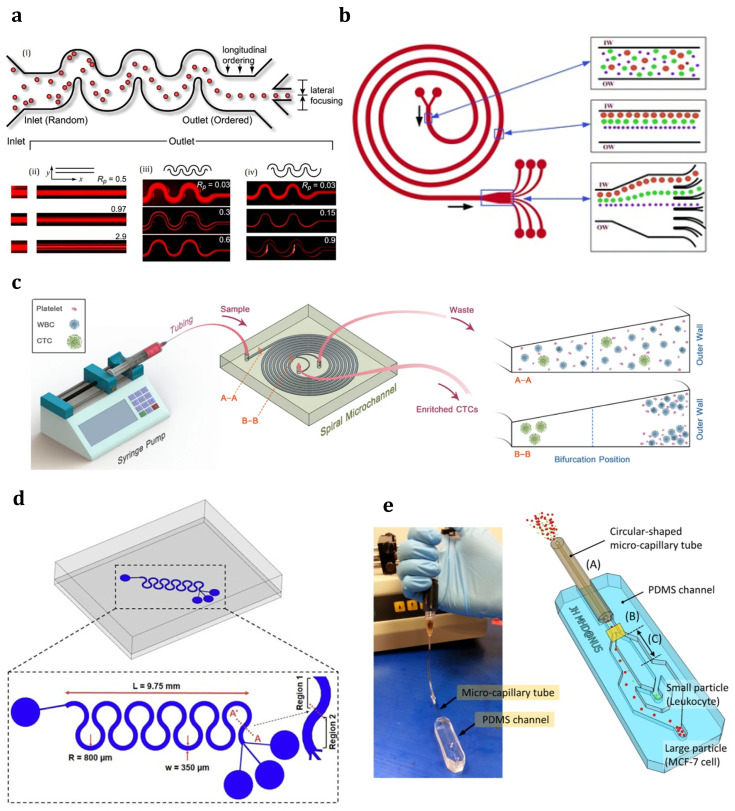
Figure 2
Figure 2
Inertial microfluidic separators in (a) a serpentine structure [99] (Reprinted/adapted with permission from Ref. [99]. 2007, National Academy of Sciences, U.S.A.); (b) a spiral structure [102] (Reprinted/adapted with permission from Ref. [102]. 2009, Royal Society of Chemistry); (c) a trapezoidal spiral channel microfluidic device [106]; (d) a symmetrically curved channel microfluidic device [107]; (e) a hybrid capillary-inserted microfluidic device [(A–C) indicates the first stage for viscoelastic 3D focusing at the inlet of the micro-capillary tube, the first bifurcation in the channel for initial separation of all particles, and the second stage of microchannel designed for viscoelastic separation, respectively.] [108] (Reprinted/adapted with permission from Ref. [108]. 2015, AIP Publishing).
Figure 6
Figure 6
LOCD applications for performing different microfluidic functions: (a) Flow sequencing using centrifugal propulsion and capillary valving in a polymer-based CD platform along with different designs for calibration purposes [181] (Reprinted/adapted with permission from Ref. [181]. 2001, Springer Nature); (b) The novel flow switch for centrifugal microfluidic platforms controlled with the Coriolis force [184] (Reprinted/adapted with permission from Ref. [184]. 2005, Royal Society of Chemistry); (c) A novel microvalve actuated using laser irradiation [185] (Reprinted/adapted with permission from Ref. [185]. 2007, Royal Society of Chemistry); (d) Schematic diagram showing the inside of the portable LOCD for DNA extraction from whole blood along with a detailed microfluidic layout and functions [186] (Reprinted/adapted with permission from Ref. [186]. 2007, Royal Society of Chemistry); (e) Centrifugal extraction of plasma from sediment with a decanting structure and metering the plasma in consecutive processes using a rotating disk [190] (Reprinted/adapted with permission from Ref. [190]. 2006, Royal Society of Chemistry).
Figure 7
Figure 7
Centrifugal microfluidic device as a passive cell separation technique: (a) Tilted sedimentation chamber effect on plasma separation based on the centrifugation/sedimentation process [195] (Reprinted/adapted with permission from Ref. [195]. 2013, Elsevier); (b) The spiral mirabilis sedimentation chamber effect on plasma separation based on the centrifugation/sedimentation process [196] (Reprinted/adapted with permission from Ref. [196]. 2013, Elsevier); (c) Blood fractionation on a centrifugal microfluidic platform with a curved channel to separate blood plasma from the other components in the blood [194]; (d) Schematic illustration showing microchannel networks on the proposed centrifugal microfluidic disk for blood assays [202] (Reprinted/adapted with permission from Ref. [202]. 2015, Springer Nature).
Figure 8
Figure 8
Centrifugal microfluidic systems on a disk: (a) Cell separation using a membrane filter; the microfluidic CD contains three sets, and each set includes a loading chamber, filtration chamber, and waste chamber [78] (Reprinted/adapted with permission from Ref. [78]. 2014, American Chemical Society); (b) A rail of gaps with increasing opening size for measuring the size distribution of CTCs clusters [203]; (c) A centrifugal microfluidic disk with zig-zag-shaped microchannels for single cell isolation [205]; (d) A schematic view showing a centrifuge-based deterministic lateral displacement (CDLD) separation system [206] (Reprinted/adapted with permission from Ref. [206]. 2016, Springer Nature); (e) A microfluidic design consisting of a blood chamber, DGM chamber, collection chamber, and waste chamber for CTC isolation from a blood sample [197] (Reprinted/adapted with permission from Ref. [197]. 2014, American Chemical Society); (f) A microfluidic design with a V-shaped trap array consisting of a cell reservoir, washing buffer reservoir, IgG reservoir, V-cup array, and waste chamber [207] (Reprinted/adapted with permission from Ref. [207]. 2012, Royal Society of Chemistry); (g) A sketch showing a centrifugal microfluidic system with the integration of a micromixer and inertial separator units for immunoaffinity-based CTC separation [208,209] (Reprinted/adapted with permission from Ref. [208]. 2015, Royal Society of Chemistry) & (Reprinted/adapted with permission from Ref. [209]. 2015, Springer Nature).
Figure 8
Figure 8
Centrifugal microfluidic systems on a disk: (a) Cell separation using a membrane filter; the microfluidic CD contains three sets, and each set includes a loading chamber, filtration chamber, and waste chamber [78] (Reprinted/adapted with permission from Ref. [78]. 2014, American Chemical Society); (b) A rail of gaps with increasing opening size for measuring the size distribution of CTCs clusters [203]; (c) A centrifugal microfluidic disk with zig-zag-shaped microchannels for single cell isolation [205]; (d) A schematic view showing a centrifuge-based deterministic lateral displacement (CDLD) separation system [206] (Reprinted/adapted with permission from Ref. [206]. 2016, Springer Nature); (e) A microfluidic design consisting of a blood chamber, DGM chamber, collection chamber, and waste chamber for CTC isolation from a blood sample [197] (Reprinted/adapted with permission from Ref. [197]. 2014, American Chemical Society); (f) A microfluidic design with a V-shaped trap array consisting of a cell reservoir, washing buffer reservoir, IgG reservoir, V-cup array, and waste chamber [207] (Reprinted/adapted with permission from Ref. [207]. 2012, Royal Society of Chemistry); (g) A sketch showing a centrifugal microfluidic system with the integration of a micromixer and inertial separator units for immunoaffinity-based CTC separation [208,209] (Reprinted/adapted with permission from Ref. [208]. 2015, Royal Society of Chemistry) & (Reprinted/adapted with permission from Ref. [209]. 2015, Springer Nature).
Figure 11
Figure 11
The four components of lift force: (a) The Magnus force (due to the interaction between slip and particle rotation at low Reynolds numbers) [96] (Reprinted/adapted with permission from Ref. [96]. 2016, Royal Society of Chemistry); (b) The Saffman force (caused by the interaction between slip velocity and shear) [223] (Reprinted/adapted with permission from Ref. [223]. 2012, AIP Publishing); (c) The wall lift force (arising from wall repulsion) [224]; (d) The shear gradient lift force [224].
Figure 12
Figure 12
The position of a particle under the effect of the net lift force: (a) The balance between the recognized lift forces creates the inertial equilibrium position for the particle in the Poiseuille flow [96] (Reprinted/adapted with permission from Ref. [96]. 2016, Royal Society of Chemistry); (b) The net lift coefficient (CL) as a function of the Reynolds number and the particle lateral position [226].
Scheme 1
Scheme 1
Overview of the research process and data collection methods used in this paper.
Figure 1
Figure 1
Particle/cell migration in a straight and curved channel: (a) In a straight channel, FLS pushes particles toward the channel walls, and FLW repulses them back toward the channel center line; (b) In the spiral channel, the balance between FL and FD causes particle migration to the equilibrium position [91] (Reprinted/adapted with permission from Ref. [91]. 2017, Springer Nature).
Figure 3
Figure 3
A spiral structure as a passive cell separation technique: (a) Five-loop and ten-loop spiral microchannels [95,102] (Reprinted/adapted with permission from Ref. [95]. 2008, Royal Society of Chemistry); (b) Schematic illustration showing DFF for CTCs isolation [112]; (c) Schematic illustration showing DFF for pathogen separation from blood [109] (Reprinted/adapted with permission from Ref. [109]. 2015, Royal Society of Chemistry); (d) A multi-layer spiral microfluidics device with a rectangular cross-section for CTCs isolation from a blood sample [113]; (e) Spiral microfluidic with trapezoidal cross-sections for CTCs isolation from WBC [(i–iii) indicate the spiral microfluidic device with an inlet sample and two outlet collections, a cross-sectional view of the channel outlets with the focused particles of different sizes, and experimental separation results under a microscope, respectively.] [97]; (f) Bonded multiple layers with a design that consists of four connected spirals [110]; (g) Schematic illustration showing cell separation in fishbone units in a multistage microfluidic chip [114] (Reprinted/adapted with permission from Ref. [114]. 2019, Elsevier); (h) Triplet-microchannel spiral microfluidic chip with tilted slits for CTC separation [115].
Figure 3
Figure 3
A spiral structure as a passive cell separation technique: (a) Five-loop and ten-loop spiral microchannels [95,102] (Reprinted/adapted with permission from Ref. [95]. 2008, Royal Society of Chemistry); (b) Schematic illustration showing DFF for CTCs isolation [112]; (c) Schematic illustration showing DFF for pathogen separation from blood [109] (Reprinted/adapted with permission from Ref. [109]. 2015, Royal Society of Chemistry); (d) A multi-layer spiral microfluidics device with a rectangular cross-section for CTCs isolation from a blood sample [113]; (e) Spiral microfluidic with trapezoidal cross-sections for CTCs isolation from WBC [(i–iii) indicate the spiral microfluidic device with an inlet sample and two outlet collections, a cross-sectional view of the channel outlets with the focused particles of different sizes, and experimental separation results under a microscope, respectively.] [97]; (f) Bonded multiple layers with a design that consists of four connected spirals [110]; (g) Schematic illustration showing cell separation in fishbone units in a multistage microfluidic chip [114] (Reprinted/adapted with permission from Ref. [114]. 2019, Elsevier); (h) Triplet-microchannel spiral microfluidic chip with tilted slits for CTC separation [115].
Figure 4
Figure 4
The passive cell separation technique: (a) A microfluidic channel with a single microchamber (single vortex) [128] (Reprinted/adapted with permission from Ref. [128]. 2003, Springer Nature); (b) A microfluidic channel with several microchambers on one side [130] (Reprinted/adapted with permission from Ref. [130]. 2009, AIP Publishing); (c) A multi-orifice flow fraction structure [131] (Reprinted/adapted with permission from Ref. [131]. 2013, AIP Publishing); (d) A microfluidic channel with multi-chambers on both sides [132] (Reprinted/adapted with permission from Ref. [132]. 2009, Royal Society of Chemistry); (e) Schematic view showing an MS-MOFF device [133] (Reprinted/adapted with permission from Ref. [133]. 2011, Royal Society of Chemistry); (f) Schematic view showing the microfluidic device for CTC separation using MOFF and dielectrophoresis (DEP) techniques [134] (Reprinted/adapted with permission from Ref. [134]. 2011, Royal Society of Chemistry); (g) Asymmetric CEA microchannel for CTC isolation with two-step filtration [135] (Reprinted/adapted with permission from Ref. [135]. 2013, American Chemical Society); (h) Schematic illustration showing a series of abruptly contracted and expanded structures on one side of a microchannel [136]; (i) A combination of symmetry and asymmetry CEA channels in a microfluidic device for CTC separation [(A–C) show the first stage of inertial-based particle focusing with 50 symmetric contraction expansion pairs in which particles are focused to the outer walls of the microchannel through a balance of wall lift and shear gradient lift forces, the trifurcating junction, and the second stage of inertial-based particle focusing with 10 pairs of asymmetric contraction expansion pairs in which small particles travel to different equilibrium positions under the effect of dean drag forces, respectively.] [137]; (j) A series of contraction regions in a low-aspect-ratio straight microchannel in a single-stream inertial microfluidics [138] (Reprinted/adapted with permission from Ref. [138]. 2013, John Wiley and Sons); (k) A schematic diagram showing a CEA channel with different structures and constant contraction–expansion ratios [139] (Reprinted/adapted with permission from Ref. [139]. 2019, Springer Nature); (l) The presence of obstacles in a spiral microchannel [140] (Reprinted/adapted with permission from Ref. [140]. 2017, Royal Society of Chemistry).
Figure 4
Figure 4
The passive cell separation technique: (a) A microfluidic channel with a single microchamber (single vortex) [128] (Reprinted/adapted with permission from Ref. [128]. 2003, Springer Nature); (b) A microfluidic channel with several microchambers on one side [130] (Reprinted/adapted with permission from Ref. [130]. 2009, AIP Publishing); (c) A multi-orifice flow fraction structure [131] (Reprinted/adapted with permission from Ref. [131]. 2013, AIP Publishing); (d) A microfluidic channel with multi-chambers on both sides [132] (Reprinted/adapted with permission from Ref. [132]. 2009, Royal Society of Chemistry); (e) Schematic view showing an MS-MOFF device [133] (Reprinted/adapted with permission from Ref. [133]. 2011, Royal Society of Chemistry); (f) Schematic view showing the microfluidic device for CTC separation using MOFF and dielectrophoresis (DEP) techniques [134] (Reprinted/adapted with permission from Ref. [134]. 2011, Royal Society of Chemistry); (g) Asymmetric CEA microchannel for CTC isolation with two-step filtration [135] (Reprinted/adapted with permission from Ref. [135]. 2013, American Chemical Society); (h) Schematic illustration showing a series of abruptly contracted and expanded structures on one side of a microchannel [136]; (i) A combination of symmetry and asymmetry CEA channels in a microfluidic device for CTC separation [(A–C) show the first stage of inertial-based particle focusing with 50 symmetric contraction expansion pairs in which particles are focused to the outer walls of the microchannel through a balance of wall lift and shear gradient lift forces, the trifurcating junction, and the second stage of inertial-based particle focusing with 10 pairs of asymmetric contraction expansion pairs in which small particles travel to different equilibrium positions under the effect of dean drag forces, respectively.] [137]; (j) A series of contraction regions in a low-aspect-ratio straight microchannel in a single-stream inertial microfluidics [138] (Reprinted/adapted with permission from Ref. [138]. 2013, John Wiley and Sons); (k) A schematic diagram showing a CEA channel with different structures and constant contraction–expansion ratios [139] (Reprinted/adapted with permission from Ref. [139]. 2019, Springer Nature); (l) The presence of obstacles in a spiral microchannel [140] (Reprinted/adapted with permission from Ref. [140]. 2017, Royal Society of Chemistry).
Figure 5
Figure 5
A simple centrifugal microfluidic system with a straight microchannel [91] (Reprinted/adapted with permission from Ref. [91]. 2017, Springer Nature).
Figure 9
Figure 9
A centrifugal microfluidic system integrated with active separation techniques: (a) Integrated DEP on the centrifugal platform for selective particle/cell separation [211] (Reprinted/adapted with permission from Ref. [211]. 2010, Royal Society of Chemistry); (b) Particle/cell sorting consists of different chambers under the effect of centrifugal and magnetic forces [A shows a single centrifugo-magnetophoretic separation system with loading and separation chambers and a focusing channel on a rotating disc, B shows the trajectories and destinations of three different particles under the effect of separation forces (i.e., centrifugal, Coriolis and magnetic forces), and C shows the separated beads in different routes] [212] (Reprinted/adapted with permission from Ref. [212]. 2012, Springer Nature); (c) Schematic showing the polymeric LOCD with microfluidic channels (colored in green) and magnets (specified with silver cylinders) [a displays an overview of a polymeric LOCD with microfluidic channels and magnets, b shows two clusters of cancer cells capped with paramagnetic beads, and c shows the trajectories and destinations of blood cells, magnetically tagged cancer cells and excess magnetic beads under the effect of separation forces (i.e., centrifugal and magnetic forces) on a CCW rotating disk] [213] (Reprinted/adapted with permission from Ref. [213]. 2014, John Wiley and Sons).
Figure 9
Figure 9
A centrifugal microfluidic system integrated with active separation techniques: (a) Integrated DEP on the centrifugal platform for selective particle/cell separation [211] (Reprinted/adapted with permission from Ref. [211]. 2010, Royal Society of Chemistry); (b) Particle/cell sorting consists of different chambers under the effect of centrifugal and magnetic forces [A shows a single centrifugo-magnetophoretic separation system with loading and separation chambers and a focusing channel on a rotating disc, B shows the trajectories and destinations of three different particles under the effect of separation forces (i.e., centrifugal, Coriolis and magnetic forces), and C shows the separated beads in different routes] [212] (Reprinted/adapted with permission from Ref. [212]. 2012, Springer Nature); (c) Schematic showing the polymeric LOCD with microfluidic channels (colored in green) and magnets (specified with silver cylinders) [a displays an overview of a polymeric LOCD with microfluidic channels and magnets, b shows two clusters of cancer cells capped with paramagnetic beads, and c shows the trajectories and destinations of blood cells, magnetically tagged cancer cells and excess magnetic beads under the effect of separation forces (i.e., centrifugal and magnetic forces) on a CCW rotating disk] [213] (Reprinted/adapted with permission from Ref. [213]. 2014, John Wiley and Sons).
Figure 10
Figure 10
Drag coefficient according to the particle Reynolds number for a spherical particle [215] (Reprinted/adapted with permission from Ref. [215]. 2002, Elsevier).

References

    1. Esfahani K., Roudaia L., Buhlaiga N., Del Rincon S.V., Papneja N., Miller W.H. A Review of Cancer Immunotherapy: From the Past, to the Present, to the Future. Curr. Oncol. 2020;27:87–97. doi: 10.3747/co.27.5223. - DOI - PMC - PubMed
    1. Roy R., Singh S.K., Misra S. Advancements in Cancer Immunotherapies. Vaccines. 2022;11:59. doi: 10.3390/vaccines11010059. - DOI - PMC - PubMed
    1. Babikr F., Wan J., Xu A., Wu Z., Ahmed S., Freywald A., Chibbar R., Wu Y., Moser M., Groot G. Distinct roles but cooperative effect of TLR3/9 agonists and PD-1 blockade in converting the immunotolerant microenvironment of irreversible electroporation-ablated tumors. Cell. Mol. Immunol. 2021;18:2632–2647. doi: 10.1038/s41423-021-00796-4. - DOI - PMC - PubMed
    1. Xu A., Zhang L., Yuan J., Babikr F., Freywald A., Chibbar R., Moser M., Zhang W., Zhang B., Fu Z. TLR9 agonist enhances radiofrequency ablation-induced CTL responses, leading to the potent inhibition of primary tumor growth and lung metastasis. Cell. Mol. Immunol. 2019;16:820–832. doi: 10.1038/s41423-018-0184-y. - DOI - PMC - PubMed
    1. Ding L., Fang Z., Moser M.A., Zhang W., Zhang B. A Single-Cell Electroporation Model for Quantitatively Estimating the Pore Area Ratio by High-Frequency Irreversible Electroporation. Appl. Sci. 2023;13:1808. doi: 10.3390/app13031808. - DOI

LinkOut - more resources
