. 2023 Jun 12;17(1):49.
doi: 10.1186/s40246-023-00494-4.

Systems genetics identifies miRNA-mediated regulation of host response in COVID-19

Affiliations

Systems genetics identifies miRNA-mediated regulation of host response in COVID-19

T Gjorgjieva et al. Hum Genomics. .

Abstract

Background: Individuals infected with SARS-CoV-2 vary greatly in their disease severity, ranging from asymptomatic infection to severe disease. The regulation of gene expression is an important mechanism in the host immune response and can modulate the outcome of the disease. miRNAs play important roles in post-transcriptional regulation with consequences on downstream molecular and cellular host immune response processes. The nature and magnitude of miRNA perturbations associated with blood phenotypes and intensive care unit (ICU) admission in COVID-19 are poorly understood.

Results: We combined multi-omics profiling-genotyping, miRNA and RNA expression, measured at the time of hospital admission soon after the onset of COVID-19 symptoms-with phenotypes from electronic health records to understand how miRNA expression contributes to variation in disease severity in a diverse cohort of 259 unvaccinated patients in Abu Dhabi, United Arab Emirates. We analyzed 62 clinical variables and expression levels of 632 miRNAs measured at admission and identified 97 miRNAs associated with 8 blood phenotypes significantly associated with later ICU admission. Integrative miRNA-mRNA cross-correlation analysis identified multiple miRNA-mRNA-blood endophenotype associations and revealed the effect of miR-143-3p on neutrophil count mediated by the expression of its target gene BCL2. We report 168 significant cis-miRNA expression quantitative trait loci, 57 of which implicate miRNAs associated with either ICU admission or a blood endophenotype.

Conclusions: This systems genetics study has given rise to a genomic picture of the architecture of whole blood miRNAs in unvaccinated COVID-19 patients and pinpoints post-transcriptional regulation as a potential mechanism that impacts blood traits underlying COVID-19 severity. The results also highlight the impact of host genetic regulatory control of miRNA expression in early stages of COVID-19 disease.

Keywords: COVID-19; Host genetics; Host immune response; MicroRNA; Multi-omics; Post-transcriptional regulation; Transcriptomics; eQTL.


Conflict of interest statement

The authors declare that they have no competing interests.

Figures
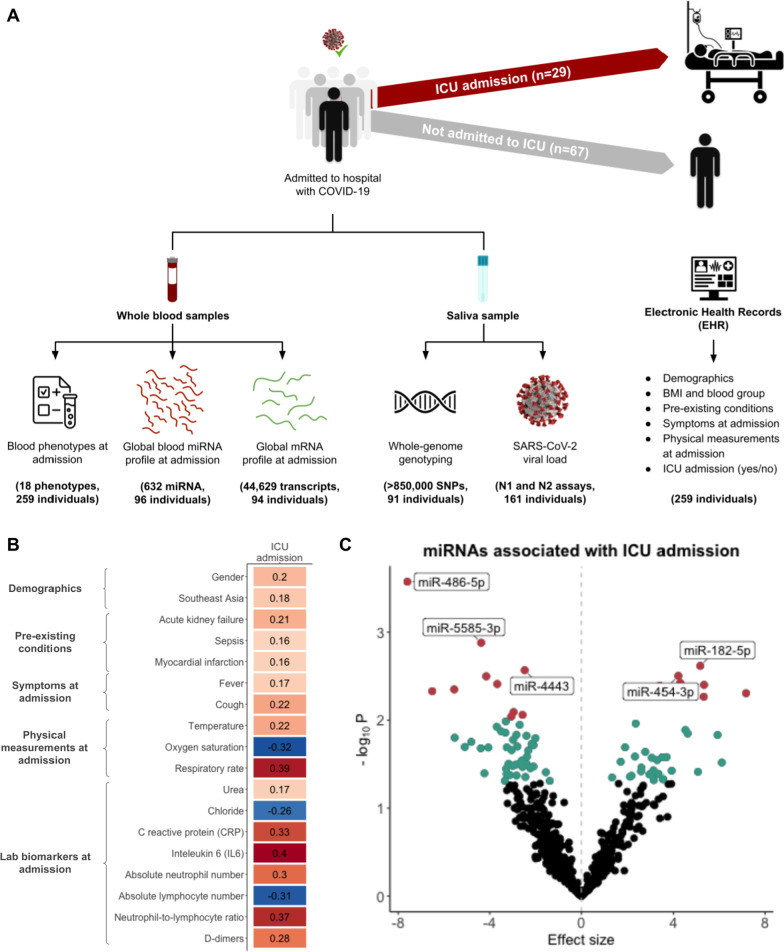
Fig. 1
Fig. 1
Clinical variables and miRNA levels at the time of hospital admission, prior to any clinical intervention or treatment, are associated with later ICU admission for COVID-19 patients. A Study design. B Significant Pearson correlations (FDR < 0.05) between 18 factors from electronic health records and ICU admission. C Volcano plots of miRNAs associated with ICU admission. Age and self-reported time from symptom onset to hospital admission were used as covariates in a logistic regression model. miRNAs significant at p < 0.05 are highlighted in blue, and miRNAs significant at p < 0.01 are highlighted in red, with the 5 most significant miRNAs labeled
Fig. 2
Fig. 2
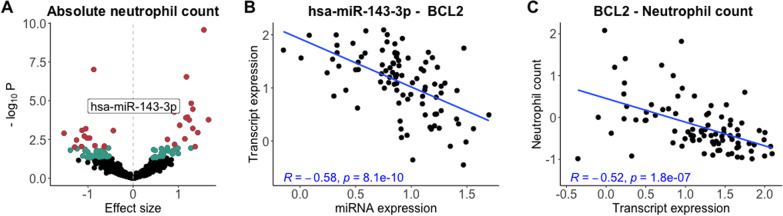
The positive association between hsa-miR-143-3p and neutrophil count is mediated by BCL2 expression. A Numerous miRNAs are associated with neutrophil count, including hsa-miR-143-3p (labeled). Both miRNA expression and blood phenotype levels were measured from the same blood sample, collected at the time of hospital admission. miRNAs significant at p < 0.05 are highlighted in blue. miRNAs significant at p < 0.01 are highlighted in red. Both miRNA expression and blood phenotype levels were standardized. B Correlation between hsa-miR-143-3p expression (x-axis) and BCL2 transcript expression (y-axis). C Correlation between BCL2 transcript expression (x-axis) and absolute neutrophil count (y-axis). The Pearson correlation and p value are in blue. miRNA expression, transcript expression and neutrophil count have all been standardized
Fig. 3
Fig. 3
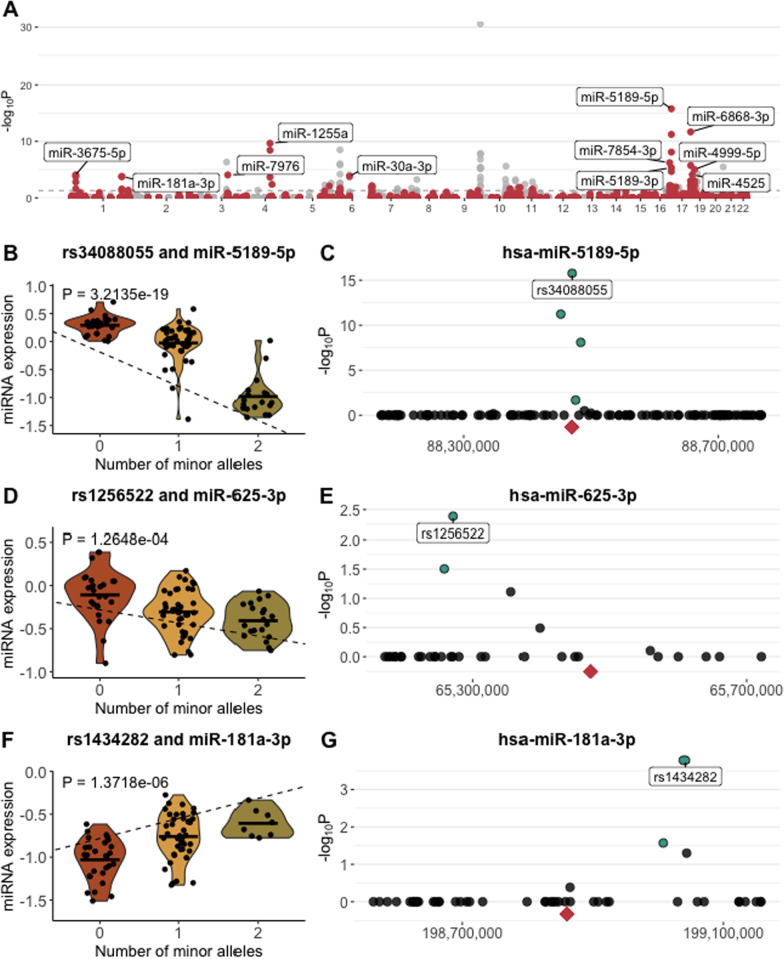
Expression of numerous miRNAs is genetically controlled by cis-eQTLs. A Manhattan plots showing all cis-eQTLs (defined as an association between a miRNA and a SNP in a 300,000 base pairs window). Points highlighted in pink show cis-eQTLs for miRNAs associated with one of the 8 blood phenotypes The dashed line corresponds to Bonferroni p < 0.05, and all points above the dashed line are significant cis-eQTLs. Labeled points refer to cis-eQTLs with Bonferroni p < 0.05, and some of the top cis-eQTLs are annotated with the e-miRNA. BG Pairs of violin and fine-mapping plots for cis-eQTLs. The violin plot shows the linear relationships between the number of minor alleles and miRNA expression associated with each genotype. The dashed line corresponds to the linear regression fit, and the p value is stated on the plot. The fine-mapping plot shows all tested SNPs for each miRNA. Points highlighted in blue show e-SNPs significant at Bonferroni < 0.05. Labeled point shows the top e-SNP for that cis-eQTL. The pink diamond shows the genomic position of the miRNA. BC cis-eQTL hsa-miR-5189-5p and rs34088055. EF cis-eQTL rs1256522 and hsa-miR-625-3p. GH cis-eQTL rs1434282 and hsa-miR-181a-3p

References

    1. Chen G, Wu DI, Guo W, Cao Y, Huang D, Wang H, et al. Clinical and immunological features of severe and moderate coronavirus disease 2019. J Clin Investig. 2020;130(5):2620–2629. doi: 10.1172/JCI137244. - DOI - PMC - PubMed
    1. Wang Y, Wang Y, Chen Y, Qin Q. Unique epidemiological and clinical features of the emerging 2019 novel coronavirus pneumonia (COVID-19) implicate special control measures. J Med Virol. 2020;92(6):568–576. doi: 10.1002/jmv.25748. - DOI - PMC - PubMed
    1. Nguyen NT, Chinn J, De Ferrante M, Kirby KA, Hohmann SF, Amin A. Male gender is a predictor of higher mortality in hospitalized adults with COVID-19. PLoS ONE. 2021;16(7):e0254066. doi: 10.1371/journal.pone.0254066. - DOI - PMC - PubMed
    1. Petrakis D, Margină D, Tsarouhas K, Tekos F, Stan M, Nikitovic D, et al. Obesity-a risk factor for increased COVID-19 prevalence, severity and lethality. Mol Med Rep. 2020;22(1):9–19. doi: 10.3892/mmr.2020.11127. - DOI - PMC - PubMed
    1. Pijls BG, Jolani S, Atherley A, Derckx RT, Dijkstra JI, Franssen GH, et al. Demographic risk factors for COVID-19 infection, severity, ICU admission and death: a meta-analysis of 59 studies. BMJ Open. 2021;11(1):e044640. doi: 10.1136/bmjopen-2020-044640. - DOI - PMC - PubMed

Publication types